 HYGO News
Harris on Yellow School Buses: Diesel Affects Kids' 'Ability to Learn' and 'Those Are the Intersections' (October 26, 2022)
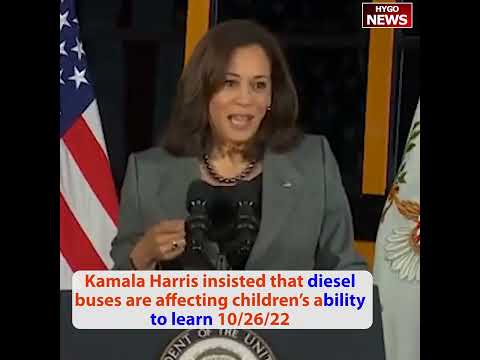
Vice President Kamala Harris stood in front of a row of new buses at Seattle’s Lumen Field and made the case against the diesel school bus. “And in America today, 25 million children a day go to school on the yellow school bus — 25 million children a day. And today, 95 percent of our school buses are fueled with diesel fuel, which contributes to very serious conditions that are about health and about the ability to learn,” Harris said on Oct. 26, 2022, according to the official White House transcript [1].
She had opened with a question for the crowd. “So here’s the thing: Who doesn’t love a yellow school bus, right? Can you raise your hand if you love a yellow school bus, right? (Applause.)” [1]
Then she greeted the audience: “And to all the young leaders who are here and the young-ish leaders — (laughter) — good morning to all of you.” [1]
The video above shows Harris in Seattle on Oct. 26, 2022. Quotes are from the official White House transcript, the EPA’s inspector general and the Washington Free Beacon [1][2][3].
”Those Are the Intersections”
Harris explained what the buses meant to her. “And in that way, our electric school bus program really does represent an intersection of all those points, on top of the importance of investing in domestic manufacturing,” she said [1].
She went on about jobs and training, then summed it up: “Those are the intersections. So that’s why I’m so excited about these electric school buses.” [1]
She brought up the pandemic, too. “We all know when, during the height of the pandemic, we saw what it means when we don’t have domestic manufacturing around the things that we need every day: It slows us down,” Harris said [1].
And she asked the parents a question. “But when we think about — how many of us, for example, have had to go to the emergency room because our child has asthma? Right?” she said [1].
She announced the money. “And when I think about what we have been able to do through the Infrastructure Law, what it means is that we have now invested — and that’s the announcement today — $5 billion over the next five years — what we are doing today is the first of those billion dollars, $1 billion,” Harris said [1].
“We are thinking about this in terms of yellow school buses being the largest form of mass transit in our country. Think about that,” she said [1].
”The Clock Is Ticking Loudly”
Harris closed on climate. “We owe it to our children to, right now, take these issues very seriously. The clock is ticking loudly,” she said [1].
She told a story about the children she met that morning. “And — and one of them said to me — I said, ‘Well, what is today about?’ And they said, ‘Saving our planet. Saving our planet,’” Harris said [1].
Her remarks ended at 10:35 a.m., eight minutes after they began [1].
The Price Tag
The buses did not come cheap. A House Energy and Commerce Committee report in September 2024 “found that electric school buses remain far more expensive than traditional diesel-powered alternatives,” the Washington Free Beacon reported. “While diesel buses—which make up the vast majority of the nation’s fleet of nearly 550,000 yellow school buses—typically cost about $100,000, the average electric bus costs upwards of $380,000.” [3]
“Electric charging infrastructure, also funded by the Clean School Bus program, costs up to an additional $30,000 per bus,” the report found, according to the Free Beacon [3].
One district told the committee the technology is “not adequate for a rural district.” [3]
“Unwitting School Districts”
The EPA’s own watchdog raised alarms. In December 2023, the agency’s inspector general reported that weak verification in the program “led to third parties submitting applications on behalf of unwitting school districts,” among other problems [2].
The inspector general found that withdrawals from the 2022 rebates topped $38 million, including districts that pulled out “because a contractor applied without their consent or knowledge.” [2]
By the Numbers
- 25 million: children who ride school buses each day, per Harris [1].
- $5 billion: the program’s total over five years [1].
- $38 million+: in 2022 rebate withdrawals, per the inspector general [2].
- $380,000+: the average cost of an electric school bus, per the House report [3].
- $100,000: the typical cost of a diesel bus [3].
What Happened Next
“Overall a failure.” “It is clear the $5 billion Clean School Bus program is overall a failure and, in many cases, a waste of Americans’ hard-earned taxpayer dollars,” the Republican chairs of the House Energy and Commerce Committee said in September 2024 [3].
“As the official tasked with ensuring the success of the program, Vice President Harris bears great responsibility for its significant shortcomings,” they said [3].
Harris lost. Weeks later, she lost the presidential race to Donald Trump, 312 electoral votes to 226, according to the National Archives [4].
For Harris on electric buses with “Wi-Fi and even USB outlets,” see HYGO News’ page on Feb. 9, 2023. For Biden losing his place in a speech the same day, see the page on Oct. 26, 2022.
Sources
- The White House (archived): Remarks by Vice President Harris on Investments in Clean School Buses (October 26, 2022)
- U.S. EPA Office of Inspector General: Management Implication Report: Preventing Fraud, Waste, and Abuse Within the EPA’s Clean School Bus Program, Report No. 24-N-0013 (December 27, 2023)
- Washington Free Beacon: ‘A Failure’: Congressional Investigation Savages Kamala Harris’s $5 Billion Electric School Bus Plan (September 17, 2024)
- National Archives: 2024 Electoral College Results