 HYGO News
 Elon Musk's Farewell to 134-Day DOGE Service: 'Not the End but Really the Beginning -- DOGE Is a Way of Life, Trillion Dollars Savings'; Trump: 'Money Should Go to Trade Schools, That's Our Pot of Gold Wasted at Harvard'; America Must Buy American-Built Cars
Elon Musk’s Farewell to 134-Day DOGE Service: “Not the End but Really the Beginning — DOGE Is a Way of Life, Trillion Dollars Savings”; Trump: “Money Should Go to Trade Schools, That’s Our Pot of Gold Wasted at Harvard”; America Must Buy American-Built Cars
Elon Musk delivered a formal farewell at the end of his 134-day Special Government Employee appointment leading DOGE in late May 2025. Musk: “This is not the end of DOGE, but really the beginning. My time as a special government employee necessarily had to end. It was a limited time thing, 134 days I believe. The DOGE team will only grow stronger over time. DOGE influence will only grow stronger. It’s like a sort of Buddhism. It’s like a way of life. So it is permeating throughout the government, and I’m confident that over time we’ll see a trillion dollars of savings.” On current impact: “FY25 to FY26 Delta are over $160 billion and that’s climbing. We expect that number will probably go over $200 billion soon.” On the Oval Office: “Isn’t this incredible? The gold in the ceiling.” Trump: “That’s 24 karat gold. Been there a long time, plastered over. Now they all see it.” On trade schools: “I’d like to see the money go to trade schools, where people learn how to fix motors and engines, where people learn how to build rocket ships. We probably found our pot of gold, and that’s what’s been wasted at places like Harvard.” On American manufacturing: “You build a car, make it in America. Over the next year, they’ve got to have the whole thing built in America.”
Musk’s Farewell
Musk opened his remarks with the ending framing.
“Well, let me say perhaps a few words that this is not the end of Doge, but really the beginning,” Musk said.
He explained the legal framework: “My time as a special government employee necessarily had to end. It was a limited time thing, 134 days I believe, which adds in a few days. So that, you know, comes with a time limit.”
He looked forward: “The Doge team will only grow stronger over time. Doge influence will only grow stronger.”
He used the philosophical metaphor: “It’s like a sort of Buddhism. It’s like a way of life.”
He described the institutional spread: “So it is permeating throughout the government, and I’m confident that over time we’ll see a trillion dollars of savings and a reduction in, a trillion dollars of waste of poor production.”
The SGE 130-Day Limitation
The “Special Government Employee” designation was a specific legal status:
Definition: SGEs are individuals who perform government work but are not full federal employees. They typically have limited-time appointments and may continue private sector activities.
130-day limit: SGEs can serve up to 130 days in any 365-day period. Musk’s 134 days slightly exceeded this but was close to the limit.
Disclosure requirements: SGEs face reduced disclosure and ethics requirements compared to full-time federal employees.
Conflict of interest management: SGEs are allowed to maintain private sector activities that would conflict with full federal employment.
The 130-day limit had been deliberately created to prevent permanent de facto federal employment under the SGE framework. Musk’s appointment had always been time-limited, with termination at the end of his permitted service period.
This was not a political departure but a legal one. Musk had not been fired or pushed out. His term had simply expired under the legal framework that had enabled his service. The departure was planned and orderly rather than contentious.
”A Way of Life”
Musk’s “Buddhism” framing was strategic communication.
Institutional permanence: By describing DOGE as “a way of life,” Musk was emphasizing that its approach would persist beyond specific personnel changes. Individual DOGE leaders might come and go, but the institutional approach would continue.
Cultural transformation: The “permeating throughout government” framing described cultural rather than merely organizational change. DOGE was changing how federal agencies thought about waste, efficiency, and accountability.
Continuity assurance: By framing DOGE’s future as assured regardless of Musk’s departure, he was reassuring:
- Team members who might worry about their own roles
- Agency officials who had started cooperating with DOGE
- Media observers tracking DOGE’s effectiveness
- Political supporters who had championed DOGE
- Opponents who had tried to dismiss DOGE as Musk-specific
The Savings Numbers
Musk provided specific metrics.
“The calculations of the Doge team thus far, in terms of FY25 to FY26, Delta are over 160 billion and that’s climbing,” Musk said.
He forecast future progress: “We expect that number will probably go over 200 billion soon.”
He projected the ultimate goal: “So we are relentlessly pursuing $8 trillion in waste and forward productions, which will benefit the American attacks.”
The numbers reflected DOGE’s rapid impact:
- $160 billion current savings: FY25 to FY26 spending reduction identified
- $200+ billion expected soon: Additional savings in pipeline
- $1 trillion long-term target: Musk’s stated ultimate objective
- $8 trillion potential: Some projections of full waste reduction potential
Context for these numbers:
- Federal discretionary spending was approximately $1.7 trillion annually
- $160 billion in annual savings represented approximately 10% of discretionary spending
- $1 trillion in savings over time was approximately 60% of one year’s discretionary spending
- $8 trillion was multi-year total reflecting compounded savings
The scale of DOGE’s success had been:
- Unprecedented in federal efficiency efforts
- Politically surprising to skeptics
- Structurally transformative
- Economically significant
The Oval Office Gold
Musk transitioned to admiring the Oval Office.
“By the way, isn’t this incredible?” Musk asked rhetorically. “Like this incredible, I mean, it’s stunning, I think, the way that the Oval Office, the president has just completely redone the Oval Office. It’s beautiful. I love the gold in the ceiling.”
Trump explained: “Thank you. It’s pretty nice. That’s been there a long time that was plastered. Nobody ever really saw it. They didn’t know the ego was up there, and we highlighted it.”
He continued: “Essentially it’s a landmark, a great landmark, and that’s 24 karat gold, and everybody loved it, and now they all see it when they come in, so it’s been good.”
Musk closed the Oval Office riff: “The Oval Office has, you know, finally has the majesty that it deserves thanks to the president.”
The Gold Ceiling Detail
The 24-karat gold ceiling detail was a specific Trump presidential revelation:
Historical context: The White House Oval Office had undergone various redesigns over the decades. Each president had made modifications to suit personal taste.
The gold: 24-karat gold ceiling details had apparently been covered by plaster or paint over previous decades, making them invisible to visitors.
Trump’s discovery/restoration: Trump’s renovation had uncovered or restored these gold elements, making them visible again.
The aesthetic effect: The gold ceiling details contributed to an elevated aesthetic that Musk characterized as “majesty.”
Trump’s style: Throughout his career in real estate, Trump had favored gold as a design element in luxury spaces. His Oval Office renovations reflected this personal aesthetic.
Critics of the renovation had framed it as ostentatious or inappropriate for government offices. Supporters had framed it as restoring visual grandeur that befit the presidency.
The specific “24-karat gold” claim was plausible. Original White House construction had included various genuine gold elements that had been covered or modified over time. Restoring them to visibility was consistent with historic preservation principles.
Trump on American Manufacturing
Trump transitioned to trade and manufacturing policy.
“All of the manufacturers will build their parts here too,” Trump said. “I mean, it used to bother me. They make a part in Canada, a part in Mexico, a part in Europe, and sent all over the place, and nobody knew what the hell was happening.”
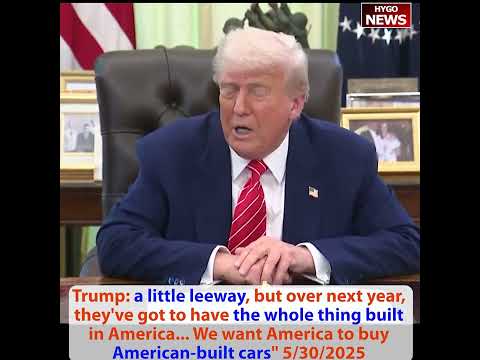
He articulated the principle: “I think it’s really… You build a car, make it in America, and I gave them a little leeway on that.”
He described the flexibility: “You know, I gave them some leeway, but over the next year, they’ve got to have the whole thing built in America. That’s what we want.”
He made the broader goal: “Mr. President, do you want America to buy American-built cars?” (Reporter question followed by Trump’s implied affirmation)
The manufacturing vision Trump described was comprehensive:
Supply chain localization: Every component of American products should be made in America rather than imported from other countries.
End of dispersed production: The decades-long trend of parts manufactured in various countries and assembled in various others should end.
Full vehicle production: Cars sold in America should be wholly American-made.
Year timeline: Manufacturers had approximately one year to shift production back to America.
Consumer preference: Americans should prefer American-built cars over imports.
This was a fundamental restructuring of global manufacturing. Modern supply chains had:
- Globalized over decades
- Optimized for cost efficiency
- Distributed production across countries
- Created interdependencies between economies
- Generated cost savings passed to consumers
Trump’s vision would partially reverse this, potentially:
- Raising some consumer prices
- Creating American manufacturing jobs
- Reducing foreign economic dependency
- Building industrial resilience
- Strengthening national security
The Economic Trade-offs
The manufacturing localization had real economic implications:
Costs: American labor, regulatory, and capital costs were higher than in many manufacturing competitor countries. Localization would tend to raise product costs.
Employment: Manufacturing employment in America would increase substantially. Millions of manufacturing jobs lost over decades could be partially recovered.
Capital investment: Massive new capital investment in American manufacturing infrastructure would be required. This would create construction jobs and supply chain opportunities.
Consumer choice: Products available to American consumers might become more expensive but also more reliable in supply.
Strategic security: National security benefits from reduced foreign dependence would be substantial.
Whether the net economic impact was positive or negative depended on:
- Scale of price increases versus wage increases
- Quality of manufacturing jobs created
- Supply chain resilience benefits
- Strategic value of domestic capability
- Long-term evolution of costs as scale increased
The Trump administration’s bet was that the combination of economic, strategic, and social benefits would justify the transition costs.
”Trade Schools”
Trump’s most substantive policy framing concerned educational investment.
“I’d like to see the money go to trade schools, where people learn how to fix motors and engines, where people learn how to build rocket ships, because you know somebody has to build those rocket ships,” Trump said.
He described specific educational investments: “And I’d like to see trade schools set up, because you could take 5 billion plus hundreds of billions more, which is what’s spent, and you could have the greatest trade school system anywhere in the world.”
He explained the connection to Musk’s projects: “And that’s what we need, to build his rockets and robots and things that he’s doing, and to build lots of other things.”
The Trade School Argument
Trump’s trade school framing was both practical and principled:
Practical economics: American manufacturing renaissance required skilled workers. Community colleges and traditional universities had underinvested in technical skills training over decades.
Personal examples: Trump cited his own experience: “I went to school with people. In some cases, they weren’t good students, but they could fix the engine of a car better than anybody I’ve ever seen. They could take it apart blindfolded. They had an ability to do that. And they did very well. They made a lot of money.”
Class appreciation: “You know, it’s a very skilled job. It’s great.”
Systemic investment: “But I’d like to see a lot of money going into trade schools. I’ve always felt that.”
Resource reallocation: “And we probably found our pot of gold, and that’s what’s been wasted at places like Harvard. And the money’s been wasted, yeah, please.”
The Harvard Comparison
Trump’s comparison of trade schools to Harvard was politically potent.
Harvard spending: Federal funding to Harvard (grants, student loans, research support) totaled billions annually. Much of this money supported:
- Tuition for wealthy students
- Research projects of questionable practical value
- Ideological programming (DEI, activist studies)
- Administrative overhead
- Endowment-supported luxury infrastructure
Trade school alternative: Similar federal investment in trade schools could support:
- Practical skill development for working-class Americans
- Direct connection to productive employment
- Shorter programs (typically 6 months to 2 years)
- Lower per-student cost
- Higher immediate economic return
Return on investment: A student completing a 1-year welding program (cost: ~$15,000) could earn $60,000+ annually. A Harvard student ($320,000 for 4 years) might or might not earn a good living depending on field.
The “pot of gold” framing captured Trump’s argument that America’s educational priorities had been misaligned. Elite universities received massive federal support while trade schools were underfunded. Redirecting this spending could benefit:
- Working-class students
- American industry
- National economic competitiveness
- Technological innovation
- Manufacturing capacity
The Rocket Builders
Musk’s presence gave the trade school discussion specific context.
Musk’s companies (SpaceX, Tesla, The Boring Company, xAI, Neuralink) employed tens of thousands of skilled workers:
- Aerospace engineers
- Manufacturing technicians
- Electricians and mechanics
- Welders and machinists
- Software developers
- Quality control specialists
These companies represented the future of American manufacturing and technology. They needed:
- Highly skilled technical workers
- Practical problem-solving abilities
- Advanced manufacturing capability
- Continuous training and upskilling
- Integration of manual and cognitive skills
Traditional universities were often poorly suited to producing workers for these jobs. Trade schools, community colleges, and specialized technical programs were better matched. But federal policy had long favored traditional university education over technical education.
Trump’s trade school framing aligned with Musk’s workforce needs. The policy vision was:
- Redirect federal education spending toward technical skills
- Build pipeline of workers for American manufacturing renaissance
- Support specific employers (like Musk’s companies) with trained workforce
- Revitalize American industrial capability
- Provide meaningful career paths for working-class Americans
Key Takeaways
- Musk’s 134-day farewell: “Not the end of DOGE but really the beginning. Like Buddhism, a way of life.”
- DOGE savings: “$160 billion current, $200 billion soon, $1 trillion long-term, $8 trillion potential.”
- 24-karat gold in Oval Office: “Been there a long time, plastered over. Now everyone sees it.”
- Trump on manufacturing: “You build a car, make it in America. Over next year, whole thing built in America.”
- Trump on education: “Money to trade schools, not Harvard. We probably found our pot of gold, wasted at places like Harvard.”