 HYGO News
 Putin speaks English on-camera! Putin flowers Soviet pilots; Obama CIA Dir Trump Nobel Peace Prize
Putin speaks English on-camera! Putin flowers Soviet pilots; Obama CIA Dir Trump Nobel Peace Prize
The video captures remarkable moments from Trump’s Alaska summit with Russian President Vladimir Putin. Vladimir Putin spoke English on-camera — extraordinarily rare for the Russian leader — to thank Trump and invite him to Moscow for a future meeting. Trump responded that he would get “a little heat” on accepting but said he “could see it possibly happening.” After the summit meeting, Putin placed flowers at the graves of Soviet pilots in Alaska and made the sign of the cross — these Soviet pilots were allies of the U.S. during WWII, helping defeat the Axis powers. The video noted that former Obama CIA Director John Brennan, previously a hostile Trump critic, followed Hillary Clinton’s framework and called for Trump to receive the Nobel Peace Prize. A Democratic commentator acknowledged Trump has “never negotiated something this complex” and expressed skepticism that Putin would pull out of occupied Ukrainian territory, while seconding the Nobel nomination if Trump achieved a comprehensive peace. B-2 flyover over the summit site was noted. Trump: “President Putin wants to see that as much as I do. So again, Mr. President, I’d like to thank you very much.” Putin (in English): “Next time in Moscow.” Trump response: “Oh, that’s an interesting one. I don’t know, I’ll get a little heat on that one, but I could see it possibly happening.”
Putin Speaks English
Vladimir Putin rarely speaks English publicly. The Russian President, despite fluency in the language, typically uses Russian in formal settings through interpreters.
When Putin spoke English on camera to Trump, it represented:
- Personal warmth toward Trump
- Accessibility gesture
- Respect for American audience
- Historic diplomatic moment
“Vladimir Putin speaks English! And on-camera! It’s not an understatement to say it’s very rare for him to do so.”
The rarity underscored the significance.
Moscow Invitation
“Putin just spoke English to Trump and invited him to Moscow in a massive sign of respect.”
The Moscow invitation:
- Putin inviting Trump for next meeting
- Moscow as diplomatic capital
- Unusual for U.S. president to visit Moscow during Russian wartime
- Symbolic reciprocity after Alaska summit
Putin’s actual English: “Next time in Moscow.”
Trump’s response: “Oh, that’s an interesting one. I don’t know, I’ll get a little heat on that one, but I could see it possibly happening.”
Trump’s acknowledgment:
- Political heat from accepting
- Domestic criticism likely
- Willingness to consider
- Diplomatic path forward
Soviet Pilots Flowers
“After the meeting with President Trump, Vladimir Putin places flowers at the graves of Soviet pilots in Alaska, USA, and makes the sign of the cross to pay his respects.”
The Soviet pilots buried in Alaska:
- World War II lend-lease program
- Soviet Union allied with U.S. against Nazi Germany
- Aircraft delivered via Alaska-Siberia route (ALSIB)
- Some crashes occurred in Alaska
- Soviet pilots buried on American soil
“These were allied to the U.S. during WWII - helping defeat the Axis.”
Putin’s gesture:
- Respect for fallen allied soldiers
- Acknowledgment of U.S.-Russia historical cooperation
- Religious observance (Orthodox sign of the cross)
- Personal engagement with shared history
The gesture was politically significant:
- Reminder of past cooperation
- Personal warmth during tense relationship
- Respect for American territory
- Religious dimension
Brennan Follows Clinton
“Obama’s Disgraced CIA Director John Brennan Follows Clinton’s Playbook — Calls for Trump to Get Nobel Peace Prize.”
John Brennan’s trajectory:
- CIA Director under Obama
- Critical of Trump throughout first term
- Promoted Russia collusion narrative
- Security clearance revoked by Trump
- Ongoing political commentary
“Brennan is now following in Clinton’s footsteps, says Trump should be nominated for a Nobel Peace Prize.”
Brennan joining Clinton in advocating Nobel recognition:
- Notable shift from prior hostility
- Acknowledgment of Trump’s diplomatic achievement
- Implicit recognition that Trump approach might work
- Political normalization of Trump success
For Brennan to advocate for Trump’s Nobel recognition represented significant shift. Brennan had been among the most prominent anti-Trump intelligence community voices. His acknowledgment reflected either genuine conversion or strategic positioning.
B-2 Flyover
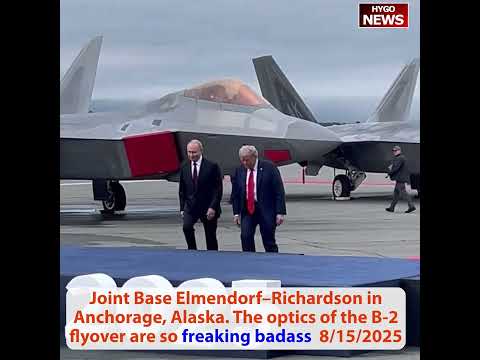
“Joint Base Elmendorf–Richardson in Anchorage, Alaska. The optics of the B-2 flyover are so freaking badass.”
B-2 stealth bomber flyover over the summit site:
- Coincident with U.S.-Russia summit
- Message of American strength
- Post-Midnight Hammer context
- Visual reminder of U.S. military capability
The B-2 flyover was politically meaningful:
- Demonstrated American strategic reach
- Reminded Putin of capability used against Iran
- Showed strength during negotiation
- Public signal of American power
Trump’s Gratitude
Trump closing comments at the summit. “President Putin wants to see that as much as I do.”
Trump’s framework — both leaders want peace. Mutual interest in resolution.
“So again, Mr. President, I’d like to thank you very much. And we’ll speak to you very soon and probably see you again very soon.”
The summit closure — continued engagement anticipated. Not a one-off meeting but beginning of sustained dialogue.
“Thank you very much, Vladimir.”
Personal first-name basis — Trump’s preferred diplomatic style. Personal rapport with foreign leaders over formal protocol.
Democratic Commentator
A Democratic commentator (possibly from CNN or similar) provided analysis.
“Made me laugh the first time I heard it, but the truth is Trump has never negotiated something this complex.”
Acknowledgment that Ukraine peace negotiation exceeds Trump’s prior deals:
- Ukraine war more complex than trade deals
- Multiple parties (Ukraine, Russia, EU, NATO)
- Territorial issues
- Security architecture
- Refugees and reconstruction
“What’s going to happen in these meetings? I don’t know.”
Honest assessment — uncertainty about outcomes.
“I hope that Donald Trump stays strong, pushes for a ceasefire across the board, not just an air ceasefire, but on the battlefield, frees that. So we can stop some of this suffering.”
The advocacy — comprehensive ceasefire across all theaters:
- Ground warfare
- Air warfare
- Territorial integrity
- Prisoner exchanges
“But I really don’t see Vladimir Putin reneging or pulling out of the territory that he’s in now.”
The skepticism — Putin unlikely to withdraw from occupied Ukrainian territory (Crimea, Donbas, other occupied areas).
“But I would second the nomination for a Nobel Peace Prize of Hillary Clinton for Donald Trump, if in fact that that happens. But I see the chances of that being next to zero.”
The commentator’s framework:
- Would support Peace Prize if peace achieved
- Doesn’t believe peace achievable given Putin’s position
- Acknowledgment of difficulty
- Conditional support
Harris Contrast
“This meeting would never have taken place under Kamala Harris.”
The political counterfactual:
- Harris-Putin relationship would have been hostile
- No direct engagement likely
- Continued proxy war approach
- No path to resolution
Trump’s willingness to engage Putin directly — controversial but potentially effective — contrasts with traditional Democratic framework of isolation and sanctions.
Air Force One
“Respect. President Trump boards Air Force One en route to Washington, DC.”
Trump departing Alaska for Washington. The summit concluded with mutual respect messaging.
Significance
The Alaska summit’s aftermath revealed multiple political dynamics:
- Putin’s extraordinary gestures — English on camera, flowers at Soviet graves, Moscow invitation
- Democratic normalization — Clinton, Brennan calling for Trump’s Nobel recognition
- Substantive complexity — Ukraine peace negotiations uniquely challenging
- Political risk acknowledgment — Trump’s “heat” on potential Moscow visit
- Military display — B-2 flyover demonstrating American strength
Putin’s gestures represented diplomatic warmth unusual for his public persona. The English speaking, the flowers at Soviet graves, the Moscow invitation — all conveyed personal engagement beyond standard diplomatic protocol.
The Democratic establishment’s shift — Clinton and Brennan advocating Nobel recognition — marked political normalization of Trump’s diplomatic approach. Even hostile critics acknowledged potential achievement.
The unanswered question — whether substantive Ukraine peace would follow the warm personal engagement. Historical parallels (Soviet peace efforts often producing photo-ops without substance) suggested caution. But Trump’s unconventional approach might succeed where conventional diplomacy had failed.
Key Takeaways
- Putin in English: “Next time in Moscow.”
- Trump response: “Oh, that’s an interesting one. I don’t know, I’ll get a little heat on that one, but I could see it possibly happening.”
- Trump thanking Putin: “President Putin wants to see that as much as I do. So again, Mr. President, I’d like to thank you very much. And we’ll speak to you very soon and probably see you again very soon.”
- Democratic commentator: “The truth is Trump has never negotiated something this complex … I would second the nomination for a Nobel Peace Prize of Hillary Clinton for Donald Trump, if in fact that that happens. But I see the chances of that being next to zero.”
- Putin gesture: “After the meeting with President Trump, Vladimir Putin places flowers at the graves of Soviet pilots in Alaska, USA, and makes the sign of the cross to pay his respects. These were allied to the U.S. during WWII - helping defeat the Axis.”