 HYGO News
 Nvidia CEO Jensen Huang: America's unique advantage is Trump; Trump: LOYALTY not in China, India
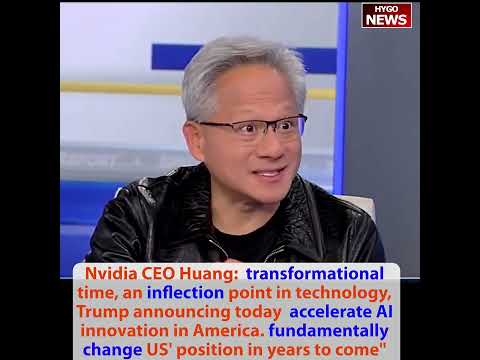
Nvidia CEO Jensen Huang: America’s unique advantage is Trump; Trump: LOYALTY not in China, India
Nvidia CEO Jensen Huang delivered one of the strongest CEO endorsements of Trump in decades: “America’s unique advantage that no country possibly have is President Trump.” Huang explained why — Trump’s day-one recognition of AI’s centrality and energy’s essential role in AI: “You can’t reshore manufacturing without energy. You can’t sustain a brand new industry like artificial intelligence without energy.” Then Trump delivered a direct challenge to Silicon Valley CEOs gathered for the AI summit: “Winning the AI race will demand a new spirit of patriotism and national loyalty in Silicon Valley … Many of our largest tech companies have reaped the blessings of America freedom while building their factories in China, hiring workers in India and slashing profits in Ireland … Under President Trump, those days are over.” Huang reframed the technological moment: “We are reinventing computing for the first time in 60 years. This is a very big deal.” And Trump claimed the deliverable: “America is the country that started the AI race. And as president of the United States, I’m here today to declare that America is going to win it."
"America’s Unique Advantage Is Trump”
The interviewer’s question. “As a CEO of a global company, what do you see are America’s unique advantages that other countries don’t have?”
Huang’s answer is extraordinary. “America’s unique advantage that no country possibly have is President Trump.”
That is not a typical CEO endorsement. Huang — who runs the single most valuable semiconductor company in the world, whose products are at the center of the global AI buildout — is naming the current U.S. president as America’s strategic advantage over other countries.
That framing matters politically because Huang has significant commercial stakes in the U.S.-China relationship. Nvidia sells chips globally, including to Chinese customers. Huang has historically been cautious about political commentary. His willingness to deliver a strong Trump endorsement reflects specific judgment about the current moment.
The Energy-AI Connection
Huang’s explanation of why Trump’s leadership matters is operationally specific. “One, on the first day of his administration, he realized the importance of AI and he realized the importance of energy. For the last, I don’t know how many years, energy production was vilified, if you guys remember.”
“Energy production was vilified” is the Huang characterization of the previous decade’s climate-policy-driven constraints on U.S. energy production. For AI specifically, that framing is critical — AI data centers consume extraordinary amounts of electricity, and constraints on energy production are constraints on AI capacity.
“We can’t create new industries without energy. You can’t reshore manufacturing without energy. You can’t sustain a brand new industry like artificial intelligence without energy.”
That is the core insight the administration has been operationalizing. Energy is the foundation. Without cheap, abundant energy, nothing else scales — not manufacturing, not AI, not the broader industrial rebuild.
“If we decide as a country the only thing we want is IP to be an IP only, a services only country, then we don’t need much energy. But if we want to produce things, something as vital as artificial intelligence and we need energy.”
Huang is drawing the distinction. A services-and-IP-only economy can run on less energy because its economic activity is largely digital. A physical-production economy — one that makes things, builds factories, runs heavy industry — requires energy at scale. The AI revolution is physical-production-adjacent because AI data centers are physical facilities consuming physical megawatts.
”The New Industrial Revolution”
“And so I’m just delighted to see pro to accelerate AI innovation, to accelerate the growth of energy so that we can sustain this new industry, you know, go after the new industrial revolution.”
“New industrial revolution” is the framing. Huang is placing current AI development in the historical category of the original industrial revolution. A new category of production capability, requiring new infrastructure, producing new economic and social patterns.
For Huang, being able to cite Trump’s leadership on both AI and energy simultaneously — the two pillars of the new industrial revolution — is an unusually clean endorsement of a coherent administration policy framework.
Trump’s Direct Challenge
The segment then pivoted to Trump’s direct speech at the AI summit. “And perhaps most importantly, winning the AI race will demand a new spirit of patriotism and national loyalty in Silicon Valley and long beyond Silicon Valley.”
“Patriotism and national loyalty in Silicon Valley” is the specific challenge. American tech companies have operated globally for decades. Their labor markets, manufacturing bases, and capital allocation have reflected that global footprint. Trump is framing that globalism as past-tense.
“For too long, much of our tech industry pursued a radical globalism that left millions of Americans feeling distrustful and betrayed.”
“Radical globalism” is the characterization. Not merely globalism as a business strategy. Globalism elevated to ideology, producing decisions that prioritized international arbitrage over American interests.
The Specific Indictments
“Many of our largest tech companies have reaped the blessings of America freedom while building their factories in China, hiring workers in India and slashing profits in Ireland.”
Three specific categories:
- Factories in China: Apple, HP, Dell, and many other consumer electronics companies have substantial manufacturing bases in China. That has been a commercial reality for two decades. Trump is framing it as a betrayal.
- Hiring workers in India: Microsoft, Google, IBM, and many other tech companies have significant engineering and support workforces in India. The cost arbitrage is substantial — Indian engineers cost a fraction of American engineers. Trump is framing that as choosing foreign workers over Americans.
- Slashing profits in Ireland: Google, Facebook, Apple, and many other multinationals use Irish corporate structures to minimize tax exposure on international profits. Ireland’s 12.5% corporate tax rate, combined with various transfer pricing arrangements, has allowed tech companies to dramatically reduce effective tax rates. Trump is framing that as tax avoidance at the expense of American fiscal health.
“You know that all the wild dismissing and even censoring their fellow citizens right here at home.”
That is the additional charge. Not only have tech companies arbitraged globally. They have actively suppressed their American customers’ speech while doing so.
”Those Days Are Over”
“Under President Trump, those days are over. We need U.S. technology companies to be all in for America. We want you to put America first. You have to do that. That’s all we ask.”
“That’s all we ask. That’s all we ask.” The repetition is for emphasis. Put America first. That is the ask.
Whether technology companies respond to that ask with genuine realignment or with the appearance of realignment is the future question. Some — Nvidia’s Huang, Meta’s Kaplan, others — are publicly positioning as aligned. Others may wait for political weather to pass before making significant operational changes.
Huang’s Technology Framing
Huang returned to describe the underlying technological moment. “We are at a transformational time and inflection point in technology. We are reinventing computing for the first time in 60 years. This is a very big deal.”
“First time in 60 years” — that is a substantial claim. 60 years ago is the mid-1960s, around the era when mainframe computing and the transition to microprocessors began defining the modern computing architecture. Huang is saying the current AI moment is reinventing computing at the same level of fundamental change.
“Before it was called general purpose computing. The software was written by hand. Now software is learned by computers. We call it artificial intelligence. And this transformation has resulted in a revolutionary technology we understand and is revolutionizing every industry.”
That is the technical framing. Traditional computing: humans write software; computers execute. AI computing: computers learn software through training; humans evaluate. That shift is not an incremental improvement. It is a categorical change in how computing works.
”Three Initiatives”
“But what the president is announcing today is going to accelerate AI innovation in America. He’s going to accelerate AI deployment in America with all of the infrastructure and the energy that he’s going to put to bear. And he’s going to enable American Text Act to be proliferated around the world in credible rate. And I think that those three initiatives are going to fundamentally change United States position over the years to come.”
Huang is mapping the three Trump executive orders to three industry consequences:
- AI innovation acceleration (permitting, infrastructure)
- AI deployment in America (energy, capacity)
- American tech proliferating globally (export promotion)
Each of those aligns with one of the executive orders Trump signed. Huang is publicly validating the strategy.
Trump’s Declaration
Trump’s closing. “Whether we like it or not, we’re suddenly engaged in a fast paced competition to build and define this groundbreaking technology that will determine so much about the future of civilization itself because of the genius and creativity of Silicon Valley.”
“Fast paced competition” is the framing. The AI race is not theoretical. It is happening now. China is racing. Others are racing. The U.S. is racing. The outcome will shape “the future of civilization itself.”
“And it is incredible, incredible genius. Without question, the most brilliant place anywhere on earth, America.”
American exceptionalism framing. America has the most brilliant people. Silicon Valley is the most brilliant place. That genius and creativity are the competitive advantage.
“Is the country that started the AI race. And as president of the United States, I’m here today to declare that America is going to win it. We’re going to work hard. We’re going to win it.”
That is the commitment. America started AI. America will win AI. The work is ongoing. The outcome is determined.
Two Messages, One Summit
Huang validates the administration’s AI agenda from the industry side. Trump delivers the demanding message to the same industry: patriotism, national loyalty, put America first. Together, they represent the reshaping of the U.S. technology industry’s relationship with the U.S. government.
Whether that reshaping holds in practice — whether Apple really does move significant manufacturing out of China, whether Microsoft really does rebalance its India hiring, whether Google really does pay more U.S. corporate taxes — will be the operational test. The political framing is set. The commercial follow-through is what comes next.
Key Takeaways
- Nvidia CEO Jensen Huang: “America’s unique advantage that no country possibly have is President Trump” — citing Trump’s day-one recognition of AI and energy’s centrality.
- Huang: “We are reinventing computing for the first time in 60 years … general purpose computing … software was written by hand. Now software is learned by computers.”
- Trump’s direct challenge to Silicon Valley: “Winning the AI race will demand a new spirit of patriotism and national loyalty in Silicon Valley.”
- Trump specifically indicted: tech companies “building their factories in China, hiring workers in India and slashing profits in Ireland” — “Under President Trump, those days are over.”
- Trump’s declaration: “America is the country that started the AI race. And as president of the United States, I’m here today to declare that America is going to win it.”