 HYGO News
Jean-Pierre Dodges on Bank Consolidation, Blames Trump for a 2018 Law That 16 Senate Democrats Backed (March 16, 2023)
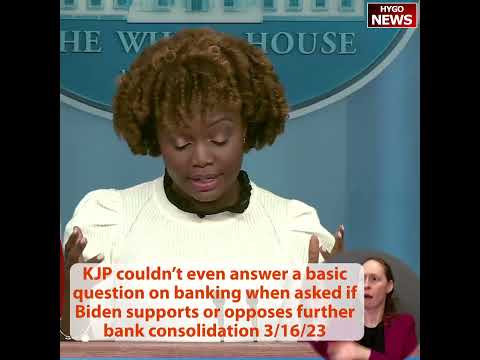
White House press secretary Karine Jean-Pierre knew whom to blame for the bank failures: the Trump administration. But when a reporter asked whether the crisis would leave America’s banks in fewer, bigger hands, she had no answer of her own. “I would refer you to the relevant banking regulators,” she said [1].
Asked a fourth time whether the administration discouraged bank consolidation, she handed it off again. “I would refer — I would refer you to the Department of Treasury,” Jean-Pierre said [1].
The video above shows the exchange from the March 16, 2023, White House briefing, days after regulators stepped in at Silicon Valley Bank and Signature Bank. Quotes are from the official transcript published by the American Presidency Project [1].
”Capitalism — Sorry, Competition”
The reporter started with the administration’s own record. “So the Biden administration has expressed a lot of concern in the past about consolidation in other sectors. You’ve spoken about meatpacking, shipping, ocean shipping, oil companies. Are you worried that this crisis surrounding several regional banks could lead to a consolidation, a concentration in the larger banking sector?” [1]
Jean-Pierre quoted the president: “Capitalism without competition isn’t capitalism.” Then she tripped over the phrase. Biden’s executive order, she said, was about “promoting capita- — capitalism — sorry, competition — pardon me” [1].
“And so, I’ll just leave it there,” she said [1].
”What Can You Do About It?”
The reporter tried again. “But, I mean, the question is: Are you concerned, and what can you do about it?” With First Republic Bank now in trouble, the reporter asked, “what tools do you have to push back against a further concentration in this critical sector?” [1]
“So, look, as it relates to specific banks and institutions, you know, I would — I would — I would refer you to the relevant banking regulators,” Jean-Pierre answered [1].
She then gave a promise: “No taxpayer money is being used or put at risk with this action” [1].
”A Distinct Issue”
The reporter turned to Europe, where the Swiss were propping up Credit Suisse and the talk was of “the biggest bank in Switzerland, UBS, stepping in to aid Credit Suisse” [1].
Jean-Pierre said the Swiss bank’s trouble had nothing to do with America’s. “But I will say that what we’re seeing currently with the Credit Suisse is a distinct issue. And it’s a problem — and its — and its problems are not related to the current economic situation, the current economic environment,” she said [1].
“And sorry to belabor the point, I just want — want to see what the Biden administration’s policy on this is. Do you discourage further consolidation in banking globally or in the U.S.?” the reporter asked. That was when she referred the question to Treasury [1].
”What the Trump Administration Did”
On blame, there was no referral. Asked what President Joe Biden wanted from Congress, Jean-Pierre pointed to 2018. “But unfortunately, in the last administration, in 2018, some of those rolled back some of — some of those regulations that would have been incredibly important as we move forward,” she said [1].
Later in the briefing she said it again: “In 2018, we saw what the Trump administration did. They did roll back some of those tough requirements” [1].
The 2018 law, the Economic Growth, Regulatory Relief, and Consumer Protection Act, was no party-line bill. The Senate passed it 67 to 31 on March 14, 2018, according to the Congressional Record [2]. By HYGO News’ count of the roll call, the yeas included 16 Democrats, among them Sens. Mark Warner and Tim Kaine of Virginia, Jon Tester of Montana, and Debbie Stabenow and Gary Peters of Michigan [2].
The House passed it 258 to 159 on May 22, 2018, with 33 Democrats voting yes, according to the House Clerk [3].
Jean-Pierre’s own fix came with a slip. She praised “bipartisan support on a piece of legislation — the Warner [Warren]-Porter bill,” as the official transcript renders it [1]. Warner had voted for the 2018 law [2].
”Not Going to Get Ahead”
The other bank answers ran the same way. Asked whether the administration supported changes to “the existing $250,000 cap on FDIC insurance limit for checkings and savings accounts,” Jean-Pierre said: “So, again, I’m not going to get ahead or get into hypotheticals on what — what the future is going to hold” [1].
Asked about reports of “a $30 billion or so plan to shore up First Republic Bank in California,” she said: “So, I’m not going to comment on any specific actions or any specific institutions from here” [1].
By the Numbers
- 4: questions in a row on bank consolidation [1].
- 2: referrals, to “the relevant banking regulators” and to “the Department of Treasury” [1].
- 67-31: the Senate vote for the 2018 law Jean-Pierre blamed on Trump [2].
- 33: House Democrats who voted for it [3].
- 3 days: from the briefing to the UBS takeover of Credit Suisse [4].
- $229.1 billion: First Republic’s total assets when JPMorgan Chase took it over [5].
What Happened Next
Switzerland consolidated. Three days later, on March 19, 2023, Swiss regulator FINMA announced it “has approved the takeover of Credit Suisse by UBS.” Credit Suisse’s crisis, FINMA said, “was intensified by the upheavals in the US banking market in March 2023.” “The takeover will result in a larger bank,” it said [4].
America’s biggest bank got bigger. On May 1, 2023, California regulators closed First Republic, and the FDIC agreed to let JPMorgan Chase “assume all of the deposits and substantially all of the assets of First Republic Bank.” First Republic had “approximately $229.1 billion in total assets.” “The FDIC estimates that the cost to the Deposit Insurance Fund will be about $13 billion,” the agency said [5].
JPMorgan Chase was already the nation’s largest commercial bank, with about $3.27 trillion in consolidated assets as of March 31, 2023, according to the Federal Reserve [6].
For who paid for the rescue, see HYGO News’ pages on Jean-Pierre and community banks and Sen. James Lankford’s questioning of Treasury Secretary Janet Yellen.
Sources
- The American Presidency Project: Press Briefing by Press Secretary Karine Jean-Pierre (March 16, 2023)
- GovInfo: Congressional Record, Senate, Economic Growth, Regulatory Relief, and Consumer Protection Act, roll call votes (March 14, 2018)
- Office of the Clerk, U.S. House of Representatives: Roll Call 216, S. 2155 (May 22, 2018)
- FINMA: FINMA approves merger of UBS and Credit Suisse (March 19, 2023)
- FDIC: JPMorgan Chase Bank, National Association, Columbus, Ohio Assumes All the Deposits of First Republic Bank, San Francisco, California (May 1, 2023)
- Federal Reserve: Large Commercial Banks (March 31, 2023)