 HYGO News
 Sen. Joni Ernst's speech in Senate Trump impeachment trial (Feb 4, 2020)
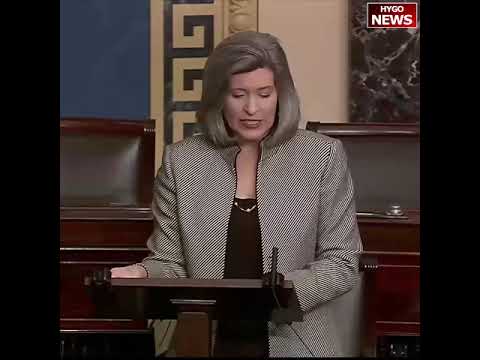
Sen. Joni Ernst’s speech in Senate Trump impeachment trial (Feb 4, 2020)
On February 4, 2020, Sen. Joni Ernst of Iowa took the Senate floor to announce she would vote against both articles of impeachment against President Trump. In a speech that was notably personal in tone compared to the legalistic arguments of many of her colleagues, Ernst called the trial “robust and at times rancorous,” acknowledged that the process had left her “feeling angry” on some days and “hopeful” on others, and warned that allowing this impeachment to stand as precedent would set the country on “a very dark path.”
The Emotional Weight of the Trial
Ernst opened her remarks by acknowledging the toll the proceedings had taken on the Senate and the country. “Yes, folks, we have had a robust and at times a rancorous trial. Some days I left here feeling angry and some days I left more hopeful,” she said.
She recognized that the impact extended far beyond the Senate chamber: “Frankly, it is likely that many Americans and in my case, Iowans from every political stripe will feel hurt by this process at some level. But we are all representatives of the ideals and beliefs of the people we are here to represent.”
Ernst reaffirmed the seriousness of her constitutional oath: “Like all of you, I have sworn an oath to uphold the Constitution and I take that oath very seriously.” The statement served as a preamble to her legal analysis, grounding her eventual acquittal vote in constitutional duty rather than partisan loyalty.
The Constitutional Standard for Removal
Ernst addressed the central constitutional question directly. She noted that the Senate had heard extensive arguments “about what the Constitution says regarding the threshold for impeaching a president” and concluded that “the Constitution goes out of its way to make it a high bar for removing the president.”
She explained the founders’ reasoning: “This is because the founders were rightfully concerned that impeachment might be used to upend the electoral will of the American people. Absent restraint, the impeachment process would all be too tempting for those that oppose a sitting president to simply use it as a tool to achieve political advantage.”
Ernst then framed the senator’s role in simple terms: “Each of us had one job, one job during this process, to decide based on the evidence whether the president committed an impeachable offense.”
Ernst’s Vote and the Evidence
After reviewing the full evidentiary record, Ernst announced her decision. “Upon reviewing the record containing the testimony of 17 witnesses and over 28,000 pages, as well as hearing from both sides on their arguments presented throughout this process, I will vote against both articles of impeachment,” she said.
Her reasoning was straightforward: “The arguments of the House managers simply did not demonstrate that the president’s actions rise to an impeachable offense.” She added a democratic argument to her constitutional one: “Given the constitutional requirements, voting any other way on these articles would remove the ability of the American people to make their own decision at the ballot box in November.”
The Process Was Politically Driven
Ernst characterized the impeachment as tainted by partisanship from the beginning. “This process was fraught from the start with political aims and partisan innuendos that simply cannot be overlooked,” she said.
She took particular issue with the House managers’ implicit argument about voter competence: “The House managers’ arguments have argued that the American people cannot be trusted to render their own judgment on this president. I reject this premise and the complete distrust of the American people with everything in my heart.”
Ernst warned that accepting the House’s case would have lasting consequences: “If the case presented by the House of Representatives is allowed to be the basis for the removal of this president, I am afraid that impeachment will become just another tool used by those who play partisan politics. This is not what the founders intended, and this is a very dark path to go down.”
Foreign Affairs and Presidential Discretion
Ernst made an argument that few of her colleagues had addressed directly: the inherent complexity of presidential foreign policy decisions. “Under the Constitution, impeachment wasn’t designed to be a litmus test on every action of the president. Elections were designed to be that check,” she said.
She argued that the Ukraine situation illustrated a broader challenge: “The issue of foreign affairs has historically been fraught with peril for presidents. Foreign affairs is an art, not a science. And trying to insert a formula into every presidential interaction with a foreign leader is a path towards ineffectiveness.”
This argument suggested that even if one disagreed with how Trump handled the Ukraine relationship, the conduct fell within the range of presidential discretion in foreign policy rather than constituting an impeachable offense.
Ernst’s Closing Prayer
Ernst closed her remarks with an appeal that stood out for its emotional directness compared to the more clinical speeches delivered by other senators during the floor debate. “The Senate is about to close this chapter in American history. I pray that we do not allow this to become the norm,” she said.
She called for unity after the divisive proceedings: “I also pray earnestly that we will shift into a spirit of cohesiveness, coming together to get our work done for the American people.”
Her final line invoked multiple constituencies: “Our people, our founders, our country, and my great state of Iowa deserve better than this.” The mention of Iowa was a reminder that Ernst, like all senators, was answerable to voters back home who had been watching the proceedings closely.
Key Takeaways
- Sen. Ernst called the trial “robust and at times rancorous” and voted against both articles after reviewing testimony from 17 witnesses and over 28,000 pages of evidence, concluding the House managers “simply did not demonstrate that the president’s actions rise to an impeachable offense.”
- She rejected the House managers’ implicit argument that voters could not be trusted to judge the president, stating “I reject this premise and the complete distrust of the American people with everything in my heart.”
- Ernst warned that accepting the House’s case would make impeachment “just another tool used by those who play partisan politics” and argued that foreign affairs is inherently complex, making it inappropriate to apply rigid formulas to every presidential interaction with a foreign leader.