 HYGO News
 Sen. Bill Cassidy's speech in Senate Trump impeachment trial (Feb 4, 2020)
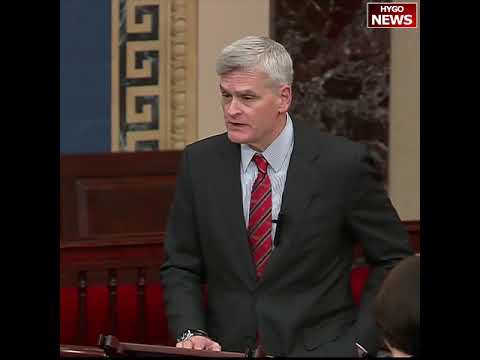
Sen. Bill Cassidy’s speech in Senate Trump impeachment trial (Feb 4, 2020)
On February 4, 2020, Sen. Bill Cassidy of Louisiana announced he would vote against both articles of impeachment against President Trump. Cassidy delivered a methodical speech organized around three considerations: the procedures used by the House, the merits of the charges, and the ramifications that removal would have on the republic. He argued the House had sacrificed “thoroughness for political timing” and that the evidence did not meet the constitutional standard for removing a president.
Procedure: The House Failed to Build Its Case
Cassidy opened by framing the decision in the starkest terms: “The Senate must determine whether to remove a president duly elected by the people. A decision of such magnitude deserves first full consideration of the procedures, two merits of the charges, and three the ramifications removal would have on our republic.”
He argued that the framers required thorough investigations before impeachment precisely because removing a president “negates an election in which Americans choose their leader.” He warned that “if substantial numbers of Americans disagree with removing the president, removal damages civic society.”
Cassidy pointed to Watergate as the model for how impeachment should work: “The Watergate investigation convinced Americans that President Nixon committed crimes, forcing his resignation, with overwhelming support for removal in the House and the Senate.”
By contrast, Cassidy argued, the House in the Trump case “declined to call witnesses it felt relevant, arguing that the courts would take too long.” He called this reasoning hollow, noting that “a congressional committee afraid of being sued, while claiming to be fearlessly pursuing truth for the good of the country, rings hollow.” He also noted the contradiction between Adam Schiff’s claim that they “could not wait for the next election” and Speaker Pelosi’s decision to hold the articles for 37 days, a delay that “smacks of partisan political motivations.”
Cassidy highlighted that “the only bipartisan votes being against impeachment” and noted that House managers Schiff, Nadler, and Lofgren had previously said “party line impeachment would divide the nation” but “never explained why their opinions changed.”
Article 2: Obstruction of Congress
Cassidy addressed the obstruction charge first, dispensing with it quickly. “In Article 2, House managers argued the President obstructed Congress for acting on the advice of legal counsel to resist subpoenas,” he said. “The judiciary resolves disputes between the executive and legislative branches. The House should have exhausted judicial remedies before bringing this charge. I shall vote against Article 2.”
Article 1: Abuse of Power
On the abuse of power charge, Cassidy laid out a three-part analytical framework: the legal standard of guilt, whether a crime was committed, and whether that crime warranted removal.
On the standard of guilt, Cassidy argued that since House managers charged “something akin to a crime,” the higher “beyond a reasonable doubt” standard used in criminal cases was appropriate. He quoted Sen. Jay Rockefeller’s statement during the Clinton impeachment that beyond a reasonable doubt “means that it has proven to a moral certainty that the case is clear, that the case is concise.”
On whether a crime was committed, Cassidy walked through the defense team’s arguments that cast reasonable doubt on the quid pro quo allegation. He cited Ambassador Kurt Volker’s denial of a connection between aid and corruption investigations, President Zelensky’s denial of feeling pressure, and Trump’s own statement to Sen. Ron Johnson: “No way I would never do that.”
He also noted that aid to Ukraine was released before the statutory deadline and that the release followed new Ukrainian anti-corruption measures, “which included swearing in a reform parliament and installing a new prosecutor general, and the newly established high anti-corruption court meeting for the first time.”
On whether the alleged conduct was impeachable, Cassidy argued that “abuse of power” was a “nebulous” term that “does not define a specific crime.” He contrasted this with the Nixon impeachment, where the House drafted an abuse of power article that “enumerated five specific criminal and non-criminal offenses.” Since the Constitution lists “treason, bribery, or other high crimes and misdemeanors,” Cassidy reasoned that “the framers meant for impeachment to occur only if a crime approached levels as severe as treason and bribery.”
Cassidy invoked the legal principle of leniency, citing Chief Justice Marshall and Justice Frankfurter: “If a law is ambiguous, it is better to narrowly interpret the words of a law in favor of the defendant.” He also cited the 1998 precedent, when the Senate acquitted Clinton despite his having lied under oath as “Chief Law Enforcement Officer of the Land,” establishing that “to remove a president, the crime must reach a high threshold of severity.”
His conclusion was direct: “The allegation against President Trump was not proven beyond a reasonable doubt, and it does not meet that high threshold. I shall vote against Article 1.”
A Prophetic Warning
Cassidy closed by quoting then-Congressman Chuck Schumer’s 1998 statement during the Clinton proceedings: “I suspect history will show that we have lowered the bar on impeachment so much, we have broken the seal on this extreme penalty so cavalierly, that it will be used as a routine tool to fight political battles. My fear is that when a Republican wins the White House, Democrats will demand payback.”
“Mr. Schumer was a prophet,” Cassidy concluded. “This must stop.”
Key Takeaways
- Sen. Cassidy structured his acquittal vote around three considerations: the House’s flawed procedures that sacrificed “thoroughness for political timing,” the failure to prove abuse of power beyond a reasonable doubt, and the ramifications of normalizing partisan impeachment.
- He argued the obstruction charge should have been resolved through the judiciary and that the abuse of power article lacked the specificity of Nixon-era charges, invoking the legal principle of leniency to interpret the ambiguous constitutional standard in the president’s favor.
- Cassidy quoted Chuck Schumer’s 1998 warning that lowering the bar for impeachment would turn it into “a routine tool to fight political battles,” calling Schumer “a prophet” in light of the Trump proceedings.