 HYGO News
 Sen. John Hoeven's speech in Senate Trump impeachment trial (Feb 4, 2020)
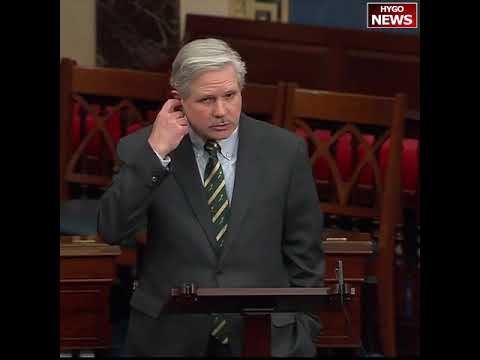
Sen. John Hoeven’s speech in Senate Trump impeachment trial (Feb 4, 2020)
On February 4, 2020, Sen. John Hoeven of North Dakota delivered a brief but pointed speech explaining his decision to vote for acquittal in President Trump’s first impeachment trial. Hoeven argued that three key facts undermined the House’s case: the public had seen the transcript of the Ukraine call, President Zelensky said he was not pressured, and the military aid was delivered without any investigations being conducted. He concluded that “the House’s allegations do not rise to the level of an impeachable offense.”
The Senate Took Its Duty Seriously
Hoeven opened by defending the seriousness of the Senate’s approach to the trial. He noted the scope of the proceedings: “For more than two weeks now, the Senate has listened as both the House managers and the President’s counsel have presented their cases. Nearly 28,000 pages of documents, including testimony from 17 witnesses gathered as part of the House investigation were made part of the Senate record.”
He detailed the question-and-answer phase: “Over the course of two days, senators asked 180 questions of the House managers and the White House counsel.” His conclusion was unambiguous: “The Senate took its constitutional duty very seriously.”
After reviewing all the evidence, Hoeven stated his position directly: “After carefully listening to the House managers, the President’s counsel, reviewing the documents and testimony and asking questions, it is clear to me that the House should not have impeached President Trump and the Senate should vote to acquit the President.”
The House Process vs. the Senate Trial
Hoeven drew a sharp distinction between the House’s impeachment inquiry and the Senate trial. On the House side, he argued that “the House process did not provide the President with important due process rights,” a complaint shared by virtually every Republican senator who spoke during the floor debate.
By contrast, Hoeven defended the Senate’s procedures as fair and thorough. “The Senate trial was conducted using past precedent of the Clinton trial as the framework,” he noted, referring to the 1999 bipartisan agreement that had been adopted unanimously by all 100 senators at the start of the Clinton trial.
He emphasized that both sides received equal treatment in the Senate: “We provided ample opportunity for both the House managers and White House counsel to make their arguments and ensured that senators had substantial time to ask their questions.” The 180 questions asked over two full days produced “lengthy answers” and “detailed answers from both the President’s counsel and the House managers.”
This framing served an important purpose in Hoeven’s argument. By establishing that the Senate had provided a fair process even if the House had not, he preempted any suggestion that his acquittal vote was based on a desire to avoid hearing the evidence. He had heard it all and found it wanting.
Three Facts That Undermined the Case
Hoeven’s substantive argument was concise. He identified three facts that he believed fatally weakened the House managers’ case for removal.
First, transparency. “The American public has seen the transcript of the call between President Trump and President Zelensky,” Hoeven said. The White House had declassified and released the rough transcript of the July 25, 2019, call that was at the center of the impeachment inquiry. Hoeven’s point was that the key evidence was available to every American, not hidden behind executive privilege.
Second, the alleged victim’s own assessment. “President Zelensky has said on several occasions that he did not feel pressured to do anything in return for the security assistance,” Hoeven stated. This was a point the president’s defense team had made repeatedly throughout the trial: the Ukrainian president himself denied experiencing the coercion that the House managers alleged had occurred.
Third, the outcome. “The military aid was provided to Ukraine without any investigations being conducted,” Hoeven noted. The security assistance that the House alleged Trump had withheld as leverage was ultimately released before the statutory deadline, and no investigation into the Bidens or Burisma was ever opened by Ukraine. In Hoeven’s view, the alleged quid pro quo never materialized.
From these three facts, Hoeven drew his conclusion: “Given these facts, the House’s allegations do not rise to the level of an impeachable offense.”
The Founders and the Coming Election
Hoeven briefly addressed the constitutional philosophy underlying impeachment. “Our founding fathers believed that impeachment should not be used as a partisan weapon and that the President serves at the will of the people,” he said. “With an election to be held in coming months, it should be up to the American people to decide who will lead the country.”
This argument placed Hoeven in the same position as many of his Republican colleagues who argued that even if one found the president’s conduct troubling, the appropriate remedy was the ballot box rather than Senate removal, particularly with the 2020 presidential election just nine months away.
Time to Get Back to Work
Hoeven closed his remarks by pivoting to the legislative agenda that he argued had been sidelined by the impeachment proceedings. “We need to put this impeachment behind us. We need to get back to work advancing measures to help improve the lives of Americans,” he said.
He listed specific priorities that he believed should command the Senate’s attention: “addressing our nation’s infrastructure, lowering prescription drug costs, providing middle-class tax relief, promoting American energy development, supporting our military and veterans, upholding our trust and treaty obligations to our tribal communities, securing our borders, and continuing to fight for our farmers and ranchers.”
Hoeven characterized these as “areas where we can work together on a bipartisan basis for the American people.” With that, he yielded the floor, having delivered one of the more concise statements in what had been weeks of Senate floor speeches.
Key Takeaways
- Sen. Hoeven based his acquittal vote on three key facts: the public had seen the call transcript, President Zelensky repeatedly said he was not pressured, and the military aid was delivered to Ukraine without any investigations being conducted.
- He defended the Senate trial as fair and thorough while criticizing the House process for denying the president due process rights, drawing a sharp distinction between the two chambers’ handling of impeachment.
- Hoeven argued the upcoming election should serve as the check on presidential power and called for the Senate to return to bipartisan legislative priorities including infrastructure, prescription drug costs, and energy policy.