 HYGO News
 Sen. Shelley Moore Capito's speech in Senate Trump impeachment trial (Feb 4, 2020)
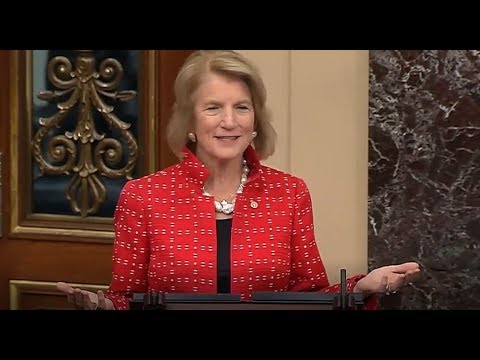
Sen. Shelley Moore Capito’s speech in Senate Trump impeachment trial (Feb 4, 2020)
On February 4, 2020, Sen. Shelley Moore Capito of West Virginia announced she would vote to acquit President Trump on both articles of impeachment. Capito called the House’s case “flimsy,” “rushed,” and full of “incomplete evidence,” arguing that the founders never intended impeachment to be used as “a blunt partisan instrument.” She framed her vote in terms of her obligation to nearly half a million West Virginia voters who chose Trump in 2016.
The Constitutional Standard for Removal
Capito opened by grounding her argument in the Constitution. “Our Constitution makes clear that only a particularly grave act — treason, bribery, and other high crimes and misdemeanors — would justify a Senate voting to reverse the will of the people and the voters and remove from office the person they chose to lead this nation,” she said.
She emphasized that the two-thirds supermajority requirement “underscores the need for a national consensus that runs across partisan lines for undoing an election.” Capito noted a historical fact to reinforce her point: “The Senate has never in our history removed a President from office following an impeachment trial.”
She then turned the constitutional argument personal: “President Trump was duly elected by the people of this country, President of the United States, in 2016. Nothing that I have heard in this process has come close to providing a reason that would justify me voting to overturn the choice made by nearly half a million West Virginians and tens of millions of other Americans and even further, to remove him from the ballot in 2020.”
A Flawed and Partisan House Process
Capito did not mince words about the House proceedings that produced the articles. “There is no doubt that the House impeachment process was partisan, politically driven, and denied President Trump some of his most basic rights of due process,” she said. “At the same time, the product that was brought to our chamber was obviously flimsy, rushed, and contained incomplete evidence.”
She challenged the House managers’ demands for Senate witnesses: “Time and again, the House managers demanded that we do things here in the Senate that they neglected to do themselves during their House proceedings, such as calling witnesses, which they refused to call the witnesses that they were now asking us to bring forward.”
The Senate Conducted a Fair Trial
Despite her criticisms of the House, Capito expressed confidence in the Senate’s own process. She noted that she had supported a trial framework modeled after the 1999 Clinton precedent that had received unanimous support from all 100 senators.
“Both the managers and the President’s attorneys were given three full days in the Senate to present their respective cases, and senators spent two full days, 16 hours, asking questions and receiving answers from the parties,” she said. “The Senate heard testimony from witnesses in 192 video segments, some of them repetitive, and received more than 28,000 pages of documents. The House record included the testimony of 17 witnesses. So there were witnesses.”
After weighing all of this material, Capito reached her conclusion: “I keenly listened to these presentations with an open mind, and I have concluded that the arguments and evidence do not provide me with a sufficient rationale for reversing the 2016 election and removing President Trump from the ballot in 2020.”
Comparing the Partisan Divide to Past Impeachments
Capito highlighted the unprecedented partisan nature of the Trump impeachment by comparing it to the Nixon and Clinton proceedings. The impeachment inquiry into President Nixon “was supported by more than 400 members of the House, many of those, overwhelming in number, from his own party.” During the Clinton impeachment, “31 House Democrats voted to open an impeachment inquiry into their president.”
“By contrast, in this case, not a single member of the President’s party voted in the House of Representatives to start an impeachment inquiry or to adopt either article of impeachment against the President,” Capito noted. She argued this stark divide confirmed that “we have a mechanism in this country for dealing with issues that divide along party lines. That mechanism is not impeachment or removal. That mechanism quite simply is an election, and we have one in nine months.”
A Call to Move Forward
The second half of Capito’s speech shifted from arguing against impeachment to making a case for returning to governance. She shared a story about a butcher in a West Virginia grocery store who had asked her why Congress was spending so much time on impeachment instead of the issues that mattered to working families.
“Our families, making our families stronger, our lives better, and our jobs more permanent,” Capito said, listing the priorities her constituents wanted Congress to focus on. She named specific policy areas: “transportation, broadband, energy, ending the drug crisis, or strengthening our military.”
Capito acknowledged the division the proceedings had created but struck an optimistic note: “When we rid ourselves of the poisonous venom of partisan politics, we see more clearly. We know that we don’t always agree. But we can certainly find common ground, as was envisioned by our founders.”
She closed by addressing the young people present in the Senate gallery: “I’m looking at a lot of young people here in the hall of the Senate, and I’m thinking, we’ve got to do better for you all. That’s where our future lies.” She pledged to work across party lines: “It’s going to take a lot of hard work, but I am certainly ready for the challenge, and I hope you will join me.”
Key Takeaways
- Sen. Capito called the House’s impeachment case “flimsy, rushed, and contained incomplete evidence,” voting to acquit Trump after concluding that nothing in the proceedings justified overturning the choice of nearly half a million West Virginia voters.
- She contrasted the completely partisan nature of the Trump impeachment with the Nixon inquiry that had overwhelming bipartisan support and the Clinton impeachment where 31 House Democrats voted to open the inquiry.
- Capito pivoted from her acquittal argument to a call for the Senate to return to governing, citing constituent concerns about transportation, broadband, energy, and the drug crisis as the issues Americans wanted Congress to address.