 HYGO News
 Jay Sekulow's closing arguments in Senate Trump impeachment trial (Feb 3, 2020)
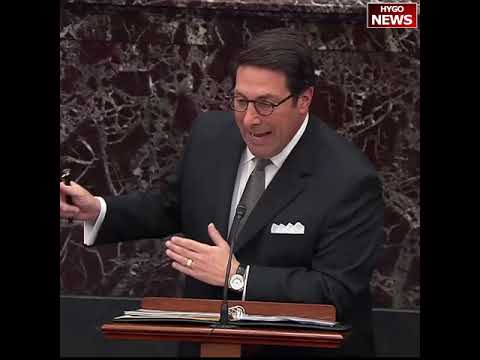
Jay Sekulow’s closing arguments in Senate Trump impeachment trial (Feb 3, 2020)
On February 3, 2020, Jay Sekulow delivered his closing arguments in President Trump’s first Senate impeachment trial, arguing that both articles of impeachment failed to allege impeachable offenses and that the entire process had been a partisan exercise that began the day Trump was inaugurated. Sekulow played video clips of Democrats calling for impeachment years before the Ukraine matter arose and urged the Senate to reject what he characterized as a dangerous expansion of impeachment power.
A Partisan Campaign from Day One
Sekulow opened his closing by establishing what he framed as the central fact of the proceedings: that Democrats had sought to remove Trump from office long before the events that formed the basis of the articles of impeachment.
“This entire campaign of impeachment that started from the very first day that the president was inaugurated was a partisan one, and it should never happen again,” Sekulow told the Senate. “For three years, this push for impeachment came straight from the president’s opponents, and when it finally reached a crescendo, it put this body, the United States Senate, into a horrible position.”
To support his argument, Sekulow displayed a Washington Post headline from January 20, 2017 — Inauguration Day — that read “The campaign to impeach President Trump has begun.” He noted the article was “posted 19 minutes after he was sworn in.”
He then played a compilation of video clips showing members of Congress and political figures calling for Trump’s impeachment well before the July 2019 Ukraine phone call. The clips included statements from multiple Democratic members of Congress, including one who used profanity in declaring intent to impeach the president and another who said “I’m concerned that if we don’t impeach this president, he will get reelected.”
Sekulow also highlighted a tweet from the whistleblower’s lawyer, Mark Zaid, dated January 30, 2017, which read: “The coup has started. First of many steps. Rebellion. Impeachment will follow ultimately.” Sekulow pointed to the screen and said, “And here we are.”
The First Article: Abuse of Power
Sekulow argued that the first article of impeachment represented an unconstitutional attempt by the House to usurp presidential authority over foreign policy. He cited the Supreme Court’s characterization of the president as “the sole organ of the federal government in the field of international relations and foreign policy.”
He pointed to testimony from the House inquiry itself to support his case. “Lieutenant Colonel Vindman, he admitted on page 155 of his transcript testimony that he did not know if there was a crime or anything of that nature,” Sekulow said, quoting Vindman’s acknowledgment that he had “deep policy concerns.”
“So there you have it. The real issue is policy disputes,” Sekulow told the senators. “Elections have consequences. And if you do not like the policies of a particular administration or a particular candidate, you are free and welcome to vote for another candidate. But the answer is elections, not impeachment.”
He declared that “however you were to define high crimes and misdemeanors, there is no definition that includes disagreeing with a policy decision as an acceptable ground to removal of a president of the United States. None. The first article of impeachment is therefore constitutionally invalid and should be immediately rejected by the Senate.”
The Second Article: Obstruction of Congress
On the obstruction charge, Sekulow argued that Trump had acted with “extraordinary transparency” by declassifying and releasing the transcript of the July 25 phone call with Ukrainian President Zelensky. He emphasized that the president released the transcript “despite the fact that privileges apply that could have been asserted.”
Sekulow pushed back forcefully against the House managers’ characterization of privilege assertions as evidence of a “cover up.” He quoted multiple Supreme Court precedents to argue that asserting constitutional privileges is a legal right, not evidence of guilt. “To punish a person because he has done what the law allows him to do is a due process violation of the basic sort,” he quoted the Court as ruling.
He further cited the Supreme Court’s recognition that constitutional privileges serve “to protect the innocent who otherwise might be ensnared by ambiguous circumstances” and act as “a safeguard against heedless, unfounded or tyrannical prosecution.”
Sekulow noted that the House had barred executive branch counsel from attending witness proceedings and had failed to pursue its subpoenas through the courts, instead choosing to convert the president’s assertion of legitimate legal protections into an article of impeachment.
Sekulow’s Final Appeal
Sekulow closed with a direct appeal to reject both articles, framing his argument in terms of institutional preservation rather than partisan allegiance.
“What this body, what this nation, and what this president has just endured, what the House managers have forced upon this great body is unprecedented and unacceptable,” he said. “This was the first totally partisan presidential impeachment in our nation’s history. And it should be our last.”
He argued that the House managers “have cheapened the awesome power of impeachment” and that “the country is not better for that.” He urged the Senate to “dispense with these partisan articles of impeachment for the sake of the nation, for the sake of the Constitution.”
Sekulow noted the timing of the trial’s conclusion, pointing out that on the very evening of his closing arguments, citizens in Iowa were caucusing in the first contest of the 2020 presidential election season. The implication was clear: voters, not senators in an impeachment trial, should determine the president’s political future.
Key Takeaways
- Sekulow argued that the push for impeachment began on Inauguration Day 2017, playing video clips of Democrats calling for Trump’s removal years before the Ukraine phone call and displaying a Washington Post headline posted 19 minutes after Trump was sworn in.
- He attacked both articles as constitutionally invalid, arguing that the abuse of power charge reduced policy disagreements to impeachable offenses while the obstruction charge punished the president for asserting legitimate legal privileges upheld by the Supreme Court.
- Sekulow called the proceedings “the first totally partisan presidential impeachment in our nation’s history” and urged the Senate to reject both articles on the same evening Iowa caucus-goers were casting the first votes of the 2020 election.