 HYGO News
 Why so darn difficult simple answer? political nominees fast-tracked while marshals not represented
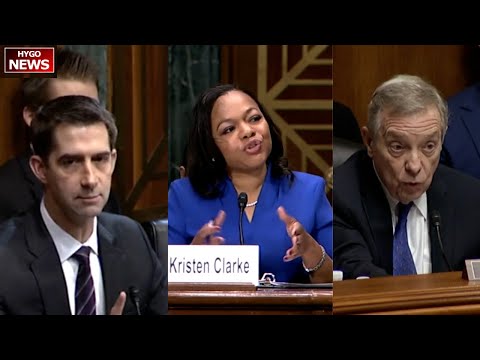
Senator Cotton Blocks All DOJ Nominees Until Marshals Who Defended Portland Courthouse Get Legal Representation
On 3/12/2022, Senator Tom Cotton of Arkansas revealed he was blocking every political nominee in the Department of Justice after the Biden administration refused to provide legal representation to four U.S. Marshals who defended the Portland federal courthouse from street militias in the summer of 2020. The DOJ had agreed to represent 70 of 74 federal employees involved but refused four marshals — and would not explain why. Senator Grassley asked: “Why is it so darn difficult to just get a simple answer to a very simple question?” The nominee could not answer and repeatedly said she needed to “take the question back.”
Four Marshals Left to Dry
Cotton laid out the facts. The DOJ had been asked to defend 74 federal employees who served in Portland. It agreed to represent 70, turned down one, and had three under review — including the four marshals Cotton was fighting for. All four had been returned to “unrestricted active duty in high-risk positions,” meaning the DOJ trusted them enough to serve but not enough to defend them.
“If Merrick Garland and Joe Biden think that they’re going to get their political nominees in this department fast-tracked through the Senate while they are hanging career law enforcement officers out to dry, they’ve got another thing coming,” Cotton said.
“It’s not a handful of U.S. attorneys and U.S. marshals — it’s every political nominee in the department,” Cotton continued. “Every political nominee in the department will not get fast-tracked through this committee or the floor until these marshals get represented or until they get an answer."
"Why Is It So Darn Difficult?”
Senator Chuck Grassley intervened on Cotton’s behalf, expressing frustration at the DOJ’s stonewalling. “Why is it so darn difficult to just get a simple answer to a very simple question of why you aren’t doing something?” Grassley asked the DOJ official testifying.
“Yes, Senator, I just want to make sure that you get an accurate answer. So I do want the opportunity to take that question back,” the official replied — the same non-answer she had given throughout the hearing.
“I believe this is handled by our civil division. I don’t know the answer, Senator,” she added.
”Someone Reviewed These Cases With Particularity”
Cotton noted the selective nature of the refusal. “The fact that 70 have been approved for representation and four have not means that someone in the department must have reviewed these cases with particularity,” Cotton said. “And there’s a reason why they’re not representing the four, and they will not give that reason.”
“They will not give it not only to me — they will not give it to those four marshals and their lawyers either,” Cotton added.
The “Defund” Question
Cotton also pressed a Biden DOJ nominee who had written an op-ed in 2020 with the phrase “defund the police.” “Have you changed your mind since you wrote the op-ed in 2020 that the police should be defunded?” Cotton asked.
“I’ve never supported defunding the police,” the nominee said. “The article talked about some of the challenges—”
“Okay, so it sounds to me like you changed your position, or at least your position from 2020 is not the department’s position,” Cotton said.
Qualified vs. Absolute Immunity
Cotton drew attention to a legal irony. “Police officers enjoy qualified immunity. What kind of immunity do prosecutors and judges enjoy?” Cotton asked.
“I don’t know the answer to that question,” the nominee said.
“I think the answer is absolute immunity,” Cotton responded. “So the lawyers who have constructed our system have given themselves absolute immunity, while police officers only get qualified immunity.”
He then posed a pointed question: “Do you think it would make police officers less likely to perform their job zealously if they knew that political bosses were going to hang them out to dry and subject them to financial bankruptcy and ruin if they were sued for actions in the course of duty?”
“I believe that under our Constitution, they are entitled to counsel and protection in the course of that lawsuit,” the nominee acknowledged.
Key Takeaways
- Cotton blocked every DOJ political nominee after the department refused to represent four U.S. Marshals who defended the Portland courthouse while agreeing to represent 70 other federal employees.
- The DOJ would not explain why the four were excluded — not to Cotton, not to the marshals, and not to their lawyers.
- Grassley asked: “Why is it so darn difficult to just get a simple answer?” The DOJ official repeatedly said she needed to “take the question back.”
- All four marshals had been returned to unrestricted active duty, meaning the DOJ trusted them to serve but not to defend.
- Cotton noted prosecutors and judges enjoy absolute immunity while pushing to reduce qualified immunity for police officers.
Transcript Highlights
The following is transcribed from the video audio (unverified — AI-generated from audio).
- If Merrick Garland thinks they’re going to get political nominees fast-tracked while hanging career law enforcement officers out to dry, they’ve got another thing coming.
- Every political nominee in the department will not get fast-tracked until these marshals get represented or get an answer.
- Why is it so darn difficult to just get a simple answer to a very simple question?
- 70 have been approved for representation and four have not. Someone reviewed these cases with particularity. They will not give that reason.
- Police officers enjoy qualified immunity. What kind of immunity do prosecutors and judges enjoy? I don’t know. The answer is absolute immunity.
- I’ve never supported defunding the police. The article talked about some of the challenges.
Full transcript: 1425 words transcribed via Whisper AI.