 HYGO News
 Gov Walz gets asked basic questions about Minnesota. WALZ: 'I'm not a prop... ; Swalwell beclowns
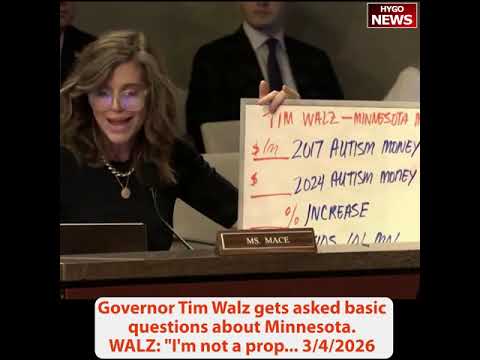
Gov Walz gets asked basic questions about Minnesota. WALZ: “I’m not a prop… ; Swalwell beclowns
Minnesota Gov. Tim Walz had a disastrous congressional hearing when a Representative grilled him on basic Minnesota facts. Walz couldn’t name Minnesota’s autism spending in 2024, couldn’t calculate the 34,200% increase from 2017 ($1M) to 2024 ($343M), couldn’t state the total number of children in Minnesota despite claiming Minnesota ranked top-three for children. When pressed, Walz refused to engage: “I’m not a prop.” Rep. Scott Perry called out Walz for licensing illegal aliens who can’t even read English — one recently drove on wrong side of road. Walz’s response: “Every day we give licenses and people speed.” Rep. Eric Swalwell told a sob story about a deported illegal immigrant named Miguel Lopez — Swalwell claimed nonviolent crime — DHS Secretary Noem informed that Lopez pleaded to nonviolent charge in 1995 (from more serious charge), and that Miguel could have self-deported with $2,600 per eligible family member via agreement with Mexico. Walz: “I’m not a prop for a member of Congress.” Noem to Swalwell: “If they’re not in legal status in this country, they can return home, we will pay for them to return home. I hope he got the $2,600.”
Autism Spending Questions
A congressional representative questioned Gov. Walz about Minnesota autism data. “I just say that you prepared for this hearing today.”
Walz had claimed to prepare. The questioner tested preparation.
“One million dollars, okay? A quick Google search or using your AI could tell you, one million dollars was spent.”
The facts: Minnesota spent $1 million on autism in 2017.
“How much money was spent on autism in Minnesota in 2024? I don’t have a number in front of me. As governor I don’t.”
Walz couldn’t recall or state 2024 Minnesota autism spending.
“Were you governor in 2024?”
“I was, but I’m not the head of the PTC.”
Walz’s excuse: he’s governor but not program director. Implicit: details below him.
”Unbelievable”
“Okay, so your excuse before that you didn’t know what 2017 autism numbers were because you were not governor and today you can’t answer the numbers about 2024 as governor and you still said you prepared for this hearing today, it’s unbelievable.”
The representative noted pattern:
- 2017 numbers: Walz excused as “not governor then”
- 2024 numbers: Walz excused as “not program director”
- Both periods have excuses for ignorance
- Walz still claimed preparation
“343 million dollars was spent in 2024. What percent increase is that from one million to 343 million? What percentage increase is that?”
The math:
- 2017: $1 million
- 2024: $343 million
- Increase: 343x
- Percentage: 34,200%
“I’m Not Your Prop”
“I’m not here to be your prop, go ahead and tell me.”
Walz refused to do the math. Defensive framework.
“Are you governor of Minnesota or not?”
The representative pressed.
“Yes I am, I’m not a prop for a member of Congress.”
Walz’s full response: “I’m not a prop."
"Sure As Hell Bet”
“Okay, well I’m governor of South Carolina, you can sure as hell bet that I’m gonna know the math.”
The questioner is apparently Rep. Ralph Norman or similar figure — someone who previously served as South Carolina governor. Their framework: I would know MY state’s data.
The contrast:
- Walz: Minnesota governor, doesn’t know
- Questioner: Former SC Governor, would know
“The math is 34,200% increase and increase of 343 times what it was in this time period.”
The questioner did the math Walz refused. 34,200% increase in autism spending.
Population Question
“Do you know the number of children in Minnesota?”
Basic state governance question.
“I know that Minnesota ranked as the top three state for children in the last period.”
Walz’s dodge — cites ranking but not actual number.
“What is the total population in Minnesota?”
“5.7 million.”
Walz knew total population.
“Okay, what is the total population of children in Minnesota? I don’t have the number in front of me right now.”
Walz couldn’t name child population despite claiming top-3 ranking.
“Are you governor of Minnesota?”
The rhetorical question captures the framework. Walz is responsible for state. Should know basic data.
Illegal Alien Licenses
The hearing then shifted to Rep. Scott Perry. “But he was licensed in your state under your law that you signed about a year and a half ago.”
Perry’s framework: Walz signed law enabling illegal alien drivers licenses.
“Every day we give licenses and people speed. So we ticket them and try and stop that.”
Walz’s deflection: everyone speeds, people get tickets. Missing the point.
“What I’m telling you is I don’t understand the connection between licenses. He’s here illegally, he can’t read and he got a license under your provisions and he’s driving all across the country and paroling everybody else.”
Perry’s clear framework:
- Illegal alien
- Cannot read English
- Got driver’s license from Minnesota
- Driving nationally
- Walz’s law enabled this
The specific case: illegal alien driving wrong way, couldn’t read signs (written in English), caused crash. All because Walz’s law gave him license.
Swalwell’s Miguel Story
The transcript shifted to Rep. Swalwell. “I went to San Miguel in Mexico. He doesn’t have a job, he’s not able to provide and he said his Spanish isn’t even that great because he hasn’t been there for 30 years and it’s hard for him to communicate.”
Swalwell’s sob story:
- Visited deported illegal in San Miguel, Mexico
- Lopez has no job
- Can’t provide for family
- Even Spanish is rusty after 30 years U.S.
Swalwell visited Mexico apparently specifically to create this story. The framework: Lopez deserves to return to U.S.
“Do you see the pain of families like Miguel Lopez, someone who did not commit a violent crime but has been separated from his family and is not providing, is not working?”
Swalwell’s framework:
- Nonviolent criminal
- Family separation
- Can’t work in Mexico
- Deserves to return
Noem’s Response
“Congressman, did he have a criminal record?”
Noem immediately focused on Lopez’s criminal record. Swalwell had said “nonviolent crime” — implying minor offense.
“Did Mr. Lopez have a criminal record? In 1995, he pled to a lesser nonviolent charge.”
Swalwell’s admission:
- Lopez HAS criminal record
- 1995 offense
- Pled down to lesser nonviolent charge
The “pled down” detail is crucial. Criminal defendants regularly plead to lesser charges to avoid prosecution of more serious offenses. “Pled to a lesser nonviolent charge” = originally charged with more serious offense (possibly violent), accepted plea deal.
Swalwell framed the plea as if the lesser charge was the original offense. But pleas reduce charges from originals. The actual underlying conduct was likely more serious.
”The Pain”
“But do you see the pain that somebody-”
Swalwell pushing emotional framework.
“I do see the pain and I wish people would do things correctly.”
Noem acknowledged pain but returned to framework: follow legal process.
“If they’re not in legal status in this country, they can return home, we will pay for them to return home.”
Noem’s framework:
- Illegal status has consequences
- Voluntary return option exists
- Administration pays for voluntary return
$2,600 Per Family Member
“I hope he got the $2,600.”
Noem referencing specific amount — $2,600 per eligible family member for voluntary self-deportation.
“He could have- Do you think that makes up for not being with the family?”
Swalwell’s follow-up: money doesn’t replace family.
“It helps because we have agreements with these countries where they are helping to facilitate housing.”
Noem’s framework:
- $2,600 helps with transition
- Agreements with home countries
- Housing assistance available
- Support system exists
The $2,600 per eligible family member program: departing aliens can receive $2,600 per eligible family member to assist with relocation costs. Includes airfare, temporary housing, transition support.
”Never Get the Chance”
“It was a nonviolent crime, Secretary. But then he gets the chance to come back the right way. Now that he’s waited until he’s been detained and deported, he will never get the chance to come back to the United States.”
Swalwell’s framework:
- Nonviolent crime
- Waited until detained
- Permanent bar to U.S. return now
The reality:
- Illegal aliens who accept voluntary departure may re-enter legally later
- Illegal aliens deported after criminal conduct are typically permanently barred
- Waiting creates worse outcome for the illegal alien
”Wish He Would Have”
“I wish he would have made the right decision and decided to go home to help his family and him to be together.”
Noem’s framework:
- Right decision: self-deport
- Stay with family in home country
- Avoid permanent bar
- Lopez made wrong choice
“They have choices that they can make to be together and we’re hopeful that they will continue to do that.”
Noem’s policy framework: give illegal aliens options. Voluntary return preserves future possibility. Forced deportation after criminal conduct permanent.
Significance
Three significant moments:
-
Walz’s ignorance: Minnesota governor couldn’t answer basic state questions. Undermines credibility as 2028 presidential candidate.
-
Scott Perry on licenses: Walz’s law enabled illegal alien licenses. Direct consequence: traffic accidents, public safety harm.
-
Swalwell’s Miguel story: Emotional framework collapsed when Noem identified criminal record and self-deportation option.
Walz’s performance was particularly damaging:
- Minnesota autism spending: couldn’t name numbers
- Minnesota child population: couldn’t name
- Minnesota autism increase 34,200%: couldn’t calculate
- Defense: “I’m not your prop”
For a potential 2028 presidential candidate, inability to answer state-level basic questions is serious. Voters expect governors to know their state.
Swalwell’s Miguel story exemplifies Democratic emotional framework:
- Highlight specific individual
- Suppress relevant details (criminal record)
- Frame as unjust
- Oppose enforcement
Noem’s response effectively:
- Exposed criminal record
- Identified choice Lopez had
- Pointed to $2,600 offer
- Framed as personal responsibility
The exchange showed how Democratic emotional arguments fail factual scrutiny.
Key Takeaways
- Questioner to Walz on autism spending: “A quick Google search or using your AI could tell you, one million dollars was spent … 343 million dollars was spent in 2024. What percent increase is that from one million to 343 million? … The math is 34,200% increase.”
- Walz’s defense: “I’m not here to be your prop, go ahead and tell me … Yes I am, I’m not a prop for a member of Congress.”
- Walz couldn’t name child population: “I know that Minnesota ranked as the top three state for children in the last period … I don’t have the number in front of me right now.”
- Perry on illegal alien licenses: “He’s here illegally, he can’t read and he got a license under your provisions and he’s driving all across the country and paroling everybody else.”
- Noem to Swalwell: “I do see the pain and I wish people would do things correctly. If they’re not in legal status in this country, they can return home, we will pay for them to return home. I hope he got the $2,600.”