 HYGO News
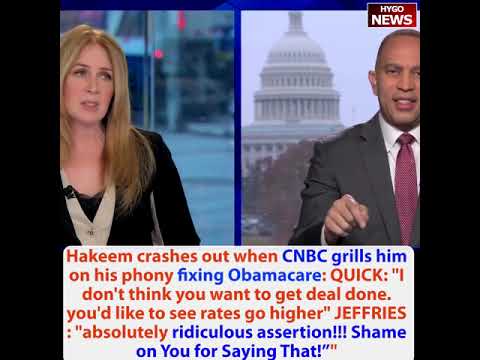
 Hakeem: Ridiculous Assertion, Shame on You for Saying That! Sen Booker: dissatisfied my own party
Hakeem: Ridiculous Assertion, Shame on You for Saying That! Sen Booker: dissatisfied my own party
Multiple Democrats caught in uncomfortable moments. CNBC’s Becky Quick pressed House Minority Leader Hakeem Jeffries on why Democrats didn’t just accept a simple ACA subsidy extension rather than insisting on complex conditions. Quick’s astute observation: “I don’t think you want to get a deal done. I think this is something where you’d like to see the rates go higher and allow the Republicans to hang themselves with that.” Jeffries erupted: “That’s absolutely a ridiculous assertion. And really shame on you for saying that.” The reaction confirmed Quick’s point — Jeffries was emotionally invested in making rates rise for Republican political damage. Sen. Mark Kelly continued pushing the “illegal orders” framework without citing specific Trump orders. Sen. Cory Booker admitted Democrats “helped pave the road” to current affordability crisis — rare Democratic acknowledgment of responsibility. Rep. Jasmine Crockett defended Stacey Plaskett’s Epstein texting, saying “people be textin” and calling accountability an attempt to “strip a black woman of her committee assignment.” Crockett’s framework racializes the ethics issue and normalizes coordinating with a convicted sex offender. Quick: “I don’t think you want to get a deal done. I think this is something where you’d like to see the rates go higher and allow the Republicans to hang themselves with that.” Jeffries: “That’s absolutely a ridiculous assertion. And really shame on you for saying that.” Booker: “I’m a guy that’s dissatisfied with my own party. I think we help pave the road to the point where we are right now.” Crockett on Plaskett: “The audacity to decide that you want to strip a black woman of her committee assignment because she was texting with Epstein.”
Jeffries Explodes
CNBC’s Becky Quick delivered a sharp observation during her Jeffries interview. She had suggested Democrats just propose a straightforward one-or-two year ACA subsidy extension rather than complex multi-layered conditions.
Jeffries tried to deflect. “Well, Lita Schumer offered a one year extension in the context of trying to end the Trump Republican shutdown.”
Quick cut him off. “That’s different. I’m talking about what you have now.”
Jeffries was referencing old framework; Quick wanted current policy.
“Let’s not go back to what’s done in the past and what has not been extended. If you want to get something that has actually done, you need to do something that we’ll have bipartisan.”
Quick’s point: if you want actual legislation, propose something Republicans can accept.
“You can ask me the question. You can ask me the question. I’ll provide the answer. I’ll provide the answer.”
Jeffries was being interrupted and was frustrated.
”Republicans Refused Yes”
“No, no, I’m providing an answer in order to provide context.”
Jeffries context framework: “Republicans have repeatedly refused to take yes for an answer.”
“It was a very reasonable multi-year extension that was offered. It was a one year straight extension, plus a multi-year process through a bipartisan commission to more permanently resolve the Affordable Care Act issue.”
The Democratic proposal was:
- 1 year straight extension
- Multi-year “bipartisan commission” (essentially delay)
- Rates don’t rise while commission works
- Subsidies maintained indefinitely through process
Republicans refused because the “commission” approach would lock in subsidies essentially permanently through procedural delays.
“So having that context is absolutely important, regardless of what you may think.”
Quick’s Devastating Observation
Then Quick delivered her question/accusation. “It’s important context to make me realize that I don’t think you want to get a deal done. I think this is something where you’d like to see the rates go higher and allow the Republicans to hang themselves with that.”
Quick’s framework:
- Jeffries doesn’t want deal
- Jeffries wants higher rates
- Higher rates damage Republicans politically
- Democrats benefit from rates rising
“Is that the answer?”
Quick directly asked Jeffries to confirm or deny.
”Shame on You”
“That’s absolutely a ridiculous assertion. And really same on you for saying- Three years is not going to get passed. So what do you do? Same on you for saying that.”
Jeffries’ outburst:
- “Ridiculous assertion”
- “Shame on you for saying that” (repeated twice)
- Pivots to procedural argument
The explosion itself is tell. Calm denial would suggest Quick was wrong. Emotional explosion suggests Quick hit truth.
“Yeah.”
Quick’s response: she maintained her position.
The exchange revealed Democratic strategy: let rates rise, blame Republicans, weaponize for 2026 midterms. Quick named the strategy; Jeffries exploded rather than genuinely denying.
Military Orders Discussion
The transcript shifted to Sen. Mark Kelly pushing the “illegal orders” framework. “They would be violating their own… That’s correct. If they followed illegal orders.”
Kelly maintained the military should refuse illegal orders.
“And I guess Senator… That is correct. Members of the military, what is your advice to them if they come across something that seems confusing?”
Military members asking for guidance on ambiguous orders.
JAG Counsel
“I think they need to talk to their leadership, talk to their commanding officer about it, and tell your commanding officer why you think this may be illegal.”
Kelly’s advice:
- Talk to leadership
- Tell commanding officer concerns
- Raise issue through chain
“There are lawyers within the military, the judge advocate general core. You can have a conversation with somebody who understands the law.”
JAG Corps (Judge Advocate General’s Corps) provides legal counsel to military. The proper channel for questioning orders’ legality.
“And you know, there’s always the option of you review the UCMJ with your leadership and you explain to somebody why you think this may not be lawful.”
UCMJ = Uniform Code of Military Justice. The legal framework governing military conduct.
The Problem
Kelly’s advice is technically correct — service members can review orders with JAG and raise concerns through chain.
But Kelly is not calling for that. Kelly’s political video called for service members to REFUSE orders. That’s different from raising legal questions through proper channels.
The framework:
- Raise concerns (proper) = chain of command, JAG consultation
- Refuse orders (improper without specific illegal order) = insubordination
Kelly’s video was political theater calling for refusal, not proper procedures.
Booker’s Admission
Sen. Cory Booker then delivered remarkable statement. “I’m a guy that’s dissatisfied with my own party. I think we help pave the road to the point where we are right now.”
Booker’s admission:
- Dissatisfied with Democratic Party
- Democrats paved the road to current affordability crisis
- Democratic responsibility acknowledged
This is rare for Booker — acknowledging Democratic Party responsibility for current economic conditions rather than blaming Republicans/Trump.
The underlying framework: Democratic Party trajectory toward socialism/progressivism has failed. Booker implicitly agrees.
Crockett on Plaskett
Rep. Jasmine Crockett then defended Rep. Stacey Plaskett. “Because I’m sorry, but like we don’t have ethical like rules that say that you can’t receive text messages or you can’t respond to text messages, especially if somebody has a certain record and you can’t do it in committee.”
Crockett’s framework:
- No ethical rules against text messages
- No rules against text responses
- No rules against committee texting
- Plaskett did nothing wrong
The framework ignores:
- General ethical principles
- Appearance of coordination
- Specific act of taking attack questions from convicted sex offender
- Using those questions in official proceedings
“We all be sitting on our phones and yes, people be texting. I mean, our staff texts us like everybody texts us like people.”
Crockett normalizes the behavior: “people be texting” — casual Black English framework. Everyone texts during meetings.
“I remember when I had the bleach blonde situation, you know, who was texting me my pastor.”
Crockett referenced her own texting controversy (“bleach blonde” may refer to the Marjorie Taylor Greene confrontation where Crockett characterized MTG). Her pastor was texting her.
The comparison fails. Pastor texting Crockett ≠ convicted sex offender texting Plaskett with attack questions. Category error.
”Strip a Black Woman”
“Okay. So like, let me be clear. There is no ethical violation. And so the idea or the audacity to decide that you want to strip a black woman of her committee assignment because she was texting with Epstein.”
Crockett’s key move: racializing the ethics question.
“Strip a black woman” — making it about race rather than conduct.
Problems with this framework:
- Any member: Any member of Congress coordinating with Epstein should face accountability regardless of race
- Minimizes misconduct: By framing as racial attack, Crockett treats Plaskett’s actual conduct as trivial
- Race shield: Suggests Black members are immune from ethics enforcement
- Demeans Plaskett: Makes Plaskett’s race more important than her agency
The framework is not consistent with serious ethics enforcement. If Democrats were genuinely concerned about ethics, they’d investigate regardless of race.
Significance
The day captures Democratic Party problems:
-
Jeffries explosion: Becky Quick’s astute observation (Democrats want rates to rise) triggered emotional rather than substantive rebuttal. Confirmed observation.
-
Kelly’s orders framework: Continues undermining chain of command without specific illegal orders. Political theater as dangerous precedent.
-
Booker’s admission: Rare Democratic acknowledgment of responsibility. Moderate Democrat breaking from party line.
-
Crockett’s racialization: Ethics question reframed as racial attack. Standard progressive defensive tactic.
Each illustrates different Democratic dysfunction:
- Jeffries: emotional incoherence when strategy exposed
- Kelly: dangerous institutional undermining
- Booker: recognition of failure (buried in framework)
- Crockett: racial deflection from ethical accountability
Quick’s exchange with Jeffries is particularly important. Mainstream financial press rarely challenges Democratic leaders this directly. Quick called out the actual strategy — Democrats benefit politically from higher rates. Jeffries couldn’t deny it substantively.
The 2026 midterm framework becomes clearer:
- Democrats want ACA rates to rise
- Blame Republicans for failure to extend subsidies
- Weaponize political damage against Republicans
- Hope voters don’t notice Democrats blocked reasonable solutions
Quick exposed the strategy. Jeffries’ explosion confirmed it. Voters may or may not see through the framework, but it’s now documented on record.
Key Takeaways
- Quick’s astute observation: “I don’t think you want to get a deal done. I think this is something where you’d like to see the rates go higher and allow the Republicans to hang themselves with that.”
- Jeffries’ explosion: “That’s absolutely a ridiculous assertion. And really shame on you for saying that … Shame on you for saying that.”
- Kelly on military orders: “Members of the military … I think they need to talk to their leadership, talk to their commanding officer about it … There are lawyers within the military, the judge advocate general core.”
- Booker’s admission: “I’m a guy that’s dissatisfied with my own party. I think we help pave the road to the point where we are right now.”
- Crockett on Plaskett: “We don’t have ethical like rules that say that you can’t receive text messages or you can’t respond to text messages … the audacity to decide that you want to strip a black woman of her committee assignment because she was texting with Epstein.”