 HYGO News
 What 4th amendment is? Come on, don't dodge my question, is really basic constitutional law
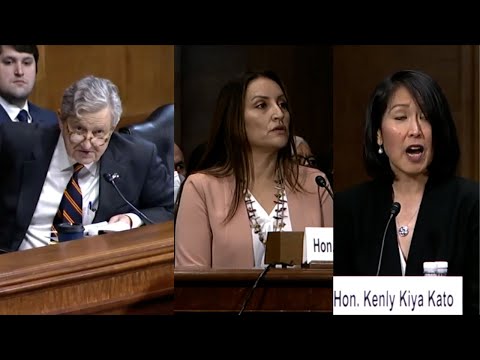
Senator Kennedy Exposes Biden Judicial Nominees Who Cannot Answer Basic Constitutional Law Questions
On 2/6/2022, Senator John Kennedy of Louisiana exposed multiple Biden judicial nominees who could not answer basic questions about constitutional law, federal procedure, and legal standards during their Senate Judiciary Committee confirmation hearings. One nominee could not explain the exceptions to the Fourth Amendment warrant requirement. Another did not know what the Daubert standard was. A third could not define a putative class action. Kennedy told one nominee “come on, don’t dodge my question — this is really basic constitutional law."
"What Is the Fourth Amendment?”
Kennedy asked nominee Judge Cotto to explain the Fourth Amendment and the exceptions to the warrant requirement. “The Fourth Amendment prohibits search or seizure without warrant,” Cotto said correctly. But when asked to list the exceptions, she struggled.
“The exceptions are quite numerous. So I certainly wouldn’t be able to — border search, exigent circumstances. You know, off the top of my head, I can’t give you the full list, but there are quite a few,” Cotto said.
Kennedy then posed a hypothetical: what if California decided not to follow the Supreme Court’s exceptions to the warrant requirement? “Can California decide it’s not going to follow the exceptions to the warrant requirement?” he asked.
Cotto tried to dodge. “Senator, it would be contrary to the Code of Conduct, specifically Canon 3, for me to give an opinion on a hypothetical like that,” she said.
“Come on, judge. Don’t dodge my question. This is really basic constitutional law,” Kennedy responded. “Can California decide it’s not going to follow the exceptions to the warrant requirement?”
Cotto attempted a procedural answer, citing the Pullman abstention doctrine. Kennedy pressed: “Suppose the state did it. This is what I’m getting to. Suppose that California said we appreciate it, Supreme Court—”
“I’m way over. I’m sorry,” Kennedy said, running out of time. “You need to look that up. It’s pretty basic."
"Tell Me What the Daubert Standard Is”
Kennedy asked nominee Judge Sykes to explain the Daubert standard — a fundamental legal test governing the admissibility of expert testimony in federal courts that virtually every federal judge must apply.
“Senator Kennedy, in my eight years of practice as a Superior Court judge and presiding in the state of California, I have not had occasion to hear the Daubert—” Sykes began.
“So you can assure you though that I have had occasion where in a civil matter I may not have known something and I do the research necessary,” Sykes continued, essentially admitting she was unfamiliar with one of the most basic evidentiary standards in federal practice.
The Daubert standard, established by the Supreme Court in Daubert v. Merrell Dow Pharmaceuticals (1993), governs how judges evaluate the reliability of expert witness testimony. It is foundational knowledge for any federal judge.
”What’s a Putative Class Action?”
Kennedy then turned to nominee Roe-Shown and asked her to define a putative class action — another basic legal concept.
“In my 25 years of experience, I have been fortunate enough to work on some class action cases including one regarding commodities manipulation. And in that case, I don’t believe there was a putative class action,” the nominee said.
“Yeah, but just tell me — what is one?” Kennedy pressed.
“I would have to research it a little bit more, but I think I would look at the case law regarding putative class actions, which I believe may differ by circuit,” the nominee responded.
Kennedy then asked if the nominee knew the distinction between a putative class action and a certified class action. The nominee correctly defined a certified class action but needed Kennedy’s prompting to arrive at the answer that a putative class action is simply a proposed class action prior to certification.
“You’re reminding me that a putative class action is prior to that certification process. It’s a proposed class action,” the nominee finally said.
“Precisely. Thank you, Senator,” she added.
”You Need to Look That Up”
Kennedy’s questioning highlighted a recurring concern with Biden’s judicial nominees: individuals being put forward for lifetime federal appointments who could not demonstrate command of foundational legal concepts. The Fourth Amendment exceptions, the Daubert standard, and the definition of a putative class action are all material that first-year law students learn and any practicing federal lawyer would be expected to know.
Kennedy’s approach was not adversarial in a partisan sense — he was simply testing whether nominees had the basic legal knowledge required for the positions to which they were being appointed.
Key Takeaways
- Nominee Judge Cotto could not fully explain the exceptions to the Fourth Amendment warrant requirement and tried to dodge a basic hypothetical about state compliance with Supreme Court precedent.
- Kennedy told her: “Come on, don’t dodge my question. This is really basic constitutional law. You need to look that up.”
- Nominee Judge Sykes admitted she had never encountered the Daubert standard — a fundamental evidentiary test in federal courts — in eight years as a California judge.
- A third nominee could not define a putative class action and said she “would have to research it a little bit more.”
- The exchanges raised questions about whether Biden’s nominees were being selected for their qualifications or other criteria.
Transcript Highlights
The following is transcribed from the video audio (unverified — AI-generated from audio).
- Can you tell me what the Fourth Amendment is and the exceptions? The exceptions are quite numerous. Off the top of my head, I can’t give you the full list.
- Come on, judge. Don’t dodge my question. This is really basic constitutional law. You need to look that up. It’s pretty basic.
- Tell me what the Daubert standard is. In my eight years as a Superior Court judge, I have not had occasion to hear the Daubert.
- Tell me what a putative class action is. I would have to research it a little bit more.
- You’re reminding me that a putative class action is prior to that certification process. It’s a proposed class action. Precisely.
Full transcript: 954 words transcribed via Whisper AI.