 HYGO News
 Vance in Greenland: 'Self-Determination' for Greenlanders; China Using 'Debt Traps'; Visits Space Force at Pituffik Base
Vance in Greenland: “Self-Determination” for Greenlanders; China Using “Debt Traps”; Visits Space Force at Pituffik Base
VP JD Vance became the first vice president to visit Greenland in March 2025, delivering a press statement that framed the Arctic island’s future as a contest between American partnership and Chinese exploitation. “The people of Greenland are going to have self-determination,” Vance said. “We hope they choose to partner with the United States because we’re the only nation on Earth that will respect their sovereignty.” He warned that China had “taken steps to put Greenland in ridiculous debt traps” and was “sending a lot of military resources here.” Vance then visited Space Force guardians at Pituffik Space Base, greeting them with: “It’s cold as sh*t here. Nobody told me."
"Self-Determination” and American Partnership
Vance opened his Greenland remarks with the administration’s clearest statement on the island’s future.
“Our message is very simple,” Vance said. “Yes, the people of Greenland are going to have self-determination. We hope that they choose to partner with the United States because we’re the only nation on Earth that will respect their sovereignty and respect their security, because their security is very much our security — as these brave Americans show.”
The “self-determination” framing was a significant evolution from Trump’s first-term comments about purchasing Greenland, which had been widely characterized as neo-colonial. Vance was explicitly affirming that Greenland’s people would make their own choices about their future while arguing that the United States was the best partner available.
The linkage of Greenland’s security to American security was the strategic core of the argument. Greenland sat between North America and Europe, controlled access to Arctic shipping routes, and hosted one of the United States’ most important missile warning installations. If Greenland’s security was compromised — by Chinese military activity, Russian encroachment, or any other threat — American national security was directly affected.
The China Threat: “Debt Traps” and “Military Resources”
Vance delivered the most detailed public assessment of Chinese activities in Greenland that any senior U.S. official had provided.
“There has been an expansion of the security footprint and the security interest of Russia and China,” he said. “They’re doing what they believe is in their interest. The United States must do what I know is in our interest, which is to make sure that Greenland is safe.”
He stated the stakes: “If Greenland doesn’t have self-determination, if the people of Greenland have their future controlled by the Chinese Communist Party, it’s not going to make their lives better off, and most importantly, it’s going to make American and world national security — world security — much, much weaker.”
Vance described the specific Chinese tactics: “They’ve taken steps to put Greenland in ridiculous debt traps, to invest and exploit the resources here, and we know that they’re sending a lot of military resources here.”
The “debt trap” reference connected Greenland to China’s global strategy of infrastructure lending. Across Africa, Asia, and the Pacific, China had offered developing nations infrastructure loans on terms that were designed to create dependency. When nations could not repay, China extracted strategic concessions — port access, resource rights, military basing agreements. Vance was warning that the same playbook was being applied to Greenland, targeting its mineral wealth and strategic position.
”Wake Up from a Failed 40-Year Consensus”
Vance placed the Greenland question in the context of a broader strategic failure.
“We need to wake up,” he said. “We need to wake up from a failed 40-year consensus that said that we could ignore the encroachment of powerful countries as they expand their ambitions.”
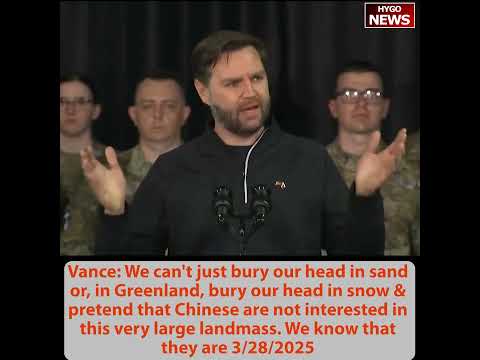
He delivered the tailored version of the warning: “We can’t just bury our head in the sand — or, in Greenland, bury our head in the snow — and pretend that the Chinese are not interested in this very large landmass. We know that they are.”
The “40-year consensus” was a reference to the post-Cold War assumption that economic integration would moderate China’s ambitions and that America’s military dominance was so assured that strategic competition in places like the Arctic could be safely ignored. Vance was arguing that this assumption had been wrong — that China had used four decades of Western complacency to expand its influence into areas that were now critical to American security.
He committed to the response: “Yes, over the medium term, the United States will meet that challenge. We will put our own resources here. We already have a lot of great resources here, but we know we’re going to have to do more to counter some of the nations that we know that we’re competitive with.”
Pituffik Space Base: “First VP to Visit”
Vance then visited the Space Force guardians at Pituffik Space Base, located in northwest Greenland above the Arctic Circle.
His arrival was characteristically informal: “Hey guys, how are we doing? Please, at ease. At ease. Good Lord. Sit down and eat. Sit down and eat. Don’t let the vice president stop you guys from eating your food here.”
Then the weather assessment: “It’s cold as sh*t here. Nobody told me.”
Vance acknowledged the historic nature of his visit: “I’ve never been to Greenland. Apparently, I’m the first vice president to ever visit Greenland, so that’s a pretty cool thing.”
He described the visit’s purpose: “We’re looking forward to hanging out and getting to know you guys and understanding what you do. We’re going to talk to the command and some of the guardians about what exactly the base does and all the important ways it contributes to national security.”
Vance acknowledged the sacrifice the posting required: “The colonel told me that this is a one-year unaccompanied duty station. When we were flying in, we were wondering whether you guys were allowed to bring your families here. So I know it’s a lot of sacrifice to spend a year away from your families, but the mission is really important.”
He connected their service to the broader strategy: “The Trump administration, the president is really interested in Arctic security. As you all know, it’s a big issue, and it’s only going to get bigger over the coming decade. So thanks for doing what you do.”
Pituffik Space Base was one of the United States’ most strategically important installations. Its radar systems provided early warning of ballistic missile launches, tracked objects in space, and contributed to the space surveillance network. The base’s location above the Arctic Circle gave it unique advantages for monitoring trajectories that crossed the North Pole — the shortest path for intercontinental missiles from Russia or China to the American homeland.
Key Takeaways
- Vance became the first VP to visit Greenland, affirming “self-determination” for Greenlanders while urging partnership with the U.S. as “the only nation that will respect their sovereignty.”
- He warned China had used “debt traps” and was “sending military resources” to Greenland, exploiting its resources and strategic position.
- Vance called for waking up from “a failed 40-year consensus” that ignored great-power competition: “We can’t bury our head in the snow and pretend the Chinese aren’t interested.”
- At Pituffik Space Base, he thanked guardians for one-year unaccompanied deployments: “The mission is really important. Arctic security is only going to get bigger.”
- He committed U.S. resources: “Over the medium term, the United States will meet that challenge. We will put our own resources here.”