 HYGO News
 Bessent: 'Chinese Will Be in Switzerland Also -- We'll Meet Saturday'; Trump: 'Crunch Time for Iran'; Miller: 'Grand Master in Chess'
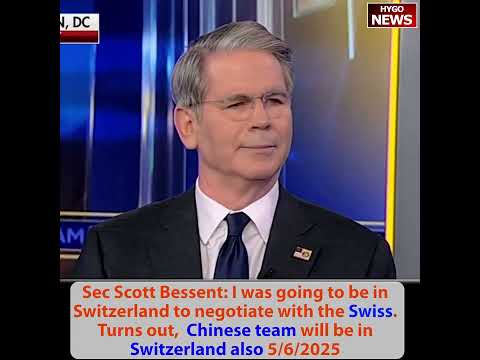
Bessent: “Chinese Will Be in Switzerland Also — We’ll Meet Saturday”; Trump: “Crunch Time for Iran”; Miller: “Grand Master in Chess”
Four major developments converged in May 2025. Treasury Secretary Bessent revealed an impending U.S.-China meeting: “I was going to be in Switzerland to negotiate with the Swiss. Turns out the Chinese team will be there also. We’ll meet Saturday and Sunday. 145% is the equivalent of an embargo — we don’t want to decouple, we want fair trade.” Trump escalated on Iran: “This is really crunch time. The most important time in the history of Iran. They can’t have a nuclear weapon. If they choose a different route, it’s going to be very sad.” Stephen Miller praised the Carney meeting: “Like watching a grand master in chess. Trump has opened a completely new relationship with Canada.” Education Secretary McMahon dropped the bombshell: “We’ve spent over $3 trillion since 1980. Student performance has continued to decline.”
China in Switzerland
Bessent described what appeared to be a coincidental — or orchestrated — diplomatic opportunity.
“The world has been coming to the U.S., and China has been the missing piece,” Bessent said.
He explained: “I was going to be in Switzerland to negotiate with the Swiss. Turns out the Chinese team is traveling through Europe and they will be in Switzerland also.”
He confirmed: “So we will meet on Saturday and Sunday.”
He stated the shared interest: “Look, we have shared interests. This isn’t sustainable, as I’ve said before, especially on the Chinese side. 145%, 125% — that’s the equivalent of an embargo.”
He stated the goal: “We don’t want to decouple. What we want is fair trade.”
When asked who made the first call, Bessent deflected diplomatically: “There are lots of calls. There isn’t a first call. There are a lot of contact points over time.”
The Switzerland meeting was a breakthrough in the U.S.-China tariff standoff. China had publicly maintained that it was not negotiating under pressure. Bessent’s framing — that the Chinese team happened to be in Switzerland at the same time — provided the diplomatic cover both sides needed. China could claim the meeting was incidental rather than a response to American pressure. The U.S. could claim it was willing to talk anywhere, anytime.
The “equivalent of an embargo” assessment was the most frank acknowledgment from any administration official about what the 145% tariff rate actually meant. At that level, virtually no Chinese goods could be competitively sold in the American market. The tariff was not a negotiating tool — it was a trade wall. The Switzerland meeting was about finding terms under which that wall could be lowered.
”Crunch Time for Iran”
Trump delivered his most urgent assessment of the Iranian nuclear situation.
“This is really crunch time, I will tell you, for Iran,” Trump said. “This is the most important time in the history of Iran.”
He repeated the offer: “We want it to be a great country. Let it be a tremendously successful, rich country. They have everything you need. The people are incredible. Vast amounts of oil and assets.”
He stated the red line: “We want it to be a successful country. We don’t want to do anything that’s going to get in the way of that. But they can’t have a nuclear weapon.”
He delivered the warning: “If they choose to go a different route, it’s going to be a very sad thing. And it’s something we don’t want to have to do, but we have no choice.”
He was emphatic: “They’re not going to have a nuclear weapon. They’re not going to have a nuclear weapon. Do you understand that?”
The double repetition — “they’re not going to have a nuclear weapon” — followed by the direct “do you understand that?” was Trump’s most forceful public statement on Iran. The message was directed simultaneously at the Iranian regime, the American public, and the global community: the United States would not accept a nuclear-armed Iran, and the consequences of pursuit would be severe.
Miller: “Grand Master in Chess”
Stephen Miller provided the administration’s assessment of the Carney meeting.
“What I witnessed was like watching a grand master in chess perform,” Miller said.
He described the outcomes: “President Trump has opened up a completely new relationship with Canada because of his strength and because of his diplomacy.”
He listed Carney’s concessions: “The Prime Minister talked about finally contributing their fair share to NATO’s defense — finally meeting that minimum 2% benchmark and climbing from there.”
He continued: “He talked about achieving fair trade with the United States. He acknowledged the need to strike a fair trade deal.”
He cited border cooperation: “He emphasized his deployment of troops and guards to the Canadian border at President Trump’s request.”
He summarized: “It’s just one concrete win after another because of President Trump’s leadership. President Trump kept emphasizing two words: friendship with Canada, but also fairness from Canada.”
The chess metaphor captured the multi-layered nature of the Carney interaction. Trump had simultaneously praised Canada, maintained the 51st state proposition, demanded fair trade, and extracted NATO spending commitments — all while keeping the relationship warm enough for continued negotiation. Each move created leverage for the next.
McMahon: “$3 Trillion, Declining Results”
Education Secretary Linda McMahon delivered the most concise indictment of federal education spending.
“The Department of Education was set up in 1980,” McMahon said. “We have now spent, as a country, over $3 trillion to watch the performance of our students continue to decline.”
She stated her position: “We’re just simply not doing something right. I don’t think education handled from a bureaucratic position in Washington, D.C. is best for the states.”
She addressed funding concerns: “Title I funding will continue. IDEA funding for disabled and special needs students will continue. It might go through a different agency or directly to the states.”
She stated the vision: “Education is going to have more funding going directly to the students, which is where it should be.”
The “$3 trillion for declining results” was the education establishment’s version of DOGE’s waste findings. The federal government had spent three trillion dollars since 1980 on a department whose results — measured by student achievement, international rankings, and literacy rates — had consistently worsened.
Key Takeaways
- Bessent: “Chinese team will be in Switzerland also. We’ll meet Saturday-Sunday. 145% is an embargo — we want fair trade, not decoupling.”
- Trump on Iran: “Crunch time. Most important moment in their history. They can’t have a nuclear weapon. If they choose differently, it’ll be very sad.”
- Miller on Carney meeting: “Like a grand master in chess. Carney committed to NATO 2%, fair trade, and border troops.”
- McMahon: “Since 1980, $3 trillion spent on education. Student performance has continued to decline.”
- Bessent on who called first: “There isn’t a first call. There are lots of contact points over time.”