 HYGO News
 Trump Announces 'Breakthrough Trade Deal with the UK'; British Ambassador: 'You've Been True to Your Word -- We Were First'
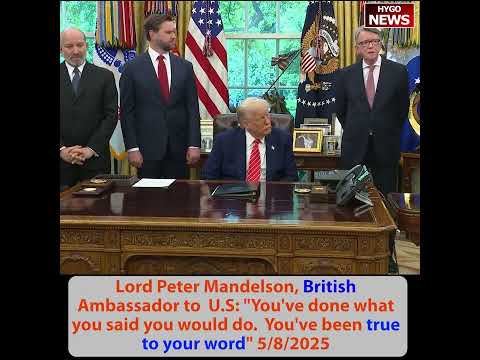
Trump Announces “Breakthrough Trade Deal with the UK”; British Ambassador: “You’ve Been True to Your Word — We Were First”
President Trump announced the first major trade deal of the tariff era in May 2025: “This morning, I’m thrilled to announce that we’ve reached a breakthrough trade deal with the United Kingdom. Today is Victory Day for World War II — we won the war together exactly 80 years ago, so there could be no more perfect morning for this historic agreement.” British Ambassador Lord Peter Mandelson praised Trump: “You’ve done what you said you would do. You said you would do a good trade deal with the UK, at pace, and that we would be first. You’ve delivered. You’ve been true to your word.” He added: “This provides a springboard for a technology partnership to create future industries and future jobs."
"Breakthrough Deal”
Trump made the formal announcement from the Oval Office.
“This morning, I’m thrilled to announce that we’ve reached a breakthrough trade deal with the United Kingdom — an incredible country,” Trump said.
He connected to the date: “Today is a Victory Day for World War II. We won the war together exactly 80 years ago, so there could be no more perfect morning to reach this historic agreement.”
He praised the partner: “It’s really, in particular, the agreement with one of our closest and most cherished allies. We’re so happy that that’s the way it worked out.”
He credited the British team: “I want to thank Prime Minister Starmer and his very talented team for their outstanding work and partnership.”
He placed it in context: “Today’s agreement with the UK is the first in a series of agreements on trade that my administration has been negotiating over the past four weeks.”
He stated the principle: “With this deal, the UK joins the United States in affirming that reciprocity and fairness is an essential and vital principle of international trade.”
The UK deal was the administration’s “proof of concept” — the first completed agreement in the tariff restructuring. Its timing on Victory Day was symbolically perfect: the countries that had fought together 80 years ago were now building a new economic partnership for the 21st century.
The “first in a series” language confirmed what Bessent had previewed: the UK deal was the opening act of a rapid succession of trade agreements. By demonstrating that the process worked — that countries could negotiate successfully with the Trump administration and reach agreements that served both sides’ interests — the UK deal removed the argument that tariffs would lead to permanent trade isolation.
Mandelson: “True to Your Word”
Lord Mandelson — a seasoned Labour Party figure and former European Commissioner — delivered praise that carried unique weight from a politician of the British left.
“Mr. President, thank you very much indeed for hosting us this morning,” Mandelson began. “And thank you also for that very typical 11th-hour intervention — your phone call to the Prime Minister, demanding even more out of the steel provision than any of us expected.”
He noted the PM’s reaction: “The Prime Minister was delighted, obviously, to take that call late tonight. But you took it to another level.”
He stated the first principle: “If we’re going to rebalance and rebuild international trade in a way that serves all our interests, then we’re better doing that together than separately and apart. And that’s what we’re on a mission to do.”
He delivered the tribute: “You’ve done what you said you would do. You said to the Prime Minister when he came and visited in the Oval — you would do a good trade deal with the United Kingdom, that you would do it at pace, and that we would be first.”
He confirmed: “And you have delivered that. You’ve been true to your word.”
He described the future: “For us, it’s not the end. It’s the end just of the beginning. There is yet more we can do in reducing tariffs and trade barriers to open our markets to each other even more.”
He outlined the bigger vision: “This provides us with the platform, the springboard, to create a technology partnership between the United States and the United Kingdom, so that we can harness science and technology to create future industries and future jobs.”
He connected to security: “In the way we work so closely already in national security and defense, we can take that to further areas of science, enterprise, and endeavor.”
He concluded: “This just shows what two countries who trust each other, who are confident in each other and familiar with each other, can do — not just for ourselves, but for those in the rest of the world who need to benefit from a bigger and better international trading system.”
Mandelson’s praise was politically remarkable. As a Labour Party grandee serving a Labour government, he was praising a Republican president’s trade policy from the podium of the Oval Office. The fact that a left-leaning British government had been the first to reach a trade deal with Trump demolished the narrative that the administration’s trade approach was incompatible with democratic governance.
The “11th-hour phone call” detail — Trump calling Starmer late at night to squeeze additional concessions on steel — captured the negotiating style that had produced the deal. Even at the final stage, Trump was pushing for more. The British ambassador’s amused acknowledgment — “you took it to another level” — suggested a negotiating partner who recognized the tactic and respected it.
The Technology Partnership
Mandelson’s description of a U.S.-UK technology partnership as the deal’s “springboard” revealed ambitions beyond tariff reduction. The vision was for a bilateral framework that would facilitate cooperation on artificial intelligence, biotechnology, quantum computing, and other emerging technologies.
The UK, with its world-class universities, deep technology sector, and English-language ecosystem, was the natural partner for American technology companies. A formalized technology partnership would create pathways for joint research, shared intellectual property frameworks, and coordinated regulatory approaches — advantages that would benefit both economies.
The connection to the existing defense and intelligence partnership — the Five Eyes alliance, NATO cooperation, and bilateral defense agreements — meant that the technology partnership would be built on a foundation of trust that no other country could replicate.
Key Takeaways
- Trump announced the first post-Liberation Day trade deal with the UK: “A breakthrough with one of our closest and most cherished allies.”
- British Ambassador Mandelson: “You’ve been true to your word. You said we’d be first, at pace, with a good deal. You delivered.”
- The deal coincided with WWII Victory Day: “We won the war together 80 years ago. No more perfect morning.”
- Mandelson: “This is the springboard for a U.S.-UK technology partnership to create future industries and future jobs.”
- Trump’s late-night call to Starmer pushed for additional steel concessions: “You took it to another level.”