 HYGO News
 UNHINGED Schumer: 'We Are All Going to Die' If OBBB Passes -- The Largest Tax Cut in History; Speaker Johnson on Elon Musk: 'We Had a Great 30-Minute Monday Talk -- Happy Texts, He Said He'd Help Keep Majority. Then 24 Hours Later, He Does a 180. It Surprised Me'; Jeffries Vows to 'Reveal Identities of ICE Agents'
UNHINGED Schumer: “We Are All Going to Die” If OBBB Passes — The Largest Tax Cut in History; Speaker Johnson on Elon Musk: “We Had a Great 30-Minute Monday Talk — Happy Texts, He Said He’d Help Keep Majority. Then 24 Hours Later, He Does a 180. It Surprised Me”; Jeffries Vows to “Reveal Identities of ICE Agents”
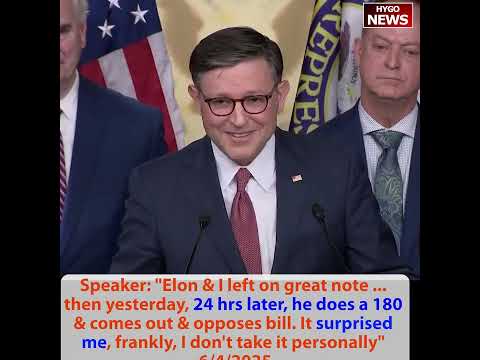
Multiple dramatic moments captured early June 2025. Senator Chuck Schumer delivered an extraordinary attack on OBBB: “Here’s the, we are all going to die at. This morally bankrupt bill boils down to a simple equation… health care cuts for Americans, walking on an economic tightrope… paid for by extra tax breaks for the ultra-wealthy.” Speaker Mike Johnson offered a different perspective on Elon Musk’s sudden opposition. Johnson described their earlier positive exchange: “Elon and I had a great conversation, a half hour long talk on Monday this week. We talked about the big beautiful bill. He said ‘I’m going to help. We’ve got to make sure the Republicans keep the House majority.’” Then: “Elon and I left on a great note. We were texting one another, happy texts, Monday. And then yesterday, 24 hours later, he does a 180 and comes out and opposes the bill. It surprised me, frankly, and I don’t take it personal… I think he’s flat wrong.” Johnson’s assessment: “No government in the history of mankind has ever cut $1.6 trillion in a piece of legislation. We’re doing that here.” Rep. Hakeem Jeffries made a disturbing threat against ICE agents: “Every single ICE agent who’s engaged in this aggressive overreach and are trying to hide their identities from the American people will be unsuccessful. This is America. This is not the Soviet Union… every single one of them, no matter what it takes, will of course be identified.”
The Schumer Catastrophe Claim
Senator Chuck Schumer delivered remarkable rhetoric.
“And we all know one thing, Donald Trump is just lying about the bill. Lying about the bill,” Schumer said.
Then came the apocalyptic claim: “Well, here’s the, we are all going to die at.”
He delivered the broader framing: “This morally bankrupt bill boils down to a simple equation, as a leader touched on health care cuts for Americans, walking on an economic tightrope is what this bill is all about, and it’s going to be paid for by extra tax breaks for the ultra-wealthy.”
The “We Are All Going to Die” Framing
The claim that OBBB would cause mass deaths was extreme even by Democratic rhetorical standards:
What OBBB actually does:
- Provides tax cuts to working and middle-class Americans
- Removes illegal immigrants from Medicaid
- Requires work from able-bodied adults
- Reduces federal spending by $1.5+ trillion
- Protects legitimate Medicaid beneficiaries
- Enhances Medicare stability
What would actually cause deaths:
- Removing healthcare from qualifying beneficiaries
- Denying medical care to pregnant women and children
- Eliminating treatment for seriously ill patients
- Collapsing hospital systems
- None of these occurred under OBBB
Why Schumer’s claim failed:
- The bill specifically protected vulnerable beneficiaries
- Reforms targeted illegal immigrants and able-bodied non-workers
- Legitimate care remained available
- No provision threatened specific vulnerable populations
- “We are all going to die” was pure hyperbole
The rhetorical pattern:
- Democrats had used “people will die” framing for years
- Applied to virtually every Republican policy proposal
- Never supported by actual data after implementation
- Had become predictable political theater
- Lost effectiveness through repetition
The Wyden Attack
Senator Ron Wyden joined the attack.
“This morally bankrupt bill boils down to a simple equation, as a leader touched on health care cuts for Americans, walking on an economic tightrope is what this bill is all about, and it’s going to be paid for by extra tax breaks for the ultra-wealthy,” Wyden said.
The Wyden Problem
Wyden’s framing mirrored Schumer’s with similar problems:
“Healthcare cuts for Americans”:
- No cuts to Medicaid for American citizens who qualified
- No cuts to Medicare for American seniors
- Work requirements for able-bodied adults
- Removing illegal immigrants
- Preserving benefits for legitimate beneficiaries
“Economic tightrope”:
- $1.6 trillion in spending cuts identified
- Strong economic growth projected
- Expanding tax base
- Reduced deficit trajectory
- Sustainable fiscal path
“Tax breaks for the ultra-wealthy”:
- No new top-rate tax reductions
- Main tax cuts for working and middle class
- No yacht or luxury tax preferences
- Reforms eliminating wealthy tax avoidance
- Distributional benefits overwhelmingly for non-wealthy
Wyden’s framing relied on emotional words that didn’t correspond to actual bill provisions. The disconnect between Democratic rhetoric and bill reality was substantial.
Johnson’s Perspective on Elon Musk
Speaker Mike Johnson provided context on Elon Musk’s shifting position.
“I consider Elon a friend, he’s obviously brilliant. I just gave, told you we credit him with all the big changes with DOGE and everything else,” Johnson said.
He expressed puzzlement: “It’s curious to me what happened this week.”
He described the Monday conversation: “Full disclosure, Elon and I had a great conversation about a half hour long talk on Monday this week, Monday morning, we talked about the big beautiful bill.”
The “Can It Be Big and Beautiful?”
Johnson recalled a specific exchange.
“I think he was trying to make a joke a couple of days earlier, it can’t be big and beautiful,” Johnson said.
He described his response: “And I started the conversation, oh yes it can, my friend, it’s very beautiful.”
This was evidently Johnson’s reference to Musk’s specific joke about the bill’s name. The framing was:
- Musk had joked that the bill couldn’t be both big and beautiful (implying compromise)
- Johnson responded that it was actually both
- They had a substantive 30-minute discussion
- Johnson explained the substance to Musk
- Musk was reportedly satisfied
The Substantive Content
Johnson described what they discussed.
“We talked about all the record level of savings,” Johnson said.
He made the historic framing: “My friends, no government in the history of mankind has ever cut $1.6 trillion in a piece of legislation. We’re doing that here.”
He continued: “I mean, the extraordinary level of savings and the historic level of tax cuts at the same time, and all these great policy prescriptions, and I talked to Elon through all that and explained to him what we’re doing, and that this is just the beginning of a long process of making government more efficient and effective, of cutting wasteful spending for all the abuse.”
He acknowledged the reality: “And you can’t do it all in one bill. It took Congress decades to get to this situation. It’s going to take us a little while to get out of it, but we have a very specific plan to do that.”
He described Musk’s reaction: “And Elon was encouraged by that conversation.”
The Midterm Election Discussion
Johnson described the political conversation.
“We had a great, it was very friendly, very fruitful conversation together, and he and I talked about the midterm elections,” Johnson said.
He quoted Musk: “And he said, ‘I’m going to help. We’ve got to make sure that the Republicans keep the House majority.’”
He described the strategic concern: “We can’t have the President impeached, which is what the Democrats would do on day one, as we all well know.”
He made the broader case: “And we’ve got to continue this. The Trump administration needs four years to do all this reform, not two years. The Biden administration, Biden-Harris, made such a disaster of every metric of public policy, it’s going to take us more than one bill to fix it all.”
The “Happy Texts” Reference
Johnson described the immediate aftermath.
“Elon and I left on a great note. We were texting one another, you know, happy texts, you know, Monday,” Johnson said.
He described what happened next: “And then yesterday, you know, 24 hours later, he does a 180, and he comes out and opposes the bill.”
He expressed surprise: “It surprised me, frankly.”
The Johnson-Musk Breakdown
The specific timeline Johnson described:
Monday: 30-minute substantive conversation
- Johnson explains bill’s spending cuts and structure
- Musk expresses support for keeping House majority
- Musk commits to helping Republicans
- Both leave on positive terms
- Text messages confirm the positive tone
Tuesday: Musk reverses position
- Publicly opposes OBBB
- Calls it “disgusting abomination”
- Advocates against its passage
- 180-degree reversal from Monday position
- No intermediate signaling of concerns
The mystery: What changed in 24 hours?
- Johnson didn’t provide specific theory
- Something must have prompted the reversal
- Possibly internal business considerations
- Possibly political strategy shift
- Possibly principled disagreement after reflection
The impact:
- Johnson lost an important ally temporarily
- Republican unity was disrupted
- Democratic opposition gained apparent Republican support
- Political momentum shifted
- The bill’s passage faced new challenges
Johnson’s Response
Johnson maintained a measured response.
“I don’t take it personal. We don’t take it personal. Policy differences are not personal,” Johnson said.
He delivered his substantive disagreement: “I think he’s flat wrong. I think he’s way off on this.”
He noted his own communications: “And I’ve told him as much, and I’ve said it publicly and privately. I’m very consistent in that.”
The Principled Approach
Johnson’s handling demonstrated professional political leadership:
Rejecting personal feud:
- Musk was previously an ally
- Their disagreement was about policy, not personality
- Personal attacks would damage both
- Professional relationship could be preserved
- Future cooperation remained possible
Making substantive case:
- “Flat wrong” on policy substance
- “Way off” on the analysis
- Both public and private communications consistent
- Not just rhetorical position but actual conviction
- Willing to argue merits respectfully
Focusing on outcomes:
- Final vote was what mattered
- Getting bill passed was priority
- Personal feelings were secondary
- Musk’s opposition couldn’t derail substance
- Political realities remained unchanged
Preserving future relationships:
- Musk remained valuable ally on other issues
- Political coalitions required many players
- Personal burn-bridges damaged long-term interests
- Trump’s coalition needed all voices
- Pragmatic approach preserved flexibility
The Political Confidence
Johnson expressed confidence about midterm implications.
“Am I concerned about effective this on the midterms? I’m not,” Johnson said.
He explained why: “Because when the big, beautiful bill is done and signed into law, every single American is going to do better.”
He described the specific demographic: “This bill is geared for middle and working-class Americans, and they are going to feel the effects of it, and they’re going to feel it before the midterm elections.”
He expressed certainty: “So I have no concern whatsoever. I’m absolutely convinced that we’re going to win the midterms and grow the House majority, because we’re delivering for the American people and fulfilling our campaign promises.”
The Midterm Calculation
Johnson’s confidence was based on specific political analysis:
What matters in midterms:
- Voters’ actual economic experience
- Specific policy effects on their lives
- Whether promises were kept
- Whether conditions had improved
- Whether incumbents were delivering
OBBB’s impact before November 2026:
- Tax cuts affecting paychecks
- Lower energy costs
- Strong employment
- Rising incomes
- Manufacturing revival
- Consumer confidence
- Economic optimism
The voting calculation:
- Americans feeling better → Republican support
- Specific economic benefits → grateful voters
- Promises kept → political rewards
- Visible results → political validation
- Continued momentum → increased margins
Johnson’s confidence reflected actual political dynamics. If voters experienced the promised benefits, they would reward the party that delivered. If voters experienced continued economic strength, they would support continued governance.
Jeffries and ICE Agent Identities
Rep. Hakeem Jeffries made a disturbing commitment.
“Every single ICE agent who’s engaged in this aggressive overreach and are trying to hide their identities from the American people will be unsuccessful in doing that,” Jeffries said.
He made the Soviet comparison: “This is America. This is not the Soviet Union. We’re not behind the Iron Curtain. This is not the 1930s.”
He delivered the specific threat: “And every single one of them, no matter what it takes, no matter how long it takes, will of course be identified.”
The Jeffries Problem
Jeffries’s statement was seriously problematic:
The “aggressive overreach” framing:
- ICE agents enforce federal immigration law
- Operations conducted under legal authority
- Procedures follow established protocols
- Oversight exists through judicial review
- “Overreach” was political characterization, not legal assessment
The Soviet Union comparison:
- Jeffries was comparing American ICE agents to Soviet secret police
- The comparison was factually absurd
- Soviet police arrested dissidents for political views
- ICE agents enforced lawful immigration policy
- The comparison trivialized actual Soviet oppression
- Diminished the meaning of “Iron Curtain”
The 1930s reference:
- Implying Nazi-like conduct by ICE agents
- Another absurd historical comparison
- Failed to acknowledge legitimate law enforcement
- Treated professional officers as equivalent to Nazi SS
- Demeaned actual victims of Nazi regime
The identification threat:
- “Every single one will be identified”
- Specifically targeting officers’ privacy
- Creating incentive for doxxing
- Enabling harassment and violence
- Putting officers’ families at risk
The “Put Targets on Backs” Reality
The practical effect of Jeffries’s statement was clear:
For ICE officers:
- Specific threat of identification
- Knowledge that their job creates targets
- Security concerns about safety
- Family safety implications
- Increased operational stress
For doxxers:
- Democratic leader’s endorsement of identification
- Political cover for doxxing activities
- Encouragement to pursue identification
- Framing of doxxing as legitimate political activism
- Protection from accusations of wrongdoing
For ICE families:
- Direct threat by Democratic leadership
- Children at schools potentially targeted
- Neighbors potentially harassed
- Community standing damaged
- Physical safety threatened
For immigration enforcement:
- Increased difficulty recruiting
- Existing officers considering resignation
- Operational limitations
- Reduced effectiveness
- Gradual institutional degradation
Jeffries’s statement was designed to damage ICE enforcement. Even if presented as policy criticism, the practical effect was facilitating attacks on officers and their families.
The Democratic Leadership Problem
The combination of Schumer, Wyden, and Jeffries illustrated systemic Democratic leadership problems:
Schumer:
- Apocalyptic and dishonest rhetoric
- “We are all going to die”
- No substantive engagement with bill
- Political theater over governance
- Leadership through extremism
Wyden:
- Systematic mischaracterization
- “Tax breaks for ultra-wealthy”
- Contradicted by actual provisions
- Selective attention to facts
- Ideological rather than analytical
Jeffries:
- Demonizing law enforcement
- Threatening officer safety
- Historical comparisons that trivialize real oppression
- Political strategy over institutional integrity
- Leadership that encouraged violence
These three leaders represented the three major roles in Democratic congressional leadership. Together, they shaped party message and strategy. Their collective rhetoric:
- Alienated moderate voters
- Confirmed partisan framing
- Damaged institutional credibility
- Enabled extremism within the party
- Made effective governance difficult
Key Takeaways
- Schumer: “We are all going to die” if OBBB passes — apocalyptic rhetoric without substantive support.
- Speaker Johnson had 30-minute positive Monday talk with Musk; “happy texts” exchanged; then Tuesday “he does a 180.”
- Johnson: “Policy differences are not personal. I think he’s flat wrong.”
- Johnson on confidence: “This bill is geared for middle and working-class Americans. They’ll feel it before midterms.”
- Jeffries threats ICE agent identification: “Every single one of them, no matter what it takes, will be identified.”