 HYGO News
 Rep. Stansbury Screams About Trans Rights at Women's Sports Hearing; SLC Adopts LGBTQ City Flags; Bessent: Baby Tariff Exemption 'Under Consideration'
Rep. Stansbury Screams About Trans Rights at Women’s Sports Hearing; SLC Adopts LGBTQ City Flags; Bessent: Baby Tariff Exemption “Under Consideration”
Three stories collided in May 2025. Rep. Melanie Stansbury (D-NM) disrupted a congressional hearing on men competing in women’s sports by screaming about trans rights, forcing the chair to repeatedly call the hearing to order. Salt Lake City adopted LGBTQ flags as official city flags to circumvent Utah’s ban on pride flags at government buildings. At a separate hearing, Rep. Ayanna Pressley grilled Treasury Secretary Bessent on baby product tariffs: “9 out of 10 car seats come from China. Do you support an exemption for items parents need for their babies? Yes or no?” After repeated interruptions preventing Bessent from answering, he finally delivered: “It is under consideration.”
Stansbury’s Hearing Disruption
Rep. Melanie Stansbury disrupted a congressional hearing on transgender athletes in women’s sports with an extended outburst.
The hearing — focused on Trump’s executive order banning biological males from competing in women’s sports — was interrupted as Stansbury began shouting about transgender rights.
The chair was forced to intervene repeatedly: “This hearing will come to order. Hearing will come to order. Hearing will come to order.”
Stansbury addressed transgender Americans directly through the cameras: “We believe in you and we love you.”
The disruption illustrated the emotional intensity that the trans sports issue generated among progressive Democrats. Trump’s ban — which polls showed was supported by approximately 97% of Americans, a figure Trump himself had cited — was being treated by some Democrats as a moral crisis rather than a widely supported policy correction.
The hearing’s purpose was to examine the policy of requiring athletes to compete in categories consistent with their biological sex. The scientific and competitive rationale was straightforward: biological males who transitioned retained significant physical advantages — bone density, muscle mass, lung capacity — that made competition against biological females inherently unfair. Stansbury’s response to this evidence was not a counter-argument but an emotional appeal that sidestepped the athletic fairness question entirely.
Salt Lake City’s Flag Gambit
Salt Lake City adopted LGBTQ flags as official city flags in a deliberate effort to circumvent Utah’s state law banning pride flags at government buildings.
A city official explained the rationale: “We want each and every resident to look up at any flag that flies at city hall and be reminded that their community values belonging and acceptance.”
The official added: “Salt Lake City is here for you. We believe in you and we love you.”
The maneuver was legally creative but politically transparent. Utah’s legislature had passed a law prohibiting non-governmental flags — including pride flags — from being displayed at government buildings. Salt Lake City, which was politically liberal within a conservative state, responded by making the LGBTQ flag an “official city flag” — arguing that as an official flag, it was no longer covered by the ban on non-governmental flags.
The gambit highlighted the ongoing cultural conflict between progressive cities and conservative state governments. Rather than accepting the legislature’s decision — which reflected the majority will of Utah’s voters — Salt Lake City’s government found a legal loophole to continue imposing its preferred symbolism on public buildings.
Pressley vs. Bessent: Car Seats
Rep. Ayanna Pressley (D-MA) used her hearing time to press Bessent on tariff impacts on baby products.
“Yes or no, Mr. Secretary, do you know what a car seat is?” Pressley opened.
“I have two children. Yes,” Bessent replied.
She built the case: “3.5 million babies born in the United States every year. That means millions of families are buying a car seat because it’s essential and it’s the law of the land in all 50 states.”
She connected to tariffs: “But now that cost is going up because Trump has announced up to 145% tariffs on Chinese-imported products. Approximately 9 out of every 10 car seats in the U.S. come from China.”
She demanded: “Do you support an exemption to tariffs on items that parents need to care for their kids? Yes or no?”
Bessent began: “Congresswoman, what you’re referring to—”
Pressley interrupted: “I’m reclaiming my time. I don’t want you to filibuster. Give me a direct answer.”
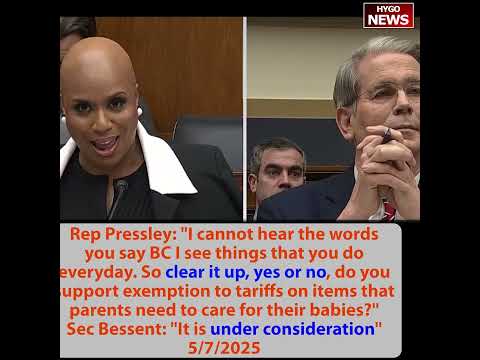
After multiple rounds of interruption, Pressley restated: “I cannot hear the words you say because I see the things that you do every day. So clear it up — yes or no, do you support an exemption to tariffs on items that parents need to care for their babies?”
Bessent finally answered: “It is under consideration.”
Pressley’s response: “Great. Good.”
The car seat example was the Democratic opposition’s strongest emotional argument against tariffs on Chinese goods. The image of parents paying more for an essential child safety product was visceral and relatable. The fact that 9 out of 10 car seats were manufactured in China was itself evidence of the dependency the tariff policy was designed to address.
But the argument cut both ways. If American children were dependent on Chinese-manufactured car seats, that dependency was a vulnerability. A disruption in Chinese supply — whether from a military conflict, a pandemic, or Chinese retaliation — could leave American parents unable to obtain essential safety equipment. The long-term case for domestic car seat manufacturing was stronger than the short-term case for cheap Chinese car seats.
Bessent’s “under consideration” response was the most he could say at a hearing without committing the administration to a specific exemption. The administration had already demonstrated flexibility on tariff exemptions — auto parts, electronics, and other categories had received temporary relief. Baby products were a logical candidate for similar treatment, and Bessent’s answer implied the process was underway.
Key Takeaways
- Rep. Stansbury disrupted women’s sports hearing by screaming about trans rights, forcing the chair to repeatedly restore order.
- Salt Lake City adopted LGBTQ flags as “official city flags” to circumvent Utah’s ban on pride flags at government buildings.
- Rep. Pressley: “9 out of 10 car seats come from China. Do you support a tariff exemption for baby products?”
- Bessent after repeated interruptions: “It is under consideration.”
- The car seat debate illustrated both the emotional argument against tariffs and the strategic case for ending Chinese dependency on essential products.