 HYGO News
 TX Dems Flee to Block GOP Congressional Redistricting, AG Paxton Calls Arrest, CALL OF THE HOUSE
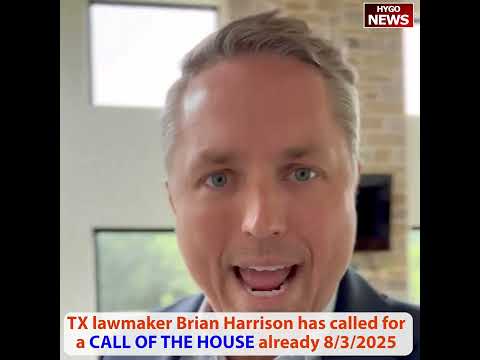
TX Dems Flee to Block GOP Congressional Redistricting, AG Paxton Calls Arrest, CALL OF THE HOUSE
Texas House Democrats fled the state to break quorum and prevent a vote on Republican redistricting legislation that would add five GOP House seats. State Rep. James Talarico (D): “My Democratic colleagues and I have just left our beloved state to break quorum and stop Trump’s redistricting power grab.” The Democrats reportedly fled to Illinois, where Governor Pritzker prepared to receive them. Republican State Rep. Brian Harrison immediately demanded the House Speaker issue a “Call of the House” — the procedural mechanism that authorizes law enforcement to arrest the fleeing lawmakers and return them to the Capitol. “Anything short of an immediate call of the House, anything short of all efforts to arrest them and bring them back is a dereliction of duty.” Sen. Alex Padilla reframed illegal immigrants as “long-term residents of the United States who happen to be undocumented.” And a reporter noted Democrats are “very shaken” by Trump’s power and “not really understanding how … they lost every battleground state.”
Talarico’s Quorum Break
Texas State Rep. James Talarico’s video announcement. “This is State Representative James Talarico from Texas. If you’re seeing this video, my Democratic colleagues and I have just left our beloved state to break quorum and stop Trump’s redistricting power grab.”
That is the specific political tactic. Texas House rules require a two-thirds quorum to conduct business. Democrats by leaving the state deny that quorum. The Texas House cannot legislate without the absent Democrats returning.
“Trump told our Republican colleagues to redraw the political maps here in Texas in the middle of the decade to get him five more seats and protect his majority in Congress.”
The political predicate. Mid-decade redistricting (typical redistricting occurs after decennial census, not mid-decade). The Republican map gains five additional Republican congressional seats. The objective: protect the House Republican majority for 2026.
“They’re turning our districts into crazy shapes to guarantee the outcome they want in the 2026 elections.”
“Crazy shapes.” That is Talarico’s characterization of the proposed map’s geographic contours. Gerrymandered districts, by design, can have unusual shapes — stretches of territory connected through narrow corridors, separated communities joined by thin geographic connections. Whether Texas’s proposed map exceeds the standard gerrymandering of prior decades is the empirical question.
”Fleeing to Illinois”
“The Texas Democrats reportedly fled to Illinois to break quorum to block the Texas House from holding a vote in a special session. The new congressional map will add five GOP House seats.”
Illinois is the specific destination. Illinois has a Democratic governor (Pritzker). Democratic state infrastructure. Potentially sympathetic Democratic state officials who would decline to cooperate with Texas law-enforcement efforts to return the fleeing Democrats.
“The Texas Democrats pulled a similar stunt back in 2021. Four years ago, Republican Texas Gov. Greg Abbott called for the arrest of fleeing lawmakers upon their return to their state.”
2021 was the previous Texas Democratic quorum break. Over voting-rights legislation, Texas Democrats fled to Washington, D.C. for multiple weeks. The 2021 flight ended when Democrats returned and legislation proceeded — Republicans could wait longer than Democrats could stay away.
Brian Harrison: Call of the House
Republican State Rep. Brian Harrison’s response. “We’ve got some breaking news right now. It appears that the Texas House Democrats, perhaps unsurprisingly, are beginning the process of engaging in a quorum break to stop the redistricting efforts we were planning on voting on the redistricting map tomorrow morning on the House floor, but appears the Democrats are in the process of or have already fled to Illinois, where their governor has apparently made preparations to welcome them.”
That confirms the Illinois destination and Pritzker’s preparation. The flight was not improvised — it was coordinated with the Illinois governor’s office.
“This is not unexpected. This is a failure of the Republicans. This is not something we should let the liberal Austin establishment blame on the Democrats.”
That is the internal-party critique. Harrison is saying Republican leadership should have anticipated this tactic (Democrats did it in 2021) and prepared procedural response (vote earlier, use special session rules that don’t require quorum, have law-enforcement ready to respond).
“This tactic has been talked about for days and weeks. We knew this was coming.”
The predictability of the tactic. Democrats had been signaling this response. Republican leadership had weeks to prepare. The fact that the Democrats successfully fled reflects a Republican failure to implement counter-measures.
”Speaker Convened a Call of the House”
“Here’s what should happen right now. Number one, the Speaker of the Texas House, who keep in mind, was the Democrat caucus candidate for Speaker. Okay, so it’s his supporters that are fleeing the state, even though he’s a Republican, it was the Democrats in the Texas House that elected him.”
That is a specific institutional complication. Texas House Speaker Dustin Burrows (the elected speaker) was actually the Democratic caucus’s preferred candidate against a more conservative Republican alternative. Democrats voted for Burrows. Burrows is, therefore, institutionally indebted to the Democratic caucus members who are now fleeing.
Whether Burrows will use the full procedural tools against the fleeing Democrats is the open question. Harrison is calling on Burrows to act against his own electoral backers.
“So his supporters are the ones breaking quorum to stop the maps. If the Speaker of the House is serious about delivering for Republicans and President Trump, he would immediately, this is what I am calling on him to do right now, he should convene immediately a session of the Texas House, get him or somebody else to go preside over the body and immediately move for what’s called a call of the House."
"Call of the House”
“The call of the House is what would authorize law enforcement to immediately be dispatched to arrest, detain, and bring back to the Capitol for the purposes of establishing a quorum.”
That is the specific procedural mechanism. A “Call of the House” in Texas parliamentary procedure authorizes law enforcement to compel attendance of absent members. The Department of Public Safety (Texas state police) could be dispatched to apprehend members who are within Texas jurisdiction.
The problem: the fleeing Democrats crossed state lines into Illinois. Texas DPS does not have jurisdiction in Illinois. Compelling their return requires federal assistance or extradition proceedings.
“These Democrats who are violating their constitutional duty and fleeing the state to thwart the will of the voters. I’m calling on the Speaker to do right now. If he’s serious, he would immediately convene a call of the House and go out and arrest these Democrats.”
“Violating their constitutional duty.” That is the legal framing. Texas state legislators have constitutional duties to attend sessions and cast votes. Fleeing the state to prevent quorum is, in Harrison’s framing, a constitutional violation.
Federal Partners
“If they are, and once they cross state lines, the governor of the state of Texas needs to do everything he can with his federal partners to arrest them and extradite them back to the state of Texas.”
Federal partners. U.S. Marshals Service. FBI. DOJ. State-level extradition processes. There are multiple federal mechanisms Texas could invoke to return the Illinois-based Democrats.
Whether those mechanisms will be invoked depends on political judgment. Past Texas governors have treated similar flights as political rather than law-enforcement matters — the Democrats eventually return, the legislation eventually passes, the fight is political theater rather than legal enforcement.
Trump’s administration has emphasized stronger federal-state law-enforcement coordination. Whether the Texas redistricting fight becomes a federal enforcement priority is the political question.
”Dereliction of Duty”
“Anything short of an immediate call of the House, anything short of all efforts to arrest them and bring them back is a dereliction of duty and another failure of the liberal rhinos that have controlled the Texas government for far too long.”
“Liberal rhinos.” Harrison’s characterization of moderate Republicans in Texas state government who he believes are insufficiently aggressive in pursuing the Republican agenda. “RINOs” (Republicans in Name Only) is conservative shorthand for Republicans whose positions align with Democrats on specific issues.
Harrison’s framing: Texas Republican leadership, including Speaker Burrows, is insufficiently aggressive. If they were genuinely conservative, they would have prevented the Democratic flight and would be actively arresting the fleeing members now.
Padilla Reframes Illegal Immigrants
The segment pivoted to Sen. Alex Padilla’s framing. “My focus has been on the people who have been here, millions of long-term residents of the United States who happen to be undocumented, that have been the target of this administration’s increasingly aggressive and cruel arrest, detention, and deportation policy.”
“Long-term residents of the United States who happen to be undocumented.” That is the euphemism-ladder. Not “illegal immigrants.” Not “unauthorized immigrants.” Not even “undocumented immigrants.” “Long-term residents who happen to be undocumented.”
The “happen to be undocumented” framing treats immigration status as an incidental characteristic rather than the defining legal status. It is the rhetorical move Democrats have been using to blur the line between lawful and unlawful presence.
The “long-term” qualifier matters. Padilla is implicitly arguing that the length of illegal presence somehow modifies the underlying illegal status. Long-term illegality becomes, in his framing, a form of legitimacy. That framing has no legal basis. Statute does not establish duration-based amnesty. But politically, long-term presence creates sympathy that can be politically leveraged.
”Cruel … Deportation Policy”
“That have been the target of this administration’s increasingly aggressive and cruel arrest, detention, and deportation policy.”
“Cruel … arrest, detention, and deportation.” The same vocabulary Letitia James has used. The same framing Stacey Abrams has used. Arrest, detention, and deportation of illegal immigrants is, in Democratic rhetoric, an inherently cruel act.
The counter-framing: arrest, detention, and deportation of individuals with no lawful right to be in the United States is the standard operation of immigration law. Calling it “cruel” requires a specific moral theory that prioritizes the illegal immigrant’s interests over the citizen’s interest in border integrity. That is a legitimate political position, but it is not a neutral characterization.
The Reporter’s Assessment
“They see all this power that President Trump has amassed and they’re very shaken by it and they’re not also really understanding how not only did they lose it, guess it was a close election, but they lost every battleground state.”
That is a reporter observation, not administration commentary. Democrats are “very shaken” by the Trump administration’s operational pace. They do not understand how they lost. “They lost every battleground state” — the 2024 election was not a close Electoral College result. Trump won every battleground state.
“And that’s something that I think Democrats are still trying to wrap their heads around.”
Democratic post-2024 analysis is still in process. The question of how they lost — whether it was candidate quality, message quality, cultural alienation, economic frustration, or something else — has not been resolved within the party. Different factions attribute the loss to different factors and push for different forward strategies.
Two Patterns
The Texas redistricting fight and the broader Democratic rhetorical framing are connected. Texas Democrats fled the state to prevent legitimate legislative voting on a redistricting map. Federal Democrats use “cruel” and “long-term residents” to characterize illegal immigration enforcement. Both patterns involve Democratic leaders using tactics and rhetoric that moderate voters may find less-than-persuasive.
The administration’s strategy is to document these tactics and let voters judge them. Whether Texas Democrats fleeing to Illinois to prevent legislation advances Democratic Party interests with voters is the empirical question 2026 will answer.
Key Takeaways
- Texas State Rep. James Talarico (D) announced Democrats had fled the state: “My Democratic colleagues and I have just left our beloved state to break quorum and stop Trump’s redistricting power grab.”
- Texas Democrats fled to Illinois where Gov. Pritzker had “apparently made preparations to welcome them” — attempting to block a map that would add 5 GOP House seats.
- Republican State Rep. Brian Harrison demanded Speaker Burrows issue an immediate “Call of the House” — the procedural mechanism authorizing “law enforcement to immediately be dispatched to arrest, detain, and bring back to the Capitol” the fleeing Democrats.
- Harrison: “Anything short of an immediate call of the House, anything short of all efforts to arrest them and bring them back is a dereliction of duty.”
- Sen. Alex Padilla reframed illegal immigrants as “long-term residents of the United States who happen to be undocumented” — using “happen to” to treat illegal status as incidental rather than defining.