 HYGO News
 Adjusters Under Oath: Allstate Reviewers 'Repeatedly Asked Us to Remove Line Items, Alter Findings, Delete Material'; Offered Ms. Miguel $40K for $497K Damage; Retaliation for Testifying
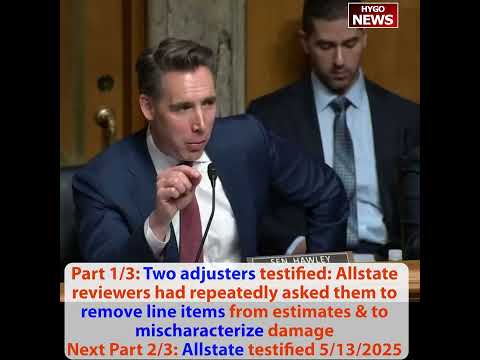
Adjusters Under Oath: Allstate Reviewers “Repeatedly Asked Us to Remove Line Items, Alter Findings, Delete Material”; Offered Ms. Miguel $40K for $497K Damage; Retaliation for Testifying
In sworn congressional testimony in May 2025, two insurance adjusters described a systematic pattern of alleged claim manipulation at Allstate. Independent adjuster Nick Schroeder and Cliff Millican, who had worked Allstate claims for at least eight years, testified that Allstate reviewers had repeatedly asked them to remove line items from storm damage estimates and mischaracterize damage. In one specific case, homeowner Ms. Miguel received a $40,000 Allstate offer for damage her own independent adjuster assessed at $497,000. Schroeder said he was taken off cases when his estimates went “too high.” Millican testified: “Frequently asked to alter factual findings, delete material, and sometimes include items that were false.” After agreeing to testify, Millican said he was placed on a company blacklist: “I’ve been told that I’m going to be worked out of the storm in Georgia. It’s eliminating me, guaranteed.”
The $40K vs. $497K Gap
The case at the center of the testimony was Ms. Miguel’s home in the Sandy Springs, Georgia area, which had suffered extensive damage during a hurricane.
The Senator questioning the witnesses (Senator Hawley, consistent with his involvement in insurance oversight) laid out the facts.
“Allstate sends out an adjuster. You said pretty quickly just a moment ago. Is that right?”
“About three weeks after,” Ms. Miguel responded.
“Oh, well, that’s not very quick. Okay. Three weeks after.”
The Senator continued: “And that you were told at the time in this first inspection verbally that the adjuster agreed with you. This was very severe damage.”
Ms. Miguel confirmed: “Correct.”
The Senator walked through the photos: “Here’s a breezeway that looks to be nearly completely destroyed. You can see some of that roof damage quite extensive that you were talking about in your testimony.”
The critical exchange followed: “What did Allstate when they finally came back with an actual assessment, a real number, what was that number again?”
“$46,000,” Ms. Miguel testified.
The Senator repeated: “$46,000. So you went to considerable expense on your own. You hired your own independent adjuster to come back out and do all of this over again. And that person looking at all of this evidence, that person found that the damage was in the neighborhood of what?”
“$497,000.”
“$497,000. Allstate offered you $40 basically.”
“Correct.”
The approximately 12-to-1 discrepancy between the independent assessment and the Allstate offer was the core evidence of alleged systematic underpayment. Either the independent adjuster had grossly inflated the damage assessment, or Allstate had grossly deflated it. The testimony would establish which was more likely.
Schroeder: Taken Off the Case for Being Thorough
Nick Schroeder had been the first adjuster to inspect Ms. Miguel’s home.
“You were a field adjuster deployed for Allstate through Pilot Catastrophe,” the Senator confirmed.
“Yeah, that’s correct,” Schroeder said.
“And you were the first one to inspect Ms. Miguel’s home after the hurricane.”
“Yeah.”
“And you went in person, I think. Is that correct? And you spent several hours, Ms. Miguel said in her testimony a moment ago, you spent several hours doing a very thorough inspection.”
“Yeah, that’s correct.”
The Senator asked about severity: “And how serious would you say the damage was in your own personal recollection?”
“Extremely — probably the most serious that I saw on this deployment.”
“The most serious that you saw on the deployment, which makes sense given these photos. So you start, if I understand correctly, you start to prepare an estimate for a full replacement of this breezeway right here. Does that sound right?”
“Yeah, that’s correct.”
The Senator described the interference: “But then you were instructed, you were told by the higher-ups, no, no, no, no, no, we’re not going to do a full replacement of the breezeway. So only do an assessment for a partial replacement of the breezeway.”
“Yes.”
The Senator described Schroeder’s removal from the case: “Okay. So then you start working on that and you’re working to get as big of a damage claim as you can for Ms. Miguel in line with the facts after you’ve already been told no, we’re not going to do the full thing. And then before you can even complete your work, you’re taken off the case.”
“Yes.”
“Why do you think that happened?”
Schroeder gave his interpretation: “I was told it was due to time I was taking too long, but I don’t believe that is the case. I think that Allstate saw from this and my recently prior estimates of being very thorough and complete and going back and forth with reviewers on coverage that it was going to be a higher estimate and it would be more cost effective to reassign it to an adjuster that would listen better.”
The Senator summarized: “An adjuster who would low-ball the policy holder really. I mean, that’s what we’re talking about.”
The pattern Schroeder described — thorough adjusters being removed in favor of compliant ones — was the mechanism by which systematic underpayment would operate. A company that simply told its adjusters to underpay would face both legal and professional resistance. But a company that reassigned cases away from thorough adjusters and toward those willing to accept reduced estimates could achieve the same result while maintaining deniability.
Schroeder: “Frequently” Told to Change Estimates
The Senator pressed for the pattern.
“Let me just ask you more broadly, Mr. Schroeder, have you ever been told to change estimates to reduce payouts?”
Schroeder was direct: “Yeah, frequently.”
“And when you’ve pushed back on this, if you’ve ever said no, what happens then?”
“If I say no, then the claims typically get reassigned due to they say either lack of compliance or other reasons like I’m taking too long.”
“In your experience, was this kind of thing a one-off thing or was this a pattern?”
“This was definitely a pattern.”
“Is it fair to say then that Allstate’s priority in your experience was not getting the best possible award for their clients. It was in protecting their bottom line.”
“Certainly in protecting their bottom line. Yeah.”
The admission was damning. Schroeder was not describing isolated incidents or rogue supervisors. He was describing a consistent pattern across his experience with Allstate: instructions to reduce estimates, reassignment when he refused, and institutional priority on reducing payouts rather than accurate assessment.
Millican: “Alter Factual Findings, Delete Material, Include Items That Were False”
Cliff Millican, the second adjuster, had even more experience.
“You worked as a field adjuster for Allstate through Pilot Catastrophe for about eight years. Do I have that right?”
“At least eight years. Yeah.”
“In that time, you have personally inspected hundreds of properties damaged after storms and disasters. Is that fair to say?”
“Thousands.”
The Senator described Millican’s experience with Ms. Miguel’s case: “When you submitted your report to Allstate recommending several hundred thousand dollars worth of payments to Ms. Miguel and her husband, what happened then?”
Millican: “My estimate was rejected and I was advised to alter it to a lower figure.”
“So you were told to alter the estimate and to alter your findings as well?”
“I was told to alter my estimate. I don’t know the findings was told to be altered.”
“Were the alterations that you were told to make, were those consistent with your own review of the property and your own assessment of the damage?”
“No, sir.”
The Senator asked about disclosure to the policyholder: “Does there any record anywhere the policy holder would ever know that your initial findings, your recommendations were rejected and somebody told you to come in and alter them?”
“No, sir.”
The policyholder disclosure question was critical. If Allstate was routinely overriding its own adjusters’ assessments and pushing down payouts — without informing the policyholders that this had happened — then policyholders had no way to know their claims were being systematically manipulated. They would receive offers that looked legitimate on their face while being substantially lower than the actual damage assessments.
The Senator expanded: “Have you ever been told in other cases with Allstate to alter or delete your findings?”
“Absolutely.”
“In fact, you testified just a second ago, I think that you were frequently asked to alter factual findings, delete material and sometimes include items that were false. Did I hear you correctly when you said that?”
“Yes, sir.”
“In the overwhelming majority of cases where you were asked to do something like this, did that cause the estimate to the policy holder to go up or to go down?”
“To go down.”
The “include items that were false” admission went beyond mere underpayment to active fraud. If Allstate was instructing adjusters to include false information in their reports, the company was manufacturing rather than merely shading the basis for its payment decisions.
”100% to Use Me to Enable Them to Make as Much Money as Possible”
The Senator sought Millican’s overall assessment.
“What is your assessment of what Allstate’s ultimate goal here is? Is it to pay out the policy according to the terms of the policy, to the best extent they can, or is it to protect their bottom line and to use you and your report as necessary to meet that end, to make sure they make as much money as possible?”
Millican was emphatic: “100% to use me to enable them to make as much money as possible.”
“And you would say that this is a pattern, this isn’t just something that happened one time like in Ms. Miguel’s case, you’ve been doing this for a long time and you’ve observed this to be a pattern with Allstate and in the industry.”
“I have, yes, sir.”
The “industry” broadening was significant. Millican was not merely accusing Allstate of isolated misconduct. He was describing a pattern he had observed across multiple insurers over an eight-plus year career. The implication was that the systematic underpayment practices extended beyond Allstate to industry-wide behavior.
The Retaliation
The final exchange documented apparent retaliation against Millican for testifying.
“Can I just ask you, did you think that Allstate might retaliate against you for your testimony here today, did that ever cross your mind?”
“Yes, sir. Yes, sir.”
“And why did you think that might happen?”
“Well, I mean, I got a phone call from Pilot Management indicating that they were aware of it and then got word from people in the office that I was going to be on the cutoff list, which has not happened in probably six years.”
The Senator sought clarification: “You’re telling me that after you agreed to testify here today, you got word that you were on a black list essentially from Allstate and that you were going to be penalized in some way?”
“Yes, sir. I’ve been told that I’m going to be worked out of the storm in Georgia, which is 100%. I mean, it’s cutting me off. It’s eliminating me, guaranteed.”
“So they’re retaliating against you. It sounds like they’ve already said it in motion.”
“Yes, sir.”
The Senator continued: “Because you testified as to what happened.”
“Yes, because I was going to testify, I guess, sir.”
“Yeah, even before you got here today, they were doing this.”
The retaliation against Millican — documented before he had even completed his testimony — was significant in multiple ways. First, it suggested that Allstate’s alleged practices were concerning enough that the company felt retaliation was necessary. Second, it represented potentially illegal witness intimidation or retaliation. Third, it corroborated Millican’s underlying testimony — a company willing to retaliate against a witness was more plausibly a company willing to manipulate claims.
Millican’s own reaction was telling: “I honestly couldn’t tell you. I thought that by telling the truth, I wouldn’t have any problem. Swear to goodness I had no idea that the company I worked for wouldn’t hold a grudge about speaking the truth.”
Key Takeaways
- Ms. Miguel’s home: Independent assessment $497K damage, Allstate offer $40-46K — more than 10x discrepancy.
- Schroeder testified: “Frequently asked to change estimates to reduce payouts. If I say no, claims get reassigned.”
- Millican (8+ years, thousands of inspections): “100% used to enable Allstate to make as much money as possible.”
- Millican testified he was asked to “alter factual findings, delete material, include items that were false” — systematic pattern.
- Retaliation before testimony completed: Millican told he’d be “worked out of the storm in Georgia” — cut off for agreeing to testify.