 HYGO News
 Labor Secretary Nominee Chavez-DeRemer: 'Made in America Is Important to the President'; Bipartisan Pro-Worker Agenda
Labor Secretary Nominee Chavez-DeRemer: “Made in America Is Important to the President”; Bipartisan Pro-Worker Agenda
At her February 2025 Senate HELP Committee confirmation hearing, Labor Secretary-designate Lori Chavez-DeRemer was presented by both Republican and Democratic senators as a uniquely positioned nominee who bridged the gap between business and labor. Senator Josh Hawley praised her “long record of working with labor, working with business, to try to advance a pro-worker agenda,” while Senator Markwayne Mullin delivered an impassioned introduction arguing that Chavez-DeRemer “reflects the historic coalition of working-class Americans that elected President Trump to a second term.” Chavez-DeRemer herself pledged to “protect the American worker” and said “Made in America is important to the President of the United States.”
Hawley: “A Long Record of Working With Labor”
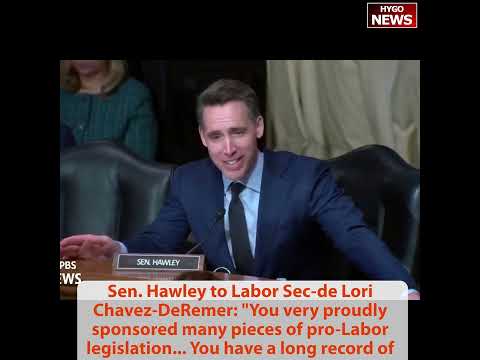
Senator Josh Hawley of Missouri opened his questioning by addressing both wings of the Republican and Democratic parties simultaneously, establishing Chavez-DeRemer’s credentials on both sides.
“I know you’ve taken a little heat from both sides. You’ve handled it beautifully,” Hawley said. “Let me just get a few things straight.”
He turned first to his Republican colleagues: “For my Republican colleagues, let me just clarify. You are President Trump’s choice to lead the Department of Labor. Have I got that right?”
“Yes, you have,” Chavez-DeRemer confirmed.
“And you support the President’s policies and will implement his agenda. Have I got that right?”
“Yes.”
Hawley then addressed Democrats: “And to my Democratic colleagues, you very proudly sponsored many pieces of pro-labor legislation in your time in the United States House of Representatives. You have a long record of working with labor, of working with business, to try to advance a pro-worker agenda. Is that fair to say?”
“Yes,” Chavez-DeRemer said.
“Which is probably why the President chose you for this role, if I’m speculating,” Hawley concluded. “I think your record is really outstanding.”
The exchange was choreographed to neutralize the two most common criticisms of the nomination: from the right, that Chavez-DeRemer was too friendly to unions, and from the left, that as a Trump appointee she would dismantle labor protections. Hawley’s dual framing established that supporting Trump’s agenda and having a pro-labor record were not contradictions — they were the reason she was nominated.
”Made in America” and the Worker-First Agenda
Chavez-DeRemer’s own remarks were concise and on-message. “Certainly, we want to protect the American worker, and ‘Made in America’ is important to the President of the United States,” she said. “I couldn’t be more proud to support the America First agenda for exactly that reason.”
She elaborated on her conversations with Trump about the role: “We certainly want to make sure that we’re focused on growing this economy. That is the conversation that I had with the President on it. How can we bring the American worker to be the pinnacle of every conversation that we have in supporting them and growing this economy?”
Chavez-DeRemer also connected the labor agenda to immigration enforcement. “The influx of the mass immigration that we’ve seen over the last four years has hurt the American worker,” she said. “We want to make sure that we’re supporting President Trump in his endeavor to support the American worker at all costs.”
The immigration-labor connection was a central element of the Trump coalition’s economic argument: that uncontrolled immigration depressed wages for American workers, particularly in blue-collar industries. By linking her Department of Labor mandate to border enforcement, Chavez-DeRemer was positioning the department as part of the administration’s broader economic nationalism framework.
Mullin’s Impassioned Introduction
Senator Markwayne Mullin of Oklahoma delivered what may have been the most unusual introduction in confirmation hearing history, mixing policy analysis with personal anecdotes and humor.
Mullin opened by confronting the election results that challenged Democratic assumptions about the labor vote. “When the words come up, like Biden administration was the most pro-union labor person in 50 years, you got to remind yourself — he also lost the labor vote by 59 percent because it wasn’t working,” Mullin said.
The statistic — that Biden lost union household voters to Trump by a significant margin despite billing himself as the most pro-union president in a generation — was one of the most devastating data points of the 2024 election. It meant that workers themselves had rejected the Biden approach to labor policy, preferring Trump’s combination of tariff protection, immigration enforcement, and economic nationalism.
Mullin then made the case for why Chavez-DeRemer represented the new coalition. “President Trump brings something unique to the table as he’s built the coalition, and Lori represents that,” Mullin said. “Lori represents someone that is uniquely positioned to bring people together.”
He revealed that he and a Democratic colleague had jointly recommended Chavez-DeRemer to Trump. “I would hope that you would set your biased opinions to the side and understand that this is a negotiation between two fractions of the party that is saying we’re willing to work together,” Mullin said. “Employees don’t exist without employers, and companies don’t exist without employees. And I recognize that as much as anybody.”
The Oklahoma Example
Mullin used his home state to illustrate that pro-business and pro-labor positions could coexist. “Oklahoma is a right-to-work state, but unions also thrive there,” he said. “And at the same time, we can find common ground. Lori represents that.”
He acknowledged his own ideological journey. “I truly say that from a position that I’ve had to move a long ways,” Mullin said. “And if I can move, and if Sean and I can move and come together on this, then that if nothing else should set some type of example.”
Mullin injected humor into the proceedings, referencing his relationship with his Democratic counterpart: “I do joke with my new friend over here — which I have the mic and he can’t defend himself — that if we were in a relationship, I’d be the man in the relationship.” He added: “But I say that because now we’re friends enough that we can make fun of each other and at the same time, we can work together.”
The laughter in the hearing room captured the unusual tone of the introduction — one of genuine personal warmth and bipartisan rapport in a setting that had become increasingly contentious during other Trump cabinet confirmations.
”The Historic Coalition of Working-Class Americans”
Mullin concluded with his formal prepared statement, placing the nomination in the context of the 2024 election’s most significant political realignment.
“Lori’s nomination reflects the historic coalition of working-class Americans that elected President Trump to a second term in the White House,” Mullin said. “As a member of Congress, she often worked across the aisle in her efforts to support this cause.”
He acknowledged the controversy around the PRO Act, which Chavez-DeRemer had co-sponsored in the House — a pro-union bill that many Republicans opposed. “One of those issues, the PRO Act, as has been mentioned a couple of times — I know that will come up in conversation today. I get it. Oklahoma is a proud right-to-work state. And yet, we still support Lori,” Mullin said.
The willingness of a senator from a right-to-work state to support a nominee who had backed the PRO Act demonstrated the political realignment Trump had engineered. The old categories — pro-business Republicans versus pro-union Democrats — no longer applied in a coalition built around economic nationalism, where protecting American workers from foreign competition and mass immigration was the unifying principle.
Mullin’s final appeal to Democrats was direct: “If you’re looking for a bipartisan, independent thinker that’s going to represent the union that you want… when you understand that you have a president that’s representing the Republican Party but also won the popular vote, you would think this is someone that you would be very happy with. Because she is directly, uniquely positioned in the center.”
Key Takeaways
- Senator Hawley established that Chavez-DeRemer both supports Trump’s agenda and has “a long record of working with labor” and sponsoring pro-labor legislation — framing the nomination as the embodiment of the new Trump coalition.
- Chavez-DeRemer pledged to make “Made in America” central to the Department of Labor’s mission and connected immigration enforcement to protecting American workers’ wages.
- Senator Mullin noted that Biden “lost the labor vote by 59 percent” despite calling himself the most pro-union president, arguing that workers themselves had rejected the old approach.
- Mullin called Chavez-DeRemer’s nomination a reflection of “the historic coalition of working-class Americans that elected President Trump to a second term.”
- The hearing showcased bipartisan rapport, with Mullin revealing he and a Democratic colleague had jointly recommended Chavez-DeRemer to Trump and acknowledging he had “moved a long ways” ideologically.