 HYGO News
 Carney: 'Canada Is Not for Sale.' Trump: 'Never Say Never'; 'I Could Announce 50-100 Deals Right Now -- I'm the Shopkeeper'
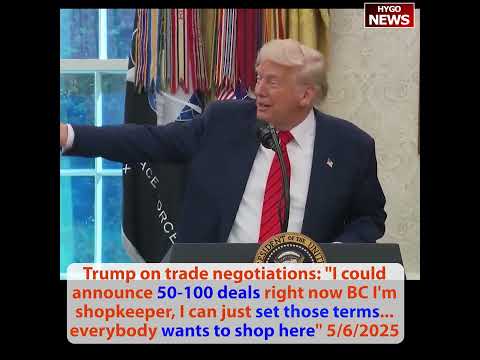
Carney: “Canada Is Not for Sale.” Trump: “Never Say Never”; “I Could Announce 50-100 Deals Right Now — I’m the Shopkeeper”
Canadian PM Mark Carney and President Trump produced the most memorable exchange of their White House meeting in May 2025. Carney declared: “There are some places never for sale. Having met with the owners of Canada — it’s not for sale, it won’t be for sale ever.” Trump’s three-word response: “Never say never.” Trump then described his trade philosophy using luxury retail: “I could announce 50 to 100 deals right now because I’m the shopkeeper and I keep the store. Everybody wants to shop here. Our country is the greatest store in the world.” He outlined the benefits of Canada joining America: “A massive tax cut for Canadian citizens. Free military. Tremendous medical care. When you get rid of that artificially drawn line, that’s the way it was meant to be."
"Never Say Never”
Carney attempted a definitive rejection of the 51st state concept.
“Well, if I may, as you know from real estate, there are some places that are never for sale,” Carney said. “We’re sitting in one right now — you know, Buckingham Palace, you visited as well.”
He stated Canada’s position: “Having met with the owners of Canada over the course of the campaign last several months, it’s not for sale. It won’t be for sale ever.”
He pivoted to partnership: “But the opportunity is in the partnership and what we can build together.”
He credited Trump: “The president has revitalized international security, revitalized NATO, and us playing our full weight in NATO will be part of it.”
Trump acknowledged the military progress: “Canada is stepping up the military participation because Mark knew they were low, and now they’re stepping it up. That’s a very important thing.”
Then he delivered the zing: “But never say never.”
The three words — “never say never” — landed like a punchline precisely because Carney had just used the word “never” emphatically. The exchange was perfectly calibrated: Carney made his declaration of sovereignty, Trump acknowledged it respectfully, and then undermined it with three syllables that implied the future might hold surprises.
”I’m the Shopkeeper”
Trump expanded his trade deal philosophy with his most vivid metaphor yet.
“I could announce 50 to 100 deals right now because I’m the shopkeeper and I keep the store,” Trump said. “I know what countries are looking for, and I know what we’re looking for, and I can just set those terms.”
He described the demand: “They can go shopping or they don’t have to go shopping, because everybody wants to shop here.”
He drew the analogy: “This is like a beautiful store. This is like one of Bernard Arnault’s” — referencing the LVMH chairman who was present — “he has the greatest stores in the world and they want to shop.”
He applied it to America: “Our country is the greatest store in the world of that kind, and everybody wants a piece of it, and they took advantage of us for years.”
He assigned blame correctly: “I don’t blame China and I don’t blame Vietnam. I could name every single country. Japan — these are friends of mine, but they took advantage of this country. I blame the people that sat behind that desk that allowed it to happen.”
He stated his difference: “But I don’t allow it to happen. I didn’t in the first term, but this is a much stronger position.”
He cited his record: “Stock market was up 88% in our first term. This is going to be a much better term.”
He described the fiscal transformation: “We were losing five billion dollars plus a day on trade. Now we’re not losing that kind of money, and we’ll soon be making a lot of money.”
The Bernard Arnault presence — the chairman of LVMH, the world’s most valuable luxury goods company, sitting in the room — made the “luxury store” metaphor literal. Arnault understood better than anyone that the value of a brand was in its exclusivity and desirability. Trump was applying the same principle to the American economy: access to the American market was the most valuable commercial privilege in the world, and countries should pay for that privilege rather than exploiting it.
”Massive Tax Cut for Canadians”
A reporter asked about the 51st state proposition directly.
“You’ve said Canada should become the 51st state,” the reporter said.
Trump acknowledged: “I still believe that, but it takes two to tango.”
He listed the benefits: “I believe it would be a massive tax cut for the Canadian citizens. You get free military. You get tremendous medical care and other things. There would be a lot of advantages.”
He revealed the aesthetic argument: “I’m a real estate developer at heart. When you get rid of that artificially drawn line — somebody drew that line many years ago with like a ruler, just a straight line right across the top of the country — when you look at that beautiful formation when it’s together, I’m a very artistic person, but when I looked at that beauty, I said that’s the way it was meant to be.”
He assessed the potential: “I think there are tremendous benefits to the Canadian citizens. Tremendously lower taxes, free military — which honestly we’d give you essentially anyway because we’re protecting Canada.”
He concluded warmly: “It would really be a wonderful marriage because it’s two places that get along very well. They like each other a lot.”
The “artificially drawn line” observation was Trump applying real estate logic to geopolitics. The U.S.-Canada border — a straight line drawn along the 49th parallel through the western half of the continent — was an arbitrary geographic division that separated communities, economies, and ecosystems. The real estate developer in Trump saw the merged entity as more valuable than the sum of its parts.
The substantive argument was economic. Canadian citizens paid higher taxes, received lower-quality healthcare (despite the system being nominally “free”), and lived under defense protection that America provided regardless of whether Canada reciprocated. Joining the United States would give Canadians lower taxes, access to the American healthcare system, and formal membership in the world’s most powerful military alliance — all improvements over their current arrangement.
The Trade Landscape
Trump connected the Canada discussion to the broader trade picture.
“Every single country took advantage of us without exception,” he said. “Japan, South Korea — these are friends, but they took advantage. I don’t blame them. I blame the people that sat behind that desk.”
He assessed the current moment: “The tariffs are starting to come in. We were losing $5 billion-plus a day on trade. Now we’re not losing that kind of money, and we’ll soon be making a lot.”
The acknowledgment that “every single country” had taken advantage was Trump’s most comprehensive statement of the trade problem. It wasn’t one or two bad actors; it was the entire global trading system that had been structured to America’s disadvantage. The tariff revolution wasn’t targeting specific countries — it was reforming the system itself.
Key Takeaways
- Carney: “Canada is not for sale. Never.” Trump: “Never say never.”
- Trump on trade: “I could announce 50-100 deals now. I’m the shopkeeper. Everybody wants to shop here — the greatest store in the world.”
- On Canada joining the U.S.: “Massive tax cut, free military, tremendous medical care. When you get rid of that artificially drawn line — that’s the way it was meant to be.”
- “Every single country took advantage of us. I don’t blame them — I blame the presidents who allowed it.”
- Carney praised Trump: “You’ve revitalized NATO and international security.”