 HYGO News
 Trump: 'We're Going to Fort Knox to Make Sure the Gold Is There'; 20% DOGE Dividend; Federal Control of D.C.
Trump: “We’re Going to Fort Knox to Make Sure the Gold Is There”; 20% DOGE Dividend; Federal Control of D.C.
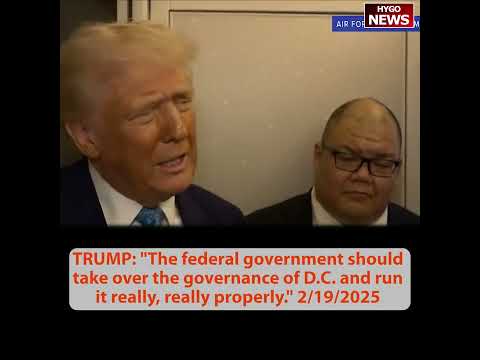
In a wide-ranging exchange with reporters in February 2025, President Trump made several headline-generating statements in rapid succession. He announced he would visit Fort Knox to personally verify the gold reserves — “the fabled Fort Knox — to make sure the gold is there. If the gold isn’t there, we’re going to be very upset.” He endorsed Elon Musk’s proposal to return 20% of DOGE savings to taxpayers as a “dividend,” calling it “a great idea.” He proposed federal takeover of Washington, D.C. governance, citing crime, graffiti, and homeless encampments. And he demanded an accounting of all the money sent to Ukraine, asking: “Where is it?"
"We’re Going to Fort Knox”
Trump announced plans to visit the United States Bullion Depository at Fort Knox, Kentucky, which holds a significant portion of America’s gold reserves. The announcement came in response to a reporter’s question and was delivered with Trump’s characteristic blend of showmanship and genuine purpose.
“We’re going to go into Fort Knox to make sure the gold is there,” Trump said. When a reporter asked for confirmation, Trump repeated: “You know that, we’re going to go into Fort Knox.”
He added gravitas to the announcement with the description that would become the widely quoted line: “We’re going to go to Fort Knox, the fabled Fort Knox, to make sure the gold is there.”
When another reporter asked where the gold would have gone, Trump responded with a mix of humor and seriousness. “If the gold isn’t there, we’re going to be very upset,” he said.
The Fort Knox visit was significant beyond its dramatic appeal. The depository is believed to hold approximately 4,580 metric tons of gold, worth several hundred billion dollars at current market prices. The gold has not been independently audited since 1953, though the Treasury Department and the U.S. Mint have maintained that periodic inventories confirm the reserves are intact. The absence of a comprehensive, publicly visible audit over more than seven decades had fueled persistent conspiracy theories about whether the gold was actually there.
Trump’s decision to personally visit Fort Knox and conduct an inspection addressed those concerns directly while also aligning with the administration’s broader transparency agenda. If DOGE was auditing Treasury’s payment systems and uncovering fraud, it was logical to extend that scrutiny to the nation’s most famous repository of physical assets.
The 20% DOGE Dividend
A reporter asked Trump about Elon Musk’s proposal to return a portion of DOGE’s savings to American taxpayers. Trump endorsed the idea immediately.
“I love it. A 20% dividend, so to speak, for the money that we’re saving by going after the waste and fraud and abuse and all the other things that are happening,” Trump said. “I think it’s a great idea.”
When asked how much money could potentially be distributed, Trump was optimistic. “It could be a lot,” he said. “I mean, if it’s 20%, we’d give back a lot of money to the taxpayer.”
Trump then identified an additional benefit of the proposal: it would incentivize public participation in the waste-identification effort. “And also, we’d give an incentive for the taxpayer to go out and report things to us where we can save money,” he said.
The 20% dividend concept was unprecedented in American governance. The idea that citizens would receive a direct cash payment representing a share of the money the government saved by cutting waste and fraud would transform DOGE from an abstract efficiency project into something with tangible, personal financial benefits for every American. It would also create a constituency for continued spending reductions, as taxpayers who had received dividend checks would have a direct financial interest in DOGE finding more waste to cut.
Federal Takeover of Washington, D.C.
When asked whether D.C. should govern itself or return to Congressional oversight, Trump offered a direct answer that went further than the question itself.
“I think that we should govern District of Columbia,” Trump said. “It’s so important, that D.C. situation. I think that we should run it strong, run it with law and order, make it absolutely flawlessly beautiful.”
Trump then elaborated on why federal governance was necessary, citing the conditions he observed in the nation’s capital. “People are getting killed. People are being hurt. You have a great police department there, but somehow they’re not utilized. They’re not utilized properly,” he said.
He expanded the critique beyond crime. “Too much crime, too much graffiti, too many tents on the lawns,” Trump said. “There’s magnificent lawns in these tents. It’s a sad thing. Homeless people all over the place.”
Trump connected the condition of the capital to his diplomatic agenda, noting that world leaders would be visiting. “When they come over to see me, like Macron is coming and the Prime Minister of the UK is coming, and all these people are coming over to see me — we’ll have ultimately President Xi and we’ll have everybody coming, right?” he said. “And you can’t let that be. You just can’t let that happen. You can’t have tents all over beautiful — you want magnificent lawns.”
He was careful to praise the mayor personally while criticizing the results. “I like the mayor. I get along great with the mayor. But they’re not doing the job,” Trump said. The comment allowed him to advocate for federal takeover without making it a personal attack, framing it as a performance issue rather than a political one.
The proposal for direct federal governance of D.C. would face significant legal and political obstacles, as the District’s home rule charter, enacted in 1973, gave the city a measure of self-governance that most residents strongly supported. However, Trump’s argument — that the nation’s capital should be a showcase of American governance rather than an advertisement for urban decay — resonated with many Americans who viewed D.C.’s visible problems as an embarrassment.
”Where Is the Money We Sent to Ukraine?”
Trump closed with a pointed demand for accountability on Ukraine spending. “All the money that we’ve been sending to Ukraine — where is it?” he asked.
He referenced a statement attributed to Ukrainian President Zelensky suggesting that a significant portion of the aid could not be accounted for. “He made the statement that half of it, he doesn’t know where it is or something like that,” Trump said. “And I’d like to find out.”
The Ukraine money question connected to the broader DOGE mission of tracking government expenditures. The United States had sent over $100 billion in aid to Ukraine under the Biden administration, a combination of military equipment, financial support, and humanitarian assistance. Trump’s demand for an accounting suggested that the same scrutiny being applied to domestic spending would be extended to foreign aid.
Trump pivoted from the accountability question to the diplomatic front. “We’re doing very well with Russia. We’re going to do something with Russia that he was unable to do,” Trump said. “We can make a deal with Russia to stop the killing of potentially additional millions of people.”
He returned to the human cost that had become a recurring theme of his Ukraine commentary. “The soldiers are being just wiped out on both sides. Wiped out. It’s horrible,” Trump said. “They’re Russian and they’re Ukrainian. I don’t want to see those soldiers killed. They have mothers and fathers. They have sisters and brothers.”
Key Takeaways
- Trump announced plans to visit “the fabled Fort Knox” to personally verify America’s gold reserves are intact, saying “if the gold isn’t there, we’re going to be very upset.”
- He endorsed Musk’s 20% DOGE dividend proposal, calling it “a great idea” that would return savings from waste and fraud to taxpayers while incentivizing the public to report government waste.
- Trump proposed federal takeover of Washington, D.C. governance, citing “too much crime, too much graffiti, too many tents on the lawns” and the need for the capital to be “flawlessly beautiful” for visiting world leaders.
- He demanded an accounting of all money sent to Ukraine, asking “where is it?” and referencing a Zelensky statement suggesting half the aid was unaccounted for.
- Trump praised D.C.’s police department and mayor personally while insisting the city’s governance results were unacceptable.