 HYGO News
 Trump: U.S. 'Laughing Stock for 40 Years' -- Now Countries 'Punished by Tariffs'; TSMC Commits $100 Billion
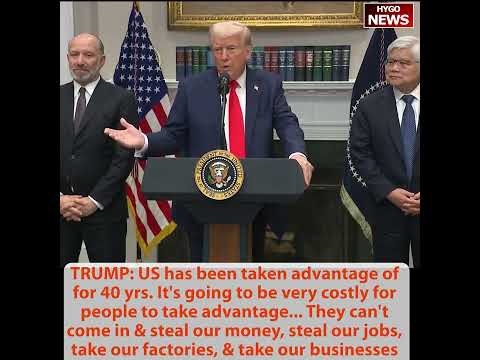
Trump: U.S. “Laughing Stock for 40 Years” — Now Countries “Punished by Tariffs”; TSMC Commits $100 Billion
President Trump used the announcement of TSMC’s $100 billion U.S. investment in March 2025 to deliver a sweeping indictment of four decades of American trade policy, calling the United States “a laughing stock for years and years” and saying that countries which “steal our money, steal our jobs, take our factories” were now “being punished by tariffs.” In a rare criticism of a Republican icon, Trump said Ronald Reagan “was bad on trade, very bad on trade” despite being “so great on other things.” Commerce Secretary Howard Lutnick credited “the power of Donald Trump’s presidency” for TSMC’s decision to invest $100 billion — compared to the $65 billion secured under Biden with a $6 billion government grant — noting companies were coming “because they want to avoid the tariffs."
"Taken Advantage of for 40 Years”
Trump opened with an assessment that traced America’s trade failures across four decades and multiple administrations of both parties.
“The United States has been taken advantage of for 40 years,” Trump said. “The United States has been a laughing stock for years and years.”
He gestured toward TSMC Chairman CC Wei: “That’s why this gentleman built in Taiwan instead of building here. It would have been better if he built here, if we had a president that knew what they were doing.”
Trump then made a statement that would have been politically unthinkable from most Republican politicians. “Look, I’m a huge fan of Ronald Reagan, but he was bad on trade, very bad on trade,” Trump said. “He allowed a lot of people, a lot of businesses to be taken.”
He added the caveat: “I say that with due respect, because he was so great on other things. But he was bad on trade.”
The Reagan critique was significant because it placed Trump’s tariff philosophy outside the traditional Republican free-trade orthodoxy. Reagan’s presidency had been defined by market liberalization and free trade principles that subsequent Republican administrations had treated as gospel. Trump was arguing that Reagan’s approach — correct on taxes, defense, and government philosophy — had been wrong on trade, and that the consequences of that error had accumulated over four decades into the massive trade deficits and manufacturing losses that Trump was now addressing.
”Punished by Tariffs”
Trump described the mechanism through which the trade imbalance was being corrected.
“It’s going to be very costly for people to take advantage of this country,” Trump said. “They can’t come in and steal our money and steal our jobs and take our factories and take our businesses and expect not to be punished. And they’re being punished by tariffs.”
He then addressed why previous presidents had failed to use this tool. “It’s a very powerful weapon that politicians haven’t used because they were either dishonest, stupid, or paid off in some other form,” Trump said. “And now we’re using them.”
The three-word explanation — “dishonest, stupid, or paid off” — was characteristically blunt. Trump was suggesting that the failure to protect American industry through tariffs was not an oversight or a genuine policy disagreement but the result of corruption, incompetence, or both. The lobbyists for multinational corporations and foreign governments had either bought off politicians, fooled them, or both.
TSMC: From $65 Billion Under Biden to $100 Billion Under Trump
Commerce Secretary Lutnick provided the context that made the TSMC announcement a direct comparison between the Biden and Trump approaches.
“President Trump has made it a fundamental objective to bring semiconductor chip manufacturing home to America,” Lutnick said.
He then drew the comparison. “Under the Biden administration, TSMC received a $6 billion grant, and that encouraged them to build $65 billion,” Lutnick said. “So America gave TSMC 10% of the money to build here.”
Then the Trump result: “And now you’re seeing the power of Donald Trump’s presidency, because TSMC, the greatest manufacturer of chips in the world, is coming to America with a $100 billion investment.”
The numbers told the story: Biden had paid TSMC $6 billion to invest $65 billion. Trump had charged TSMC tariffs that made it cheaper to build in America than to export from Taiwan, producing a $100 billion investment without a dollar of government subsidy. One approach cost taxpayers money; the other made money for taxpayers while producing a larger investment.
Lutnick explained the mechanism: “That is backed by the fact that they can come here because they can avoid paying tariffs. So the idea is: come to America, build greatness in America, build for the American customers — the Apple, Nvidia, that whole list — in order to bring production to America."
"Almost 40% of Their Company”
Trump highlighted the scale of TSMC’s commitment in terms that underscored its strategic significance.
“When you have companies like this coming in, and almost 40% of their company in one signature is going to be devoted to what he does, which is one of the most important businesses in the world — that’s an unbelievable thing,” Trump said.
The claim that TSMC was committing nearly 40% of its total capacity to American operations represented a fundamental shift in global semiconductor geography. Taiwan had been the world’s dominant chip manufacturing location, with TSMC producing the vast majority of the world’s most advanced semiconductors. Moving 40% of that capacity to the United States would reduce America’s dependence on a single island in the Taiwan Strait — an island that China had repeatedly threatened to invade.
Trump connected TSMC’s decision to the broader wave of corporate investment. “When Apple now is going to start building all of their plans here, all because of what we’ve done — it’s not because he likes me or they like me, they don’t probably like me at all,” Trump said. “I don’t know, I think he likes me a little bit at least. But it’s the incentive we’ve created, or the negative incentive.”
The distinction between “incentive” and “negative incentive” captured the dual nature of Trump’s trade policy. The positive incentive was a deregulated, low-tax American business environment. The negative incentive was tariffs that made producing abroad and exporting to America prohibitively expensive. Together, they created a one-two combination that was reshoring manufacturing at a pace that subsidies alone had never achieved.
Lutnick: “The Most Incredible Path”
Lutnick placed the TSMC announcement within the broader investment wave.
“This continues the most incredible path you’ve ever seen in these first weeks and months of the Trump administration of incredible manufacturing coming to America,” Lutnick said. “The keys that the president has called out are coming here. They’re coming here in huge size because they want to be in the greatest market in the world, and they want to avoid the tariffs that, if they’re not here, they’d have to suffer.”
He concluded by directing credit where the administration believed it belonged: “I want to congratulate CC Wei for bringing in this incredible $100 billion investment, but it’s on the shoulders of our president, Donald Trump, which is why he’s coming.”
The “on the shoulders” phrase placed Trump’s tariff policy — not government grants, not tax incentives, not diplomatic persuasion — as the primary driver of the investment decision. Companies were not coming to America because they wanted to; they were coming because the alternative — paying tariffs on exports to the world’s largest consumer market — was economically untenable.
The Reagan Comparison in Context
Trump’s willingness to criticize Reagan on trade reflected a broader realignment within Republican economic thinking. The traditional Republican position — free trade benefits everyone through comparative advantage — had been the party’s orthodoxy since at least the 1980s. Trump’s argument was that free trade had benefited everyone except American workers, who had watched their factories close, their wages stagnate, and their communities decline while corporations moved production overseas.
By naming Reagan specifically — rather than simply criticizing “past presidents” — Trump was placing a marker on the intellectual history of the Republican Party. The party of Reagan was now the party of Trump, and the difference was trade. Everything else Reagan stood for — strong defense, limited government, individual liberty — remained. But the free-trade dogma that had accompanied those principles was being replaced by economic nationalism that prioritized American workers over global efficiency.
The TSMC investment was the evidence that the new approach was working. A $100 billion commitment from the world’s most important chipmaker, achieved through tariff leverage rather than taxpayer subsidies, was the kind of result that free-trade theorists had said was impossible. Trump was proving them wrong — just as he had proved Reagan wrong, with “due respect.”
Key Takeaways
- Trump called the U.S. “a laughing stock for 40 years” on trade and said countries that “steal our money, steal our jobs” were now “being punished by tariffs.”
- He criticized Ronald Reagan as “bad on trade, very bad on trade” despite being “so great on other things” — a rare Republican-on-Republican critique spanning four decades.
- TSMC committed $100 billion to U.S. manufacturing under Trump, compared to $65 billion under Biden — which had required a $6 billion government grant.
- Commerce Secretary Lutnick said companies were investing because of “the power of Donald Trump’s presidency” and the desire to “avoid the tariffs.”
- Trump said nearly 40% of TSMC’s total capacity would move to the U.S., reducing dependence on Taiwan for critical semiconductor manufacturing.