 HYGO News
 Trump Shuts Down CNN Reporter: 'We Haven't Asked You to Speak Yet'; $370B Trade Imbalance Exposed
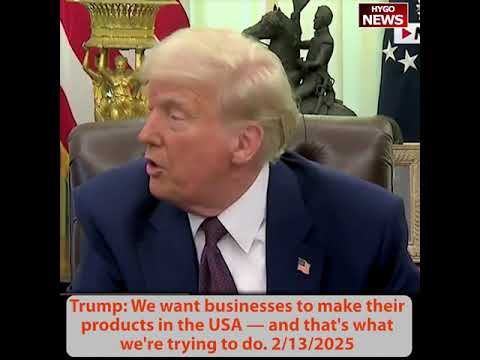
Trump Shuts Down CNN Reporter: “We Haven’t Asked You to Speak Yet”; $370B Trade Imbalance Exposed
During a February 2025 signing event for reciprocal tariffs, a CNN reporter attempted to interject with a question linking Trump’s tariff policy to inflation. Trump cut him off mid-sentence: “Excuse me, we haven’t asked you to speak yet, please.” He then laid out his case for reciprocal trade, predicting that “jobs will go up tremendously,” while National Economic Council Director Kevin Hassett revealed a staggering data point: U.S. companies had paid foreign governments $370 billion in taxes the previous year while foreign companies paid the United States just $57 billion. Trump also praised the steel and aluminum industries’ response to his tariffs and demanded that Taiwan’s chip manufacturing and China’s pharmaceutical production return to the United States.
”Excuse Me, We Haven’t Asked You to Speak Yet”
The exchange that generated the most immediate attention occurred when a CNN reporter attempted to challenge the tariff policy before being recognized.
“Mr. President, you won the White House in part because of high inflation. If your tariffs make prices go up—” the reporter began.
Trump interrupted firmly: “Excuse me, we haven’t asked you to speak yet, please.”
The moment was characteristic of Trump’s approach to media management during signing events and Oval Office remarks. Unlike formal press conferences where reporters are typically called on in sequence, the signing event format gave the president more control over the flow of questions. Trump used that control to shut down a line of questioning that assumed the conclusion he was attempting to rebut — that tariffs would increase consumer prices.
After silencing the reporter, Trump addressed the substance of the implied question. “I mean, not necessarily,” he said of the price concern. “But I’ll tell you what will go up is jobs. The jobs will go up tremendously. We’re going to have great jobs, jobs for everybody.”
The China Example: Why Companies Left
Trump used China’s tariff history to illustrate the very problem reciprocal tariffs were designed to solve. “China did it,” Trump said of using tariffs to restructure trade. “They did it at a level that probably nobody’s ever seen before. If you manufactured a car, you couldn’t send it into China. The tariff was so high, so everybody went and they built in China.”
The argument was that China had used tariffs strategically to force manufacturing within its borders — and it worked. Companies that wanted access to the Chinese market were effectively required to build factories there, transferring jobs, technology, and economic activity out of the United States and into China.
Trump’s reciprocal tariff policy was designed to reverse the incentive. By imposing equivalent tariffs on goods entering the United States, the cost advantage of manufacturing abroad would diminish. And because goods manufactured in the United States faced zero tariffs under the new policy, companies would have a concrete financial reason to bring production home.
“This is something that should have been done many years ago,” Trump said. “It’s going to mean tremendous amounts of jobs. And ultimately, prices will stay the same, go down, but we’re going to have a very dynamic country.”
The $370 Billion vs. $57 Billion Revelation
National Economic Council Director Kevin Hassett then presented a data point that distilled the trade imbalance into its most powerful form.
“Last year, U.S. companies paid foreign governments $370 billion in tax,” Hassett said. “And then we in the U.S. asked them to pay us tax for what they did, and the U.S. gathered $57 billion. So we paid them $370 billion, and they paid us $57 billion.”
The 6.5-to-1 ratio was staggering. American companies were paying more than six times as much in taxes to foreign governments as foreign companies were paying to the United States. Hassett connected the imbalance to broader economic reality: “They have three quarters of world GDP. We have one quarter of world GDP. And we’re paying them $370 billion. They’re paying us $57 billion.”
The framing was designed to make the case for reciprocal tariffs self-evident. If the current system produced a $313 billion annual tax disadvantage for American companies, the system was broken. Reciprocity would, at minimum, begin to close that gap by ensuring that foreign companies faced comparable costs when accessing the American market.
Hassett’s data point also served as a preemptive answer to critics who argued that tariffs would hurt American consumers. The implicit response was: American companies were already bearing $370 billion in costs imposed by foreign governments. The question was not whether trade barriers existed but whether they were applied fairly.
Steel and Aluminum: “They Are in Love With It”
When asked about industry reaction to the tariffs, Trump reported enthusiastic support from the sectors most directly affected.
“They are in love with it,” Trump said of steel and aluminum companies. “As you know, in Pennsylvania, U.S. Steel is through the roof. They’re all through the roof.”
Trump connected the steel tariff response to his decision to block the proposed acquisition of U.S. Steel by Japan’s Nippon Steel. “That’s why I didn’t want U.S. Steel to make a deal with Japan or anybody else. I think it’s going to do great,” he said.
The Pennsylvania reference was politically significant. Pennsylvania had been a key battleground state in the 2024 election, and the steel industry’s revival under Trump’s tariff policy was directly connected to the economic interests of working-class voters in the state. The enthusiasm of steel companies for the tariffs validated Trump’s campaign promise to protect domestic manufacturing.
Trump predicted the positive reaction would spread beyond steel. “This will eventually be the car companies and chip companies,” he said. “We have to have chips made in this country.”
The Chip and Pharmaceutical Imperative
Trump then pivoted to two industries he viewed as critical for both economic and national security reasons: semiconductor manufacturing and pharmaceuticals.
On chips, Trump was direct about the problem. “Right now, everything’s made in Taiwan, practically. Almost all of it. A little bit in South Korea. But everything, almost all of it, is made in Taiwan,” he said. “And we want it to be made — we want those companies to come to our country.”
He characterized the loss of semiconductor manufacturing as a form of economic theft. “Taiwan took our chip business away,” Trump said. “We had Intel. We had these great companies that did so well. And it was taken from us. And we want that business back. We want it back in the United States. If they don’t bring it back, we’re not going to be very happy.”
On pharmaceuticals, Trump framed the issue in explicitly national security terms. “China and other places — we want to get the pharmaceutical and drug business back into the United States, where it should be,” he said. The concern about foreign pharmaceutical manufacturing had been amplified by the COVID-19 pandemic, which exposed the vulnerability of supply chains that depended on Chinese and Indian manufacturing for critical medications and medical supplies.
Wall Street “Nervousness”
A reporter asked about “nervousness on Wall Street” regarding the tariff announcement. Trump dismissed the concern while acknowledging it.
“I mean, it hasn’t been very much,” Trump said of market volatility. “And I think it’s going to make the United States stronger. And in many ways, it could make other countries stronger too. You know, other countries want to have a strong United States. They want to have a strong America. And I think it’s going to make us very, very strong, much stronger.”
The response reframed tariffs as a source of global strength rather than global disruption. Rather than treating trade policy as a zero-sum game in which American gains came at other countries’ expense, Trump argued that a stronger, more self-sufficient United States would benefit the entire international system.
Key Takeaways
- Trump shut down a CNN reporter mid-question — “Excuse me, we haven’t asked you to speak yet” — before predicting that reciprocal tariffs would cause “jobs to go up tremendously.”
- NEC Director Kevin Hassett revealed that U.S. companies paid foreign governments $370 billion in taxes the prior year while foreign companies paid the U.S. just $57 billion — a 6.5-to-1 imbalance.
- Steel and aluminum companies were “in love” with the tariffs, with U.S. Steel stock “through the roof,” validating Trump’s decision to block Nippon Steel’s acquisition.
- Trump demanded chip manufacturing return from Taiwan, saying “Taiwan took our chip business away” and warning companies would face consequences if they did not relocate production to the U.S.
- Trump framed pharmaceutical manufacturing as a national security issue, calling for the drug business to return from China to the United States.