 HYGO News
 Trump Asks Bukele: 'Do You Allow Men to Box Your Women?' -- Bukele: 'That's Violence'; Weightlifting Records 'Crazy'
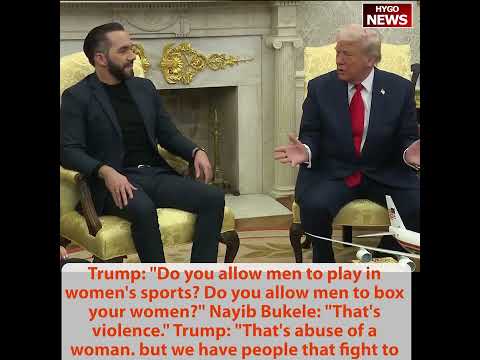
Trump Asks Bukele: “Do You Allow Men to Box Your Women?” — Bukele: “That’s Violence”; Weightlifting Records “Crazy”
President Trump turned to El Salvador President Nayib Bukele during their April 2025 joint appearance and asked: “Do you allow men to play in women’s sports? Do you allow men to box your women?” Bukele’s immediate response — “That’s violence” — produced the most concise international validation of the administration’s gender policy. Trump described weightlifting records being shattered by male competitors and said “the whole thing is crazy,” while Bukele revealed that “most of my cabinet are women” and that El Salvador was “big in protecting women.” The exchange demonstrated that the American gender ideology debate looked absurd from the perspective of the rest of the world.
”Do You Allow Men to Box Your Women?”
Trump posed the question directly to Bukele.
“Do you allow men to play in women’s sports?” Trump asked. “Do you allow men to box your women and box? Because I know you have a lot of boxers.”
Bukele’s response was instant: “That’s violence.”
Trump agreed: “That’s abuse of a woman.”
He described the American political situation: “But we have people that fight to the death because they think men should be able to play in women’s sports.”
Trump acknowledged the gradations: “Some of those sports, it wouldn’t matter much, but it still matters. Some of them are very dangerous for women.”
The exchange was powerful because of its simplicity. Trump asked a foreign leader — one who governed a country with traditional values — whether his country allowed biological males to compete against women. Bukele didn’t need to think about it. He didn’t consult advisors or parse the question for political implications. He said “that’s violence” with the immediacy of someone stating the obvious.
The boxing example was the most visceral illustration of the issue. A biological male punching a woman in a competitive boxing match was, in every other legal and social context, classified as assault. Domestic violence laws specifically protected women from male physical aggression. The idea that the same act became acceptable when labeled “sport” was, as Bukele said, violence — regardless of what label was applied.
Bukele: “We’re Big in Protecting Women”
Bukele then provided a longer analysis that grounded the issue in recent feminist history.
“Some years ago — a few years ago — women’s rights movements were pressuring so that we enacted specific laws to avoid men abusing women,” Bukele said. “And I think those laws were great because there were a lot of men abusing women.”
He identified the contradiction: “But now some of the same people are trying to backtrack on that and actually trying to make new laws allowing men to abuse women in sports.”
His conclusion: “So actually, that doesn’t make sense. It doesn’t make sense.”
When Trump asked whether El Salvador had the same issue, Bukele was clear: “No, of course not. We’re big in protecting women.”
Trump approved: “That’s a very important form of protection too.”
Bukele’s analysis was intellectually devastating because it used the feminist movement’s own logic against its current position. The same advocates who had fought for decades to protect women from male violence were now arguing that male violence against women was acceptable in athletic competition. The inconsistency was not a matter of political perspective; it was a logical contradiction that Bukele — coming from outside the American culture war — could see with perfect clarity.
”A Record That Hadn’t Been Broken in 18 Years”
Trump provided the specific athletic example that made the argument concrete.
“They have weightlifting records, right?” Trump said. “A woman gets up — let’s see, she’s incredible. A guy gets up and beats her by a hundred pounds.”
He described the incremental nature of women’s records: “A record that hadn’t been broken in 18 years. They put on an ounce, a quarter of an ounce, an eighth of an ounce for 18 years.”
The contrast: “They have a guy come up — phew.”
His verdict: “The whole thing is crazy.”
The weightlifting example illustrated the biological reality that no amount of political rhetoric could change. Women’s weightlifting records represented the absolute peak of female athletic achievement — records that had been approached and refined over decades of training, nutrition science, and competitive optimization. When a biological male entered the competition, those records were shattered instantaneously. The decades of female achievement were rendered irrelevant by the biological advantages of male physiology.
”Don’t Even Talk About It”
Trump made a candid political admission about the gender sports issue.
“But they continue to fight,” he said. “And I don’t like talking about it because I want to save it for just before the next election.”
He addressed his team: “I say to my people, don’t even talk about it because they’ll change.”
He cited a current example: “I watched this morning — there was a congressman fighting to the death for men to play against women in sports. And you say to yourself, why? What are they doing?”
The strategic observation was remarkably transparent. Trump was acknowledging that the gender sports issue was so politically advantageous for Republicans that he wanted to preserve it as an electoral weapon. If Democrats continued to defend men in women’s sports — a position opposed by approximately 94% of Americans — they would continue losing elections. The rational Republican strategy was to let Democrats keep fighting for an unpopular position rather than pressuring them to change.
”Most of My Cabinet Are Women”
Bukele revealed a detail about his own government.
“As you can see, most of my cabinet are women,” Bukele said.
Trump reacted: “That’s impressive.”
Bukele continued: “And they’re not token hires or anything. They earned their positions.”
Trump noted the dynamic at his own table: “This is very impressive. We’ve had women, but we’ve never had three of them right here. Four and three men.”
The detail that Bukele — the leader of a conservative Central American nation often characterized by Western media as backward — had a majority-female cabinet was a quiet rebuke to the assumption that protecting women’s sports was anti-woman. El Salvador protected women from male athletic competition and simultaneously elevated women to the highest levels of government. The two positions were not contradictory; they were complementary.
The International Perspective
The Trump-Bukele exchange on gender sports was significant because it demonstrated that the American debate over transgender athletes was viewed as absurd by the rest of the world. No other country was seriously debating whether biological males should compete against women in boxing, weightlifting, or other contact sports. The controversy was uniquely American — a product of a political culture in which a vocal minority’s ideological commitments had overridden the biological reality that every other nation took for granted.
When two heads of state discussed the issue and agreed in seconds that men boxing women was “violence,” the American political class’s inability to reach the same conclusion looked less like a genuine debate and more like a peculiar form of institutional dysfunction.
Key Takeaways
- Trump asked Bukele: “Do you allow men to box your women?” Bukele’s instant response: “That’s violence.”
- Bukele analyzed the contradiction: feminist movements “enacted laws to avoid men abusing women. Now the same people are making laws allowing men to abuse women in sports.”
- Trump cited a weightlifting record unbroken for 18 years, shattered instantly by a male competitor: “The whole thing is crazy.”
- Bukele revealed a majority-female cabinet: “We’re big in protecting women.” Trump: “That’s a very important form of protection too.”
- Trump’s political admission: “I don’t like talking about it — I want to save it for just before the next election.”