 HYGO News
 Trump Signs Reciprocal Tariff Order: 'Whatever They Charge, We Charge' -- Including Nonmonetary Barriers
Trump Signs Reciprocal Tariff Order: “Whatever They Charge, We Charge” — Including Nonmonetary Barriers
On February 14, 2025, President Trump signed an executive order establishing reciprocal tariffs on every country that charged the United States more than it was being charged in return. The order went beyond traditional tariff policy by instructing Commerce Secretary Howard Lutnick and other cabinet officials to quantify nonmonetary trade barriers — regulatory obstacles, testing requirements, and market access restrictions that countries used to keep American products out without formally imposing tariffs. Trump explained the concept with a memorable example: some countries “drop a bowling ball on the hood of a car” and reject the vehicle if the hood dents, effectively banning American automobiles through regulatory theatrics rather than stated tariff rates.
The Reciprocal Principle: “Whatever They Charge, We Charge”
Trump’s executive order was built on what he described as the simplest possible trade formula. “Whatever they charge, we charge,” Trump said. “So nobody can complain. I don’t think anybody can complain.”
The president read from the order itself, establishing the formal policy: “I have decided, for purposes of fairness, that I will charge a reciprocal tariff — meaning, whatever countries charge the United States of America, we will charge them. No more, no less.”
The order also addressed the VAT system used by many European countries, which Trump argued functioned as a hidden tariff. “For purposes of this United States policy, we will consider countries that use the VAT system, which is far more punitive than a tariff, to be similar to that of a tariff,” the order stated.
Trump framed the entire approach as an escape valve for trading partners who objected. “In some cases, if a country feels that the United States would be getting too high a tariff, all they have to do is reduce or terminate their tariff against us,” he said. “In which case, we’re going to pay the same thing. There is no tariff.”
The Bowling Ball on the Hood: Nonmonetary Barriers
The most vivid moment of Trump’s remarks came when he explained what nonmonetary trade barriers looked like in practice.
“That’s where they charge and they do things that aren’t — there’s no dollar amount, but they make it impossible for you to do business,” Trump said. He then offered an example that instantly communicated the absurdity of the practices.
“They do tests on cars, like dropping a bowling ball on the hood of a car,” Trump said. “If the hood doesn’t withstand it, which no hood would except for an Army tank, then they say, ‘I’m sorry, you can’t sell your car into a certain country.’ That’s a nonmonetary tariff.”
The bowling ball anecdote, which Trump had used in various forms during his first term and the 2024 campaign, was effective because it made an abstract trade policy concept immediately understandable. Countries that wanted to block American products did not always do so through visible tariffs. Instead, they created testing requirements, inspection protocols, certification standards, and regulatory hurdles that were designed to fail — effectively banning imports without declaring a formal trade barrier.
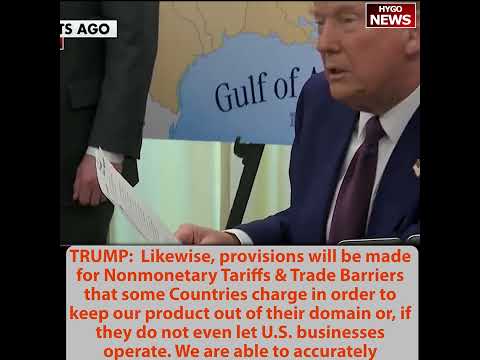
Trump noted that some countries went even further. “In some countries, they just won’t let us even operate there,” he said. “They charge us a lot, but they won’t even let us go in.”
Commerce Secretary Lutnick to Quantify the Barriers
Trump announced that Commerce Secretary Howard Lutnick, standing behind him during the signing, would be responsible for converting these nonmonetary barriers into dollar equivalents.
“What he’s going to be doing is he’s going to come up with a number that’s an equivalent number to that,” Trump said. “But they effectively don’t let us do business, so we’re going to put a number on that that is a fair number.”
Trump expressed confidence in the methodology. “We’re able to accurately determine the cost of these nonmonetary trade barriers, and we’ll be able to do that very accurately,” he said.
The assignment was one of the most complex tasks in trade policy. Converting regulatory barriers, testing requirements, and market access restrictions into specific dollar amounts required analysis of each country’s entire regulatory framework as it applied to American goods and services. Lutnick’s Commerce Department would need to work with the State Department, Treasury, and the United States Trade Representative to produce numbers that could withstand both diplomatic scrutiny and potential legal challenges.
Trump directed all four agencies to collaborate: “I have instructed my Secretary of State, my Secretary of Commerce, Secretary of the Treasury, and the United States Trade Representative to do all the necessary work to deliver reciprocity to our system of trade.”
The EU Already Responded
Trump cited immediate evidence that the reciprocal approach was already producing results before the order was even signed.
“I believe I heard that the EU today or yesterday lowered the tariff on their cars to 2.5 percent, because that’s what we charge,” Trump said. “And they lowered it from 10 percent, but it was really much higher than 10 percent. But 10 percent to 2.5 — that’s already happened.”
He added with evident satisfaction: “That’s a big win. We’ve been after that to happen for many years, but it never happened. But nobody did anything about it sitting in this lovely chair.”
The EU’s preemptive tariff reduction illustrated the leverage that credible reciprocal action provided. The mere announcement of the policy was sufficient to change behavior, before a single retaliatory tariff had actually been imposed. For Trump, this validated the central argument for reciprocity: countries would adjust their own policies voluntarily when faced with the prospect of equivalent treatment.
”No Tariffs If You Build in the United States”
Trump emphasized a key feature of the reciprocal system: the zero-tariff incentive for domestic manufacturing.
“There are no tariffs if you manufacture or build your product in the United States,” Trump said. “So if you build your product in the United States, there are no tariffs, nothing. You don’t have to worry about it. It doesn’t exist.”
He predicted the policy would drive a manufacturing renaissance. “A lot of companies will come back to the United States to build their product, make their product in the United States, because there will be no tariff, nothing,” Trump said.
The manufacturing incentive was designed to address both the trade deficit and domestic employment simultaneously. By creating a tariff-free environment for goods produced on American soil, the policy gave companies a concrete financial reason to locate or relocate production in the United States.
”Our Allies Are Worse Than Our Enemies”
Trump saved some of his sharpest rhetoric for America’s trading partners, drawing a distinction between military alliances and economic behavior.
“Our allies, our allies in many cases are worse than our enemies in this, having to do with trade,” Trump said. “And this has been going along. That’s why we have a $36 trillion amount of money that we owe.”
He connected the trade imbalance directly to the national debt: “We owe $36 trillion, but that will come down rapidly.”
The comment reflected a central grievance of Trump’s trade philosophy: that countries the United States defended militarily — particularly NATO allies in Europe and economic partners in Asia — were simultaneously exploiting America on trade. The reciprocal tariff order was, in this framing, not merely an economic policy but a correction of a decades-long injustice in which American generosity was repaid with commercial exploitation.
Trump characterized the expected revenue from the new tariff system in vivid terms. “The numbers are going to be very fair but staggering,” he said. “They’re going to be large, but very fair. And this should have been done years ago.”
Key Takeaways
- Trump signed an executive order establishing reciprocal tariffs on every country, with the simple formula: “Whatever they charge, we charge. No more, no less.”
- The order directed Commerce Secretary Howard Lutnick and three other cabinet officials to quantify nonmonetary trade barriers — including regulatory obstacles and market access restrictions — and convert them into equivalent tariff rates.
- Trump used the “bowling ball on the hood of a car” example to illustrate how countries create impossible testing standards to block American imports without formally imposing tariffs.
- The EU preemptively reduced its auto tariff from 10% to 2.5% to match the U.S. rate, which Trump called “a big win” achieved before the order was even signed.
- Trump emphasized that goods manufactured in the United States would face zero tariffs, predicting “a lot of companies will come back” to build products domestically.