 HYGO News
 Trump Declares 'The Golden Age of America Is Upon Us'; Shares Father's Advice and Uncle's MIT Legacy
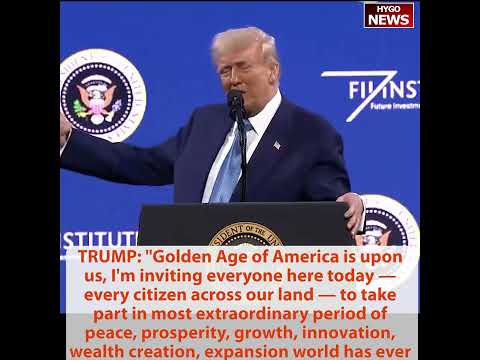
Trump Declares “The Golden Age of America Is Upon Us”; Shares Father’s Advice and Uncle’s MIT Legacy
During a February 2025 address that blended personal reflection with sweeping policy vision, President Trump shared what he called the best advice he ever received — watching his father’s example of loving one’s work — revealed family history about his uncle Dr. John Trump, the longest-serving professor in MIT history, and declared that “the Golden Age of America is upon us.” Trump invited “every citizen across our land to take part in the most extraordinary period of peace, prosperity, growth, innovation, wealth creation, and expansion the world has ever seen,” then pivoted to announce that reciprocal tariffs would soon be imposed on any country engaging in “unfair and unequal trading practices,” specifically singling out the European Union’s VAT tax as “devastating."
"You Have to Love What You Do”
When asked about the best advice he had ever received, Trump offered a deeply personal answer rooted in observing his father, Fred Trump.
“I was watching my father,” Trump said. “My father was a very hard worker, and he just worked hard. And he was very smart. He had good genetics.”
Trump then revealed a family history detail that connected his lineage to one of America’s most prestigious scientific institutions. “His brother was the longest-serving professor in the history of MIT, Dr. John Trump,” the president said. “And my father was every bit as smart, but my father had a work — he was older, and he put his brother through school. In fact, he once said, ‘Boy, I put him through so much school.’ He had three different degrees, and they asked him to stay on at MIT.”
Dr. John G. Trump was indeed a renowned physicist and electrical engineer at MIT, where he served for decades and was recognized for his pioneering work in high-voltage generators and radiation therapy for cancer treatment. The fact that Donald Trump’s uncle was a prominent MIT scientist added a dimension to the Trump family story that was often overlooked in political coverage.
Trump drew the lesson directly from watching his father. “I noticed that my father was a happy man,” he said. “And what he did is he worked. He just worked all the time. He worked, worked, worked, and he loved it.”
The advice: “You have to love what you do. And if you love what you do, you’re going to have a happy life.”
Trump expanded on the principle. “If you don’t — I mean, I see so many people. They’re in businesses that they don’t want to be in. They’re in businesses that they’re bored in or they’re not good at. They don’t have a natural ability at it,” he said. “There is such a thing as natural ability, whether it’s sports or acting or anything else. I mean, some people have an ability for something. Try and find that ability."
"The Golden Age of America Is Upon Us”
Trump then transitioned from personal reflection to his grandest declaration about his second term’s ambitions.
“The Golden Age of America is upon us,” Trump said. “And I’m inviting everyone here today and every citizen across our land to take part in the most extraordinary period of peace, prosperity, growth, innovation, wealth creation, and expansion the world has ever seen.”
The “Golden Age” framing had been a recurring theme since before the inauguration, but this iteration was the most expansive version yet. Trump was not merely promising economic growth or job creation; he was describing a civilizational moment that encompassed peace, innovation, discovery, and what he called “a quantum leap in the quality of life.”
He cited the administration’s early momentum as evidence. “We’re on our way. I mean, everyone’s talking about us,” Trump said. “Three weeks. We’re in there for a couple of days more than three weeks. And everyone’s talking about it. You have to see the crowds of people outside. It’s pretty amazing what’s happening.”
Trump painted an optimistic picture of the near future. “We’re on the verge of soaring markets, surging incomes, booming production, groundbreaking technologies, thrilling discoveries, and a quantum leap in the quality of life,” he said. “Absolutely a quantum leap.”
He delivered the prediction as both a policy commitment and an inevitability: “One day very soon, our country will have the greatest economy in the history of the world, because we once again have a president who puts America first."
"Put Your Country First”
Trump addressed foreign leaders directly — noting that “some of the leaders are in this room right now” — with advice that extended his domestic philosophy to the international stage.
“Your country should put your country first,” Trump told foreign attendees. “But in the end, we want America first.”
He then offered a framework for how American strength would benefit others. “And when it’s all beautiful, which is going to be pretty soon, we want to help other countries, and you want to help other countries,” Trump said. “But I tell your leaders — and some of the leaders are in this room right now — you’ve got to put your country first, whether it’s Saudi Arabia, whether it’s something else, you’ve got to put your country first.”
The message was both nationalist and generous: America would prioritize its own interests first, but a strong and prosperous America would have “plenty left over to help others also.” The sequence mattered — self-strengthening first, international generosity second — because it reversed the approach that Trump attributed to previous administrations, which he characterized as sacrificing American interests for the benefit of foreign nations.
Reciprocal Tariffs: “Ransack and Plunder”
Trump pivoted from the aspirational to the specific, connecting the Golden Age vision to the trade policy that would fund it.
“We’ll no longer allow other countries to ransack and plunder our nation,” Trump said. “That’s why I’ve announced that we will soon begin imposing reciprocal tariffs on any country that engages in unfair and unequal trading practices.”
He restated the core principle: “If they tariff us, as I said, we will tariff them at the exact same rate.”
Trump then singled out the European Union for particular criticism, focusing on the VAT (Value Added Tax) system that he argued functioned as a hidden tariff.
“Some of these countries, even countries that I’ve already mentioned, are extremely aggressive with tariffs,” Trump said. “Nobody knows that. European Union — they have a VAT tax. It’s devastating. It’s very tough for people on the outside. Hard to sell cars, really impossible to sell them, because they also have non-monetary tariffs that are very, very tough.”
The VAT issue had become a central element of Trump’s trade argument. The EU’s VAT system — which taxed goods at each stage of production and sale — applied equally to domestic and imported goods in theory, but in practice functioned as an additional cost layer that foreign exporters had to absorb while EU companies could recover their VAT payments through the tax system. Trump’s decision to treat VAT as equivalent to a tariff for purposes of reciprocal policy was one of the most aggressive elements of his trade framework.
“If you take a look at that, it’s a very unfair situation, and the VAT tax is similar to the tariff,” Trump concluded.
The Audience and the Moment
The remarks were delivered to an audience that included both American business leaders and foreign dignitaries, giving the address a dual purpose. For domestic listeners, the Golden Age declaration and the reciprocal tariff announcement reinforced the message that the Trump administration was moving aggressively to restore American economic dominance. For foreign leaders in the room, the message was more pointed: adjust your trade practices voluntarily, or face equivalent treatment from the world’s largest economy.
The personal opening about his father’s advice and his uncle’s MIT career added an unusual dimension of vulnerability to a speech that was otherwise characterized by presidential assertiveness. By connecting his own work ethic and ambition to a family story that spanned two generations, Trump was suggesting that the Golden Age he envisioned was not merely a political project but an extension of values that had been instilled in him from childhood.
Key Takeaways
- Trump said the best advice he ever received came from watching his father: “You have to love what you do. And if you love what you do, you’re going to have a happy life.”
- He revealed that his uncle, Dr. John Trump, was “the longest-serving professor in the history of MIT” with three degrees, and that his father “was every bit as smart” but chose to work and put his brother through school.
- Trump declared “the Golden Age of America is upon us” and invited citizens to participate in “the most extraordinary period of peace, prosperity, growth, innovation, wealth creation, and expansion the world has ever seen.”
- He announced reciprocal tariffs on countries engaging in “unfair and unequal trading practices” and singled out the EU’s VAT tax as “devastating” and “similar to a tariff.”
- Trump told foreign leaders in attendance to “put your country first” while promising that a strong America would have “plenty left over to help others also.”