 HYGO News
 Trump Signs Three Executive Orders: IVF Affordability, Radical Transparency, Independent Agency Oversight
Trump Signs Three Executive Orders: IVF Affordability, Radical Transparency, Independent Agency Oversight
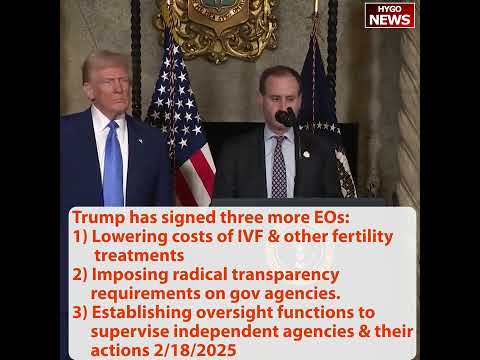
President Trump signed three executive actions on February 18, 2025, covering IVF affordability, government transparency, and oversight of independent agencies. The first directed the Domestic Policy Council to find ways to make in vitro fertilization and other fertility treatments more affordable. The second imposed “radical transparency requirements” on government agencies, mandating public disclosure of waste, fraud, and abuse findings as well as canceled programs and saved taxpayer dollars. The third established oversight functions in the Office of Management and Budget to supervise independent agencies and reestablished the norm that only the president or attorney general can state the government’s legal position. Trump also addressed the Associated Press’s restricted access to the Oval Office, saying he would “keep them out until such time as they agree that it’s the Gulf of America.”
Executive Order 1: Making IVF Affordable
A senior administration official briefed reporters on the first executive order, which addressed fertility treatment costs that had become prohibitive for many American families.
“The first is an executive order relating to the affordability and availability of in vitro fertilization and other fertility treatments,” the official said. “These are treatments that have become unaffordable for many Americans or have been unaffordable for many Americans.”
The order directed the Domestic Policy Council “to examine ways to make IVF and other fertility treatments more affordable for more Americans.” While the order itself was a directive to study and propose solutions rather than an immediate cost reduction, it established IVF affordability as an official administration priority.
The IVF issue had become politically significant during the 2024 campaign after an Alabama Supreme Court ruling raised concerns about the legal status of frozen embryos. Trump had repeatedly promised to protect and expand access to IVF, positioning himself as a champion of families trying to conceive. The executive order was a concrete follow-through on that campaign commitment.
IVF treatments in the United States typically cost between $15,000 and $30,000 per cycle, with many patients requiring multiple cycles. The costs were not covered by most insurance plans, making the treatments effectively inaccessible to middle-class and working-class families. By directing the Domestic Policy Council to examine affordability, Trump was setting the stage for potential regulatory or legislative action that could reduce costs through insurance mandates, tax credits, or direct subsidies.
Executive Order 2: “Radical Transparency”
The second action was a presidential memorandum that the administration described using the term “radical transparency” — an unusually aggressive label for a government disclosure requirement.
“The second item that we signed was a presidential memorandum imposing radical transparency requirements on government departments and agencies,” the official said. “In keeping with President Trump and the administration’s broader commitment to governmental transparency, what this presidential memorandum would do is require — as waste, fraud, and abuse is uncovered, as programs are canceled, and ultimately as taxpayer dollars are saved — this presidential memorandum would require departments and agencies to make all of the details of that freely available to the public.”
The memorandum was designed to work in tandem with DOGE’s audit activities. As Elon Musk’s team identified questionable spending, canceled programs, and recovered taxpayer money, the transparency order would require agencies to publish the details of those findings rather than allowing them to be quietly resolved behind closed doors.
The policy served both accountability and political purposes. On the accountability side, it ensured that the public could verify DOGE’s claims about waste and fraud by reviewing the underlying documentation. On the political side, it created a continuous stream of public disclosures that would reinforce the administration’s narrative about government inefficiency and the value of the DOGE mission.
The “radical” modifier was a deliberate messaging choice. The administration was signaling that its transparency expectations went far beyond conventional Freedom of Information Act compliance. Agencies were not merely required to respond to information requests; they were required to proactively publish the results of waste and fraud reviews.
Executive Order 3: Independent Agency Oversight
The third executive order was the most legally significant, establishing a framework for presidential oversight of independent agencies that had traditionally operated with minimal White House control.
“This executive order would establish important oversight functions in the Office of Management and Budget and its subsidiary office, OIRA, supervising independent agencies and many of their actions,” the official said.
OIRA — the Office of Information and Regulatory Affairs — had long served as the executive branch’s primary tool for reviewing regulations proposed by cabinet departments. However, independent agencies such as the Federal Reserve, the Federal Communications Commission, the Securities and Exchange Commission, and others had historically been exempt from OIRA review. The executive order extended that oversight to independent agencies, a move that would give the White House a formal role in reviewing their regulatory actions.
The order also contained a provision with potentially far-reaching implications: “It also reestablishes the long-standing norm that only the President or the Attorney General can speak for the United States when stating an opinion as to what the law is.”
This provision addressed a pattern in which independent agency heads and general counsels had issued legal interpretations that conflicted with the president’s stated positions. By centralizing legal authority in the president and attorney general, the order was designed to prevent independent agencies from freelancing on legal questions in ways that undermined the administration’s agenda.
The Associated Press Standoff
A reporter asked Trump what it would take for the AP to regain its privileged access to White House spaces, including the Oval Office. The question also referenced concerns within the administration about AP’s style guide, which directed reporters to avoid terms like “illegal immigrant” and to use phrases like “gender-affirming care.”
Trump addressed the style guide concern first. “I do think that some of the phrases that they want to use are ridiculous,” he said. “And I think, frankly, they become obsolete, especially in the last three weeks, because many things have happened in the last three weeks.”
He then turned to the specific issue driving the access restriction: the AP’s refusal to use “Gulf of America” in its reporting. “The Associated Press just refuses to go with what the law is and what is taking place,” Trump said. “It’s called the Gulf of America now. It’s not called the Gulf of Mexico any longer. I have the right to do it, just like we have the right to do Mount McKinley. And nobody’s even challenging that. But only the Associated Press — essentially, it’s primarily the Associated Press.”
Trump stated the condition for restoring access: “I just say that we’re going to keep them out until such time as they agree that it’s the Gulf of America. We’re very proud of this country, and we want it to be the Gulf of America.”
He then broadened his critique. “The Associated Press, as you know, has been very, very wrong on the election, on Trump and the treatment of Trump and other things having to do with Trump and Republicans and conservatives,” Trump said. “And they’re doing us no favors. And I guess I’m not doing them any favors. That’s the way life works.”
The standoff with the AP was unprecedented in modern presidential history. The AP had served as the primary wire service for White House pool reports for decades, and its restricted access created a practical problem for the entire press corps. However, Trump framed the issue as one of factual accuracy rather than press freedom: the Gulf of America was its legal name under executive order, and an outlet that refused to use the legal name was not reporting facts.
Key Takeaways
- Trump signed an executive order directing the Domestic Policy Council to find ways to make IVF and other fertility treatments more affordable for American families, following through on a 2024 campaign promise.
- A presidential memorandum imposed “radical transparency requirements” on agencies, mandating public disclosure of all waste, fraud, and abuse findings as well as canceled programs and saved taxpayer dollars.
- A third executive order extended OMB/OIRA oversight to independent agencies and reestablished that only the president or attorney general can state the U.S. government’s official legal position.
- Trump said the AP would remain restricted from Oval Office access “until such time as they agree that it’s the Gulf of America,” calling their refusal to use the legal name a factual error.
- Trump dismissed the AP’s style guide prohibitions on terms like “illegal immigrant” as “ridiculous” and said such phrases had “become obsolete” in the three weeks since he took office.