 HYGO News
 Trump Unveils $5 Million 'Gold Card': Replace EB-5, Create Jobs, Potentially Eliminate National Debt
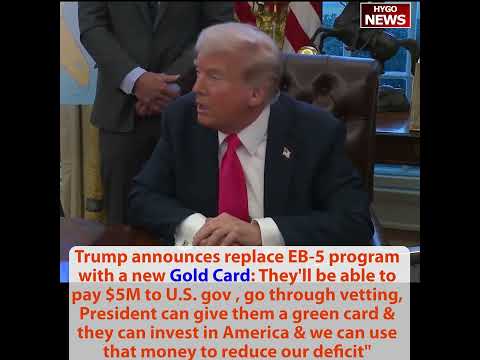
Trump Unveils $5 Million “Gold Card”: Replace EB-5, Create Jobs, Potentially Eliminate National Debt
President Trump announced on February 25, 2025, that the United States would replace the fraud-ridden EB-5 immigrant investor program with a new “Gold Card” that would sell for $5 million and provide “green card privileges-plus” with a path to citizenship. Trump said the program would bring in “wealthy and successful” people who would “spend a lot of money, pay a lot of taxes, and employ a lot of people.” Commerce Secretary Howard Lutnick explained the mechanics, noting that buyers would be vetted as “wonderful world-class global citizens.” Trump projected that selling one million cards would generate $5 trillion — enough to dramatically reduce or eliminate the $35 trillion national debt. The program was expected to launch within two weeks.
The Gold Card Concept
Trump introduced the program by contrasting it with the existing green card system. “We’re going to be selling a gold card. You have a green card. This is a gold card,” he said.
He outlined the basic terms: “We’re going to be putting a price on that card of about $5 million, and that’s going to give you green card privileges. Plus, it’s going to be a route to citizenship.”
Trump described the target demographic. “Wealthy people will be coming into our country by buying this card,” he said. “They’ll be wealthy, and they’ll be successful, and they’ll be spending a lot of money and paying a lot of taxes and employing a lot of people.”
He expressed confidence in the concept: “We think it’s going to be extremely successful. It’s never been done before or anything like this.”
Trump noted that the program had already cleared legal review. “We have it all worked out from the legal standpoint. It’s totally legal to do,” he said. “It hasn’t been done before. It’s been done in many different forms. We give them away. Why should we give them away? We shouldn’t give them away.”
The philosophical argument was simple: the United States had been distributing residency and citizenship through programs like the diversity visa lottery and the EB-5 investor program at low or no cost to the government. The gold card monetized what was already one of the most valuable commodities in the world — American residency — at a price that reflected its true market value.
Replacing the “Ridiculous” EB-5 Program
Commerce Secretary Howard Lutnick provided the policy rationale for the transition from EB-5 to the gold card.
“The EB-5 program was really — you lend some money, but it was all — it was full of nonsense, make-believe, and fraud, and it was a way to get a green card that was low priced,” Lutnick said.
He then framed the gold card as Trump’s alternative: “So the President said, rather than having this sort of ridiculous EB-5 program, we’re going to end the EB-5 program. We’re going to replace it with the Trump gold card, which is really a green card gold.”
Lutnick described the mechanics: “They’ll be able to pay $5 million to the U.S. government. They’ll have to go through vetting, of course. We’re going to make sure they’re wonderful world-class global citizens. They can come to America. The President can give them a green card, and they can invest in America, and we can use that money to reduce our deficit.”
He then posed the fundamental question that justified the program: “Why do we give out lotteries of green cards? Why do we give out EB-5 for green cards? The President of the United States understands that the right answer is: why don’t we eliminate the deficit of the United States of America instead?”
The argument reframed immigration policy through an economic lens. If the United States was going to admit immigrants, it should admit immigrants who brought maximum economic value — and charge them accordingly. The $5 million price tag was not arbitrary; it was designed to attract the kind of ultra-high-net-worth individuals who would create jobs, pay substantial taxes, and invest in the American economy.
The Revenue Projections
Trump then provided the math that transformed the gold card from an immigration policy into a fiscal strategy.
“We’ll be able to sell maybe a million of these cards, maybe more than that,” Trump said. “And if you add up the numbers, they’re pretty good.”
He calculated: “As an example, a million cards would be worth $5 trillion. $5 trillion.”
The audience reacted audibly. Trump continued with an even more ambitious projection: “And if you sell 10 million of the cards, that’s a total of $50 trillion.”
He connected the revenue to the national debt: “Well, we have $35 trillion in debt. That’d be nice.”
Trump tempered the projections with appropriate hedging: “So we’ll see. But it could be great. Maybe it will be fantastic.”
The numbers were aspirational. Whether one million or ten million ultra-wealthy individuals worldwide would pay $5 million each for American residency was uncertain. But the conceptual framework — monetizing American citizenship to pay down the national debt — was bold enough to capture both public imagination and serious policy debate.
Who Would Buy
Trump and Lutnick identified several categories of potential gold card purchasers.
Wealthy individuals: The primary market would be high-net-worth individuals globally who wanted the security, lifestyle, and business environment of the United States. “Generally speaking, it will be people with money and people that create jobs,” Trump said.
Companies hiring talent: “Apple and all these companies that want to get people to be working for them will be able to buy a card,” Trump said. He described a scenario in which corporations would sponsor gold cards for exceptional employees: “You today graduate from the Wharton School of Finance, or Harvard, or Stanford, or any college, and nobody knows if you can even go to work for a company. So companies will pay to get people in.”
Top graduates: “For the people that are number one in their class at top schools, I see that as one of the things,” Trump said, suggesting that extraordinary academic achievement could be a factor in gold card eligibility even when the individual applicant might not personally have $5 million.
Tax Treatment
Trump addressed the tax implications of the gold card with a framework that distinguished between domestic and foreign income.
“They won’t have to pay any tax on income outside of the United States, which they’re not paying right now — they’re not citizens,” Trump said. “But they’ll have to pay if they create jobs in the United States. They’ll pay full taxes like everybody else.”
The structure was designed to be attractive to international business people who maintained operations in multiple countries. Foreign income would remain untaxed — consistent with the existing treatment of non-resident aliens — while any economic activity within the United States would be subject to normal American tax rates.
“So you’re getting big taxpayers, big job producers,” Trump summarized.
The Timeline
Trump said the program would launch quickly. “It’s something that we’re going to be putting out over the next, would you say, two weeks out?” he asked, turning to Lutnick for confirmation.
The two-week timeline was aggressive for a program of this scope, but the administration had demonstrated throughout its first month that it was willing to move at a pace that would have been considered impossible under previous administrations. The claim that the program had already been approved by administration lawyers suggested that the legal framework was in place and the launch was a matter of logistics rather than policy development.
Key Takeaways
- Trump announced a $5 million “Gold Card” that would replace the EB-5 program, providing “green card privileges-plus” with a path to citizenship for vetted wealthy individuals.
- Commerce Secretary Lutnick called the EB-5 program “full of nonsense, make-believe, and fraud” and said the gold card would ensure buyers were “wonderful world-class global citizens.”
- Trump projected that selling one million gold cards would generate $5 trillion, noting the national debt stood at $35 trillion: “That’d be nice.”
- Gold card holders would pay no tax on foreign income but full U.S. taxes on domestic economic activity, designed to attract “big taxpayers, big job producers.”
- Companies like Apple would be able to purchase gold cards to bring in top talent, including “people that are number one in their class at top schools.”