 HYGO News
 Trump Answers 'What Is a Woman?' -- 'Easy for Me'; Alina Habba Sworn In as U.S. Attorney: 'Every Dream I've Surpassed'
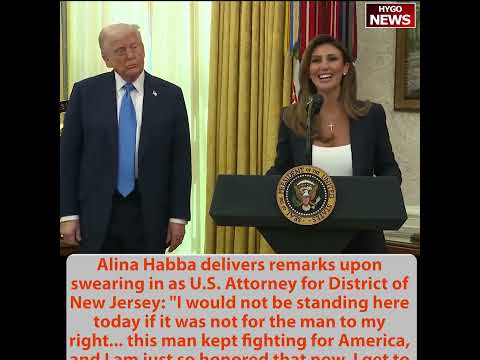
Trump Answers “What Is a Woman?” — “Easy for Me”; Alina Habba Sworn In as U.S. Attorney: “Every Dream I’ve Surpassed”
President Trump answered the question that had stumped Democrats for years — “What is a woman?” — with a response that was both humorous and pointed: “A woman is somebody that can have a baby. A woman is a person who’s much smarter than a man. A woman is a person that doesn’t give a man even a chance of success.” He called men in women’s sports “ridiculous and very demeaning to women” and a “94 percent issue.” In a separate segment, Alina Habba was sworn in as U.S. Attorney for the District of New Jersey by AG Pam Bondi, delivering emotional remarks: “I would not be standing here today if it was not for the man to my right."
"What Is a Woman?”
A reporter posed the question with deliberate context.
“Since Democrats seem to struggle answering this question, I want to ask you: What is a woman, and why is it important that we understand the difference between men and women?”
Trump’s answer came without hesitation: “Well, it’s sort of easy to answer for me because a woman is somebody that can have a baby under certain circumstances. She has a quality.”
He then pivoted to the compliments that drew laughter: “A woman is a person who’s much smarter than a man — I’ve always said that.”
More humor: “A woman is a person that doesn’t give a man even a chance of success.”
Then the serious turn: “And a woman is a person that in many cases has been treated very badly, because I think that what happens with this crazy, this crazy issue of men being able to play in women’s sports is just ridiculous and very unfair to women and very demeaning to women.”
The “what is a woman” question had become one of the defining cultural tests of American politics. Supreme Court Justice Ketanji Brown Jackson had declined to answer the question during her confirmation hearing in 2022, saying “I’m not a biologist.” Democratic politicians had tied themselves in rhetorical knots trying to define womanhood without offending gender ideology advocates. The question that every human being could answer at age five had become an impossibility for one political party.
Trump’s answer demonstrated why the question was devastating for Democrats. He answered it immediately, without qualification, and in terms that 94% of Americans agreed with. The contrast between his effortless response and the Democratic Party’s years of contorted non-answers was itself the political message.
”A 94 Percent Issue”
Trump cited the polling that quantified the political consensus.
“And that’s got to be about a 94 percent issue,” he said. “I read today it was a 94 percent issue.”
He recounted the Democratic response: “And I watched the other day — I watched a congressman, a well-known Democrat congressman, fighting for the fact that men should be allowed to compete essentially in women’s sports.”
Trump’s political assessment: “And I say, I hope they keep that going because they’ll never win another election. That’s a big deal.”
A 94% issue was, by definition, a political consensus so overwhelming that opposing it was electoral suicide. For context, few policy positions in American politics commanded 94% agreement. The bipartisan support for opposing men in women’s sports crossed every demographic line — age, race, party, income, education. Democrats who continued to defend the practice were not taking a courageous minority position; they were alienating virtually the entire electorate.
Trump’s strategic assessment — “I hope they keep that going” — reflected his understanding that the issue was a gift that kept giving. Every time a Democratic politician defended men in women’s sports, the party lost credibility with moderate voters who might otherwise be persuadable on economic or social issues.
”We Love Our Women”
Trump concluded the gender discussion with a statement of values.
“But women are basically incredible people who do so much for our country,” he said. “And we love — we love our women. And we’re going to take care of our women.”
The framing positioned the administration as the defender of women — a reversal of the Democratic narrative that had portrayed Trump as hostile to women’s interests. By defining the protection of women’s spaces, women’s sports, and women’s dignity as core policy priorities, Trump had reappropriated the language of women’s rights from the party that had traditionally claimed ownership of it.
The irony was profound. The party that had spent decades as the self-proclaimed champion of women could not define what a woman was. The party that Democrats had accused of waging a “war on women” was now signing executive orders protecting women’s spaces, defending women’s sports, and using the White House to celebrate women’s achievements.
Alina Habba: “First Generation American”
The compilation then featured the swearing-in of Alina Habba as U.S. Attorney for the District of New Jersey.
Habba’s remarks were personal and emotional. “I would not be standing here today if it was not for the man to my right,” she said, gesturing toward Trump.
She grounded her story in the immigrant experience: “As a person who’s a first-generation American with parents that came in legally, I would like to say that I do not ever, ever take for granted that every dream that I ever could have imagined I have surpassed because of this administration, because of President Trump.”
Habba described her journey: “Four years ago, he entrusted faith in me as his personal attorney, and I have been on the journey of a lifetime every single day for that.”
She then addressed the darker chapters: “But I’ve also been with him through some very dark days when I lost faith in our justice system, when I saw things that I never, ever thought I would ever see.”
Habba described what she had witnessed: “And from being outside the courtroom steps, defending him and defending our great nation, I saw the most resilience I’ve ever seen in my life. This man kept fighting for America.”
Her conclusion: “And I’m just so honored that now I get to fight for the state of New Jersey. I will do a good job. We’ll clean it up, and we’re going to make New Jersey great again.”
Attorney General Pam Bondi then administered the oath of office, with Habba swearing to “support and defend the Constitution of the United States against all enemies foreign and domestic.”
Habba’s appointment carried particular significance because of her personal history with Trump’s legal battles. She had served as one of his personal attorneys during the New York civil fraud case and other legal proceedings. Her transition from defending Trump in court to serving as a federal prosecutor reflected the broader narrative of vindication — the lawyers who had defended Trump against what the administration called “weaponized” prosecution were now being placed in positions to reform the system that had targeted them.
Key Takeaways
- Trump answered “What is a woman?” without hesitation: “Someone who can have a baby. Much smarter than a man. Doesn’t give a man even a chance of success.”
- He called men in women’s sports “a 94 percent issue” and said Democrats who defend it “will never win another election.”
- Alina Habba was sworn in as U.S. Attorney for New Jersey, calling herself “a first-generation American” who “never takes for granted” the opportunities the country provided.
- Habba praised Trump’s resilience: “Through some very dark days when I lost faith in our justice system, this man kept fighting for America.”
- AG Pam Bondi administered the oath; Habba pledged: “We’ll clean it up and we’re going to make New Jersey great again.”