 HYGO News
 Trump: 'Globalists Won't Love This' -- 90,000 Lost Factories Coming Back; Hassett: 'Glimpse of the Golden Age'
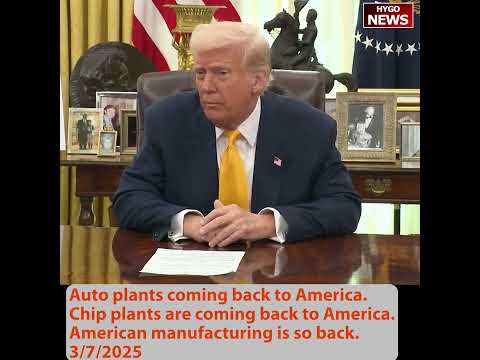
Trump: “Globalists Won’t Love This” — 90,000 Lost Factories Coming Back; Hassett: “Glimpse of the Golden Age”
President Trump and NEC Director Kevin Hassett provided a joint assessment of the economic transformation underway on March 7, 2025. Trump said “globalists won’t love this because this brings jobs back to America” and pledged to “bring back a lot of those 90,000 factories that have been lost over the last number of years.” Hassett delivered a pointed rebuttal to critics who had predicted that deportations would hurt employment: “A lot of people said that if you deported illegals, employment would go down. If you look, 280,000 American-born folks were hired. Manufacturing jobs are going up.” Hassett called the February numbers “a glimpse of the Golden Age to come,” noting that $1.7 trillion in factory commitments “haven’t even happened yet — those aren’t even in the numbers."
"Globalists Won’t Love This”
Trump framed the tariff-driven reshoring explicitly as a choice between global interests and American interests.
“Globalists won’t love this because this brings jobs back to America,” Trump said. “So if they’re coming back to America, maybe you’ll lose some in other parts of the world.”
He offered the counterpoint: “But the other parts of the world have done very well and they’ll continue to do very well. But I think the United States is going to be doing record business.”
The “globalists” reference was Trump’s shorthand for the multinational corporations, international institutions, and political elites who had benefited from the offshoring of American manufacturing. For these actors, cheap overseas labor and minimal trade barriers had produced enormous profits. For American workers and communities, the same dynamics had produced factory closures, wage stagnation, and the hollowing out of the industrial heartland.
Trump then cited a number that captured the scale of the deindustrialization he was reversing. “We’ll bring back a lot of those 90,000 factories that have been lost over the last number of years,” he said. “Think of what 90,000 is. 90,000 plants and factories.”
The 90,000 figure represented the cumulative loss of manufacturing facilities over several decades of globalization. Each closed factory was not just a lost building but a destroyed community — the jobs, the tax base, the small businesses that served factory workers, the schools funded by industrial property taxes. Trump was promising to rebuild what had been dismantled.
“Who’s going to bring back many of those plants and factories?” Trump asked, making the question rhetorical.
Hassett: Deportations Created Jobs, Not Unemployment
NEC Director Hassett addressed one of the most common economic objections to the administration’s immigration enforcement — the prediction that deporting illegal workers would cause labor shortages and hurt the economy.
“A lot of people said that if you deported illegals, employment would go down because no Americans would take those jobs,” Hassett said.
He then cited the data that refuted the prediction. “If you look, 280,000 American-born folks were hired. Manufacturing jobs are going up,” Hassett said.
The February data demonstrated the opposite of what critics had predicted. Rather than creating labor shortages, the reduction in illegal immigrant workers had tightened the labor market in ways that benefited American-born workers. Employers who had relied on cheaper immigrant labor were now hiring Americans at competitive wages. The 280,000 native-born job gains were not merely correlation — they were the direct result of a labor market that was being returned to conditions that favored American workers.
Hassett connected the three pillars of the economic agenda: “You wanted to create domestic, high-paying manufacturing jobs. You wanted to end wasteful government spending and reduce unproductive government workers — and in fact, unleash them into the private economy where they could be more productive. And to create jobs for Americans."
"A Glimpse of the Golden Age to Come”
Hassett placed the February data in the context of what was still ahead.
“This is just out of the expectation of your future policies, really, sir,” Hassett said. “It’s in April when your reciprocal trade act is expected to happen. The tax cuts haven’t passed yet. People are clearly expecting the Golden Age.”
He made the forward-looking case: “If you want to forecast the future numbers, everybody, just keep in mind that President Trump has already gotten us $1.7 trillion in commitments of new factories. Those haven’t even happened yet. Those aren’t even in the numbers.”
Hassett delivered his prediction: “I suspect this is going to be a glimpse of the Golden Age to come, sir.”
The observation was economically significant. The February job gains reflected anticipation of Trump’s policies — companies hiring in expectation of tariffs and tax cuts that had not yet taken full effect. When the April 2 reciprocal tariffs activated, when the reconciliation bill delivered tax cuts, and when the $1.7 trillion in announced factory investments began construction, the employment gains would accelerate far beyond what February showed.
Auto Plants and Chip Plants
Trump described the specific sectors where reshoring was already visible.
“We’ve already had five major automobile companies,” Trump said. “First time you’ve heard this in a long time, since my first term, actually, where we were really rocking and rolling. And then Biden came in and he stopped everything — such a stupid thing to do, not even a believable thing.”
He cited the automotive investments: “We have many auto plants now coming in.”
On semiconductors, Trump described both the TSMC commitment and the history of how America lost the chip industry.
“We have big chip plants. They’re the biggest chip company in the world, most powerful, probably one of the most powerful companies in the world,” Trump said. “When they’re coming in, they’re building one of the largest chip plants in the world. That’ll be done in Arizona, mostly in Arizona. That’ll give us a big percentage. One plant will give us a big percentage of the chip market, something we have very little of.”
He then told the Intel story with characteristic narrative flair. “We used to have Intel, and Intel was run by a man named Andy Grove. Andy Grove was a tough, smart guy. I used to read about him when I was a young man, and he did an incredible job. He really dominated the chip business,” Trump said.
“And then he died, and I guess they had a series of people that didn’t know what the hell they were doing, and we gradually lost the chip business,” Trump continued. “And now it’s almost exclusively in Taiwan. They stole it from us. They took it from us.”
Trump placed the blame: “I don’t blame them. I give them credit. I blame the people that were sitting in the seat, because they allowed it to happen. We could have protected that so easily.”
The Andy Grove narrative personalized the deindustrialization story. A brilliant immigrant had built Intel into the world’s dominant chipmaker. After his death, incompetent successors and indifferent politicians had allowed the industry to migrate overseas. Trump was now bringing it back — not through government subsidies but through tariff leverage that made domestic manufacturing economically inevitable.
Key Takeaways
- Trump said “globalists won’t love this” because tariffs bring jobs back to America and pledged to recover “a lot of those 90,000 factories lost over the last number of years.”
- NEC Director Hassett rebutted predictions that deportations would hurt employment: “280,000 American-born folks were hired. Manufacturing jobs are going up.”
- Hassett called February’s data “a glimpse of the Golden Age to come,” noting $1.7 trillion in factory commitments “haven’t even happened yet — those aren’t even in the numbers.”
- Trump said five major auto companies were building plants in America, “first time you’ve heard this since my first term.”
- He traced the loss of the chip industry to the death of Intel’s Andy Grove and blamed “people that were sitting in the seat” who “allowed it to happen.”