 HYGO News
 Trump on Greenland: 'It Will Happen'; On Canada: 'Not Going to Bend -- We Don't Need Anything They Have'
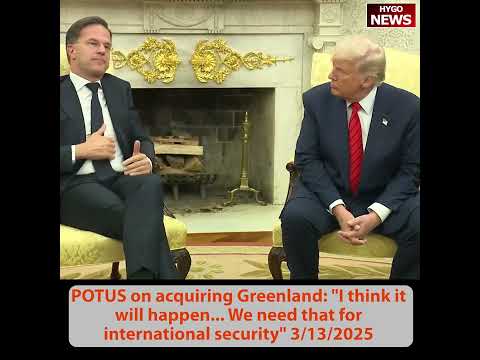
Trump on Greenland: “It Will Happen”; On Canada: “Not Going to Bend — We Don’t Need Anything They Have”
President Trump said “I think it will happen” about acquiring Greenland during a March 2025 exchange, citing “international security” and Chinese and Russian activity in the Arctic. NATO Secretary General Rutte acknowledged the Arctic security concern while diplomatically sidestepping the sovereignty question. Trump then delivered his most extensive case yet for why “Canada only works as a state,” saying the U.S. was “subsidizing Canada for $200 billion a year” and “we don’t need their cars, their energy, their lumber — we don’t need anything they have.” He said he was “not going to bend at all — aluminum or steel or cars” on tariffs, while praising Canadians including “the great one, Wayne Gretzky.”
Greenland: “It Will Happen”
A reporter asked Trump about his vision for Greenland. His answer was his most direct yet.
“I think it will happen,” Trump said. “I’m just thinking — I didn’t give it much thought before, but I’m sitting with a man that could be very instrumental.”
He stated the rationale: “We need that for international security. Not just security — international. We have a lot of our favorite players cruising around the coast, and we have to be careful.”
The “favorite players” reference was to Russian and Chinese naval and military assets that had been increasingly active in Arctic waters. Greenland’s geographic position — between North America and Europe, astride key Arctic shipping routes, and atop vast mineral and energy reserves — made it a strategic asset of the first order.
NATO Secretary General Mark Rutte acknowledged the security concern while carefully avoiding the sovereignty question. “When it comes to Greenland, just — we’re not joining the U.S. I would leave that outside for me this discussion, because I don’t want to drag NATO in that,” Rutte said.
But on the underlying security issue, Rutte agreed completely. “When it comes to the High North and the Arctic, you are totally right,” he said. “The Chinese are now using these routes. We know that the Russians are re-arming. We know we have a lack of icebreakers.”
Rutte endorsed U.S. leadership: “The fact that the seven, outside Russia, seven Arctic countries working together on this under U.S. leadership is very important to make sure that that region stays safe.”
The exchange was diplomatically significant because Rutte was validating the strategic rationale for Greenland’s importance while declining to comment on the acquisition question itself. His acknowledgment that Chinese and Russian activity in the Arctic posed a genuine security threat — and that U.S. leadership was essential to addressing it — gave Trump’s Greenland aspirations a NATO-endorsed security foundation.
”Not Going to Bend at All”
Trump then pivoted to trade policy with the absolute language that characterized his tariff stance.
“Look, we’ve been ripped off for years, and we’re not going to be ripped off anymore,” Trump said. “I’m not going to bend at all — aluminum or steel or cars. We’re not going to bend.”
He described the historical pattern: “We’ve been ripped off as a country for many, many years. We’ve been subjected to costs that we shouldn’t be subjected to.”
The “not going to bend” declaration was directed at trading partners who hoped the administration might soften its position under pressure. Whether the pressure came from Wall Street volatility, allied government complaints, or media criticism, Trump was signaling that the tariff policy was non-negotiable. The only path to reduced tariffs was for trading partners to reduce their own barriers — the reciprocity principle in its most absolute form.
”Canada Only Works as a State”
Trump delivered his most comprehensive argument yet for why Canada’s relationship with the United States was fundamentally unsustainable in its current form.
“In the case of Canada, we’re spending $200 billion a year to subsidize Canada,” Trump said. “I love Canada. I love the people of Canada. I have many friends in Canada. The great one, Wayne Gretzky — how good is Wayne Gretzky? He’s the great one.”
The personal warmth toward Canadians — and the Gretzky shout-out — served as a cushion for the harsh economic argument that followed.
“But the United States can’t subsidize a country for $200 billion a year,” Trump said. He then listed what the U.S. did not need from Canada: “We don’t need their cars. We don’t need their energy. We don’t need their lumber. We don’t need anything that they give.”
He explained the current arrangement: “We do it because we want to be helpful, but it comes a point when you just can’t do that. You have to run your own country.”
Trump then made the statehood argument with geographic logic. “To be honest with you, Canada only works as a state,” he said. “We don’t need anything they have. As a state, it would be one of the great states anywhere.”
He described the visual appeal: “This would be the most incredible country visually. If you look at a map, they drew an artificial line right through it between Canada and the U.S. Just a straight artificial line. Somebody did it a long time ago, many decades ago, and it makes no sense.”
Trump even offered cultural concessions: “It’s so perfect as a great and cherished state. Keeping ‘O Canada’ as the national anthem. I love it. I think it’s great. Keep it. But it will be for the state, one of our greatest states. Maybe our greatest state.”
He returned to the economic bottom line: “Why should we subsidize another country for $200 billion? Of course, it’s $200 billion a year.”
He repeated the independence argument: “We don’t need their lumber. We don’t need their energy. We have more than they do. We don’t need anything. We don’t need their cars. I’d much rather make the cars here. There’s not a thing that we need.”
Trump acknowledged the transition costs but minimized them: “There’ll be a little disruption, but it won’t be very long.”
He concluded with the asymmetry that defined the relationship: “They need us. We really don’t need them. And we have to do this. I’m sorry. We have to do this.”
Key Takeaways
- Trump said Greenland acquisition “will happen,” citing “international security” with Chinese and Russian activity in the Arctic. NATO’s Rutte validated the security concern.
- He declared “not going to bend at all” on tariffs — aluminum, steel, or cars — saying “we’ve been ripped off for years.”
- Trump called Canada’s current relationship unsustainable: “We’re subsidizing Canada $200 billion a year. We don’t need their cars, energy, lumber — we don’t need anything they have.”
- He argued “Canada only works as a state,” describing the border as “an artificial line” and offering to let the state keep “O Canada” as its anthem.
- Trump praised Wayne Gretzky and Canadian people but concluded: “They need us. We really don’t need them. And we have to do this.”