 HYGO News
 Trump: 'We Don't Want Canada to Make Cars for Us'; Confirms Daily China Contact; Signs Workforce EO for 1 Million Apprenticeships
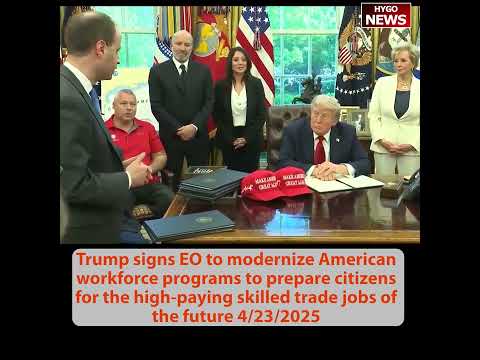
Trump: “We Don’t Want Canada to Make Cars for Us”; Confirms Daily China Contact; Signs Workforce EO for 1 Million Apprenticeships
President Trump signed an executive order on workforce development in April 2025, targeting one million new apprenticeships to fill jobs created by manufacturing reshoring. He was blunt about Canada: “We don’t really want Canada to make cars for us, to put it bluntly. We want to make our own cars, and we’re now equipped to do that.” He questioned the $200 billion U.S. subsidy: “I asked Carney why we’re spending $200 billion to subsidize Canada, and he was unable to answer the question. We don’t need their oil, their lumber, their cars — we don’t need anything.” When asked about China negotiations, Trump confirmed: “Yeah, of course — every day.” The workforce EO aimed to “bring back tradecraft to America” and train workers for the factories tariff policy was creating.
”We Want to Make Our Own Cars”
Trump addressed Canada with a directness that previous presidents had avoided.
“We don’t really want Canada to make cars for us, to put it bluntly,” Trump said. “We want to make our own cars, and we’re now equipped to do that.”
He described the problem: “They took a lot of our car business. Mexico too, took a lot of our car business. We want to make the cars here.”
He drew the line: “I’m running this country. I’m not running Canada.”
He recounted a conversation with Canada’s prime minister: “I asked Carney, who I call Governor Carney, affectionately — I asked him, why are we spending $200 billion to support Canada, to subsidize Canada, and he was unable to answer the question.”
He pressed the point: “I mean, why are we doing that?”
He assessed Canada’s economic dependency: “As a state, it works great. As a nation, considering the fact that most of the nation, 95% of Canada, what they do is they buy from us and they sell to us.”
He cataloged the unnecessary imports: “We don’t need their oil. We have more oil than anyone. But we don’t need their oil, we don’t need their lumber, we don’t need their cars, we don’t need anything.”
He framed the fundamental question: “Representing this country, why are we spending $200 billion to support and subsidize another country?”
He cited Carney’s own admission: “Because if they didn’t have us, and if we didn’t spend that money, as Carney told me, they would cease to exist. He said that to me. They would cease to exist — which is true. Certainly as a country.”
The “$200 billion subsidy” figure represented the combination of the bilateral trade deficit and various economic advantages that Canada derived from its relationship with the United States. American consumers purchased Canadian oil, lumber, automobiles, and other goods at prices that effectively subsidized Canadian industries. Meanwhile, American auto plants had relocated north of the border to take advantage of Canadian government incentives.
Trump’s argument was economic, not hostile. He wasn’t threatening Canada; he was asking why America was supporting an arrangement that benefited Canada at America’s expense. The fact that Canada’s prime minister reportedly could not answer the question — and reportedly acknowledged that Canada would “cease to exist” without American economic support — validated the premise.
”Direct Contact — Every Day”
A reporter asked the question that markets had been waiting for.
“Has there been any direct contact between the U.S. and China on trade at all?”
Trump’s answer was two words: “Yeah, of course.”
He added: “Every day.”
The confirmation that the United States and China were in daily contact on trade was a significant market-moving statement. Amid media speculation that the two countries were in a standoff with no communication, Trump revealed that negotiations were ongoing at a pace that suggested both sides were actively working toward a deal.
“Every day” meant that the tariff situation was not a frozen conflict. Officials from both countries were engaged in continuous dialogue, exchanging proposals, discussing terms, and working through the complex issues that any U.S.-China trade agreement would need to address.
The Workforce Executive Order
Trump signed an executive order that connected his trade policy to domestic workforce development.
An administration official explained the order: “This executive order is going to charge numerous departments and agencies within the government to reshape the way that we do workforce development.”
The specific target: “We’re looking to get the total number of new apprenticeships up to a million in the country to ensure that in critical job areas — in areas where we currently don’t have enough trained workers — we’re recreating that pipeline.”
The rationale: “Particularly as we onshore industrial jobs and new industries, those industries have the workforce they need to be competitive globally.”
Trump summarized: “This is like a training center for what we’re trying to do, which is jobs and great salaries. It’s a great salary system.”
An official elaborated: “All those factories that you bring in because of your trade policy, we’re going to train people in tradecraft, bring back tradecraft to America so that people can work in these factories with great paying jobs.”
Another official added: “We will work with our state partners and work with our businesses to see exactly who they need in that workforce, and we will skill and upskill these apprentices so they can get right to work.”
The workforce EO addressed what could have been the fatal flaw in the tariff strategy. Bringing manufacturing back to America through tariffs only worked if American workers had the skills to fill the jobs those factories created. Decades of deindustrialization had eroded the skilled trades pipeline — welders, machinists, electricians, tool-and-die makers — that manufacturing depended on.
The one million apprenticeship target was ambitious but necessary. The administration was not merely reshoring factories; it was rebuilding the entire ecosystem of vocational training, apprenticeship programs, and skilled trades development that had been dismantled during the decades when manufacturing was being offshored.
”Bring Back Tradecraft”
The “tradecraft” language was itself significant. For decades, American educational policy had emphasized four-year college degrees as the primary path to economic success, with vocational and trade education treated as a lesser alternative. The result was a nation with too many college graduates in fields with limited job prospects and not enough skilled tradespeople in fields with massive demand.
The workforce EO reversed that hierarchy. Skilled trades — welding, electrical work, plumbing, CNC machining, industrial maintenance — offered “great paying jobs” that didn’t require four-year degrees or the six-figure student debt that accompanied them. By framing these careers as the “American dream,” the administration was redefining success away from college credentials and toward practical skills.
The “America at Work Tour” mentioned by an official suggested a public campaign to promote skilled trades careers, connecting with businesses to identify specific workforce needs and training apprentices to fill those exact positions. The approach was demand-driven rather than supply-driven — training workers for jobs that existed rather than credentials that might or might not lead to employment.
Key Takeaways
- Trump on Canada: “We don’t want them to make cars for us. We don’t need their oil, lumber, or cars — we don’t need anything.” He questioned the $200 billion U.S. subsidy.
- He cited Carney’s admission: “If they didn’t have us, they would cease to exist. He said that to me.”
- Confirmed daily U.S.-China trade contact: “Yeah, of course — every day.”
- Signed workforce EO targeting 1 million new apprenticeships to fill jobs created by tariff-driven reshoring.
- Vision: “Bring back tradecraft to America so people can work in these factories with great paying jobs — remake the American dream.”