 HYGO News
 Trump Announces $20B CMA CGM Investment; 'Why Not American Flags?'; Cabinet Told to Keep Good People
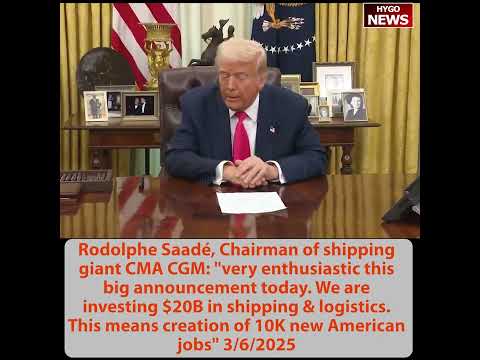
Trump Announces $20B CMA CGM Investment; “Why Not American Flags?”; Cabinet Told to Keep Good People
President Trump welcomed CMA CGM Chairman Rodolphe Saade to the White House on March 6, 2025, to announce a $20 billion investment in American “shipping logistics, infrastructure, and terminals” that would create 10,000 new jobs. Trump asked why international shipping vessels flew “Panamanian flags and Liberian flags” instead of American ones, and Saade committed to tripling CMA CGM’s U.S.-flagged fleet from 10 to 30 ships. Trump also previewed “a massive new program for building very large ships” to be announced in coming weeks, and instructed cabinet members to “keep the good people” while allowing DOGE to cut “people that aren’t doing a good job.”
$20 Billion for American Shipping
Trump introduced Saade with the competitive framing that characterized his approach to corporate announcements.
“Today we’re delighted to be joined by Rodolphe Saade, the chairman and CEO of CMA CGM, one of the largest shipping companies in the world — probably number two in the world,” Trump said. “Probably going to be number one in the not-too-distant future, knowing him.”
He announced the investment: “I’m thrilled to announce that he’s going to be investing $20 billion into the United States because of the election. The election results, which comes along with a lot of other things like great protections and other things.”
Trump described where the money would go: “This massive investment will go toward building out shipping logistics, infrastructure, and terminals, which will create an estimated 10,000 new jobs in America.”
He connected the investment to the broader shipbuilding agenda he had announced during the joint address. “It’s so important because it’s about shipping. We lost our way for many years. We haven’t done anything,” Trump said. “We used to build a ship a day, and now we essentially don’t build ships.”
Trump previewed the next phase: “We’re going to start that, and we’re going to be announcing next week or the week after a massive new program for building very large — larger ships in the world.”
The $20 billion CMA CGM commitment added to the administration’s growing investment scoreboard, pushing the total well past $1.7 trillion. The shipping focus was particularly significant because it addressed an industry that had been almost entirely abandoned by the United States over the previous half-century.
”Why Not American Flags?”
Trump then raised a question that connected shipping investment to national sovereignty — one that few American presidents had addressed publicly.
“Why is it that more people don’t have American flags?” Trump asked. “They seem to have Panamanian flags and Liberian flags. They don’t seem to have a lot of American flags.”
The question referred to the practice of “flags of convenience,” in which shipping companies registered their vessels in countries like Panama, Liberia, and the Marshall Islands to take advantage of lower taxes, less stringent safety regulations, and cheaper labor requirements. The result was that the vast majority of the world’s commercial shipping fleet — including ships owned by companies based in the United States and Europe — flew foreign flags rather than the flag of their home country.
For the United States, the flag-of-convenience system meant that American shipping companies employed foreign crews, paid foreign taxes, and operated under foreign regulations — even when their ships carried American cargo. The U.S.-flagged merchant fleet had shrunk to a fraction of its Cold War-era size, creating a national security vulnerability: in a major conflict, the United States would depend on foreign-flagged vessels to supply its military.
Saade responded directly to Trump’s challenge: “This will change, Mr. President. You will have more ships with U.S. flag as we move forward, and you can count on us to do as much as we can.”
He provided specifics: “We would like also, Mr. President, to go for more U.S.-flag vessels. And we will go from 10 that we operate today to 30 U.S.-flag ships, and hopefully doing more in the months to come.”
The tripling of CMA CGM’s U.S.-flagged fleet — from 10 to 30 ships — was a concrete commitment that went beyond investment dollars. Each U.S.-flagged ship required an American crew, American safety standards, and American tax payments. Thirty ships represented a meaningful expansion of the merchant marine at a time when the nation’s commercial fleet was dangerously small.
Trump expressed satisfaction: “That’s very good. It’s true. The other countries take advantage of us even on that. So we’re going to be changing that around.”
Saade’s Commitment: “$20 Billion and Shipbuilding”
Saade provided his own summary of the investment in formal remarks.
“We are CMA CGM, one of the leaders in shipping and logistics around the world,” Saade said. “We are very enthusiastic about this big announcement today. We are investing $20 billion in shipping and logistics. This means the creation of 10,000 new American jobs.”
He then added a dimension that went beyond the initial announcement: “We’re also looking at investing in shipbuilding of container vessels. And we most probably will be making also an announcement in the next coming weeks.”
The shipbuilding commitment was potentially more significant than the logistics investment. Building container vessels in the United States would require the construction or expansion of shipyards, the training of a skilled workforce, and the development of a domestic supply chain for ship components. Each ship built in America would generate far more economic activity than a ship merely flagged in America.
Cabinet Instructions: “Keep the Good People”
Trump then addressed the relationship between DOGE’s workforce reduction mission and the cabinet’s operational needs.
“I want the cabinet members to keep good people. I don’t want to see a big cut where a lot of good people are cut,” Trump said.
He described the instruction he had given: “I had a meeting and I said, I want the cabinet members to go first — keep all the people you want, everybody that you need.”
Trump acknowledged the tension between efficiency and institutional knowledge: “It would be better if they were there for two years instead of two weeks, because in two years they’ll know the people better. But I want them to do the best job they can.”
He framed the priority: “When we have good people, that’s precious. That’s very important. We want them to keep the good people.”
Then the enforcement mechanism: “We’re going to be watching them, and Elon and the group are going to be watching them. And if they can cut, it’s better. And if they don’t cut, then Elon will do the cutting.”
The “Elon will do the cutting” line established a clear hierarchy. Cabinet secretaries had first right to retain the employees they needed. But if they failed to identify and remove underperformers, DOGE would step in and make the cuts for them. The framework gave cabinet members authority and ownership over their workforces while maintaining DOGE as a backstop that ensured accountability.
The instruction also reflected a maturation of the DOGE approach. The early weeks had been characterized by broad-based actions — emails to all employees, blanket hiring freezes, agency-wide reviews. Trump was now directing a more surgical approach where cabinet secretaries who understood their agencies would make the first-pass decisions, preserving institutional expertise while still achieving workforce reduction.
Key Takeaways
- CMA CGM announced a $20 billion U.S. investment in shipping logistics, infrastructure, and terminals, creating 10,000 jobs, with Chairman Saade committing to triple U.S.-flagged ships from 10 to 30.
- Trump asked “why not American flags?” on shipping vessels, highlighting the flag-of-convenience system where ships fly Panamanian and Liberian flags to avoid U.S. regulations and taxes.
- Saade previewed additional investment in American shipbuilding of container vessels, with a formal announcement expected “in the next coming weeks.”
- Trump instructed cabinet members to “keep the good people” and let secretaries make first-pass retention decisions, with DOGE serving as backstop: “If they don’t cut, then Elon will do the cutting.”
- Trump said “we used to build a ship a day and now we essentially don’t build ships,” previewing “a massive new program” for large-vessel construction.