 HYGO News
 Trump Thanks Musk: 'Treated Unfairly but Respected'; Core GDP +3%, Investment 22%, '$8 Trillion' in New Commitments
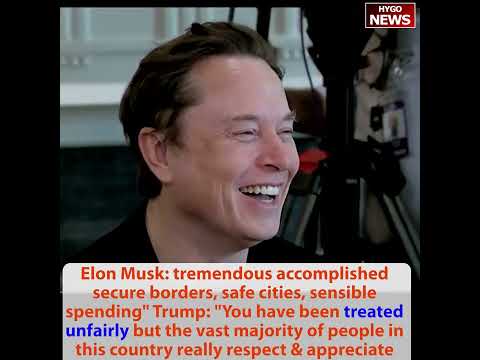
Trump Thanks Musk: “Treated Unfairly but Respected”; Core GDP +3%, Investment 22%, “$8 Trillion” in New Commitments
President Trump and Elon Musk exchanged praise at a 100-day meeting in April 2025. Musk assessed the administration: “The American people voted for secure borders, safe cities, and sensible spending. And that’s what they’ve gotten. A tremendous amount has been accomplished — more than any administration before, ever.” Trump responded: “You have been treated unfairly, but the vast majority of people in this country really respect and appreciate you.” Trump then presented economic data: “Core GDP — removing distortions from imports, inventories, and government spending — was up +3%. Gross Domestic Investment was a whopping 22%.” He announced “$8 trillion” in investment commitments, citing Samsung building “massive facilities” because of tariffs: “If we didn’t do the tariffs, they wouldn’t be doing that.”
Musk: “Greatest Administration Ever”
Musk delivered his assessment of the first 100 days with characteristic directness.
“The American people voted for secure borders, safe cities, and sensible spending,” Musk said. “And that’s what they’ve gotten.”
He quantified the achievement: “A tremendous amount has been accomplished in the first 100 days. As everyone has said, it’s more than has been accomplished in any administration before, ever. Period.”
He projected forward: “This portends very well for the rest of the administration. This could be the greatest administration in the entire country.”
Musk’s endorsement carried unique weight because of his position outside traditional Republican politics. He was not a lifelong conservative or a party loyalist; he was a technology entrepreneur who had supported Democrats for most of his career. His assessment that the Trump administration had accomplished more in 100 days than any administration “ever” was a statement from someone who evaluated performance with the same metrics he applied to his companies — results delivered relative to time invested.
”Treated Unfairly but Respected”
Trump’s response to Musk mixed sympathy with praise.
“We all want to thank you for your help,” Trump said. “You really have sacrificed a lot. You’ve been treated very unfairly.”
Musk interjected with dry humor: “Well, they did like to bend my cars, which is not great.”
Trump continued: “But you have been treated unfairly. But the vast majority of people in this country really respect and appreciate you. And this whole room can say that very strongly.”
He praised the impact: “Really, a tremendous help. You opened up a lot of eyes as to what could be done.”
He offered the invitation: “You’re invited to stay as long as you want. And at some point, he wants to get back to his cars.”
He cited the savings: “He’s done an incredible job. $150 billion.”
He hinted at more: “A lot of stuff is being worked on. That number could be doubled and even tripled. A lot of things are being worked on that we don’t count yet because it’s not quite there.”
The “$150 billion” in DOGE savings — with the potential to “double or triple” — was the most ambitious projection the administration had offered. If realized, $300-450 billion in annual savings would represent approximately 5-7% of the entire federal budget — a reduction that would fundamentally alter the fiscal trajectory of the United States.
The “bending my cars” reference drew laughs but pointed to a serious issue. Tesla vehicles had been vandalized across the country by anti-Musk protesters who opposed DOGE’s government restructuring. The campaign of destruction targeted a consumer product as punishment for its CEO’s public service — a form of political intimidation that the administration consistently condemned.
Core GDP and Investment
Trump turned to economic data with the caveat that the quarterly numbers reflected Biden’s economic legacy.
“For GDP, you probably saw some numbers today,” Trump began. “I have to start off by saying that’s Biden. That’s not Trump, because we came in on January — this is quarterly numbers.”
He cited the key metric: “Core GDP — removing distortions from imports, inventories, and government spending — was up plus 3%.”
He highlighted investment: “Gross Domestic Investment was a whopping 22%.”
He explained what was driving the investment: “I just heard Samsung is now, because of the tariffs, going to build massive facilities in the United States. If we didn’t do the tariffs, they wouldn’t be doing that.”
The distinction Trump drew between headline GDP and “core GDP” was economically sophisticated. Headline GDP numbers in the first quarter could be distorted by companies front-loading imports ahead of tariff deadlines, by inventory buildups, and by government spending patterns inherited from the previous administration. By stripping out these distortions, core GDP showed the underlying momentum of the private economy — and at +3%, it was growing at a healthy pace.
The 22% Gross Domestic Investment figure was the most significant number in the briefing. Investment spending — companies building factories, buying equipment, and expanding capacity — was the leading indicator of future economic growth. A 22% increase in investment meant that businesses were betting heavily on the American economy’s future, committing capital to domestic production at a pace that dwarfed recent history.
”$8 Trillion”
Trump announced the total investment commitments the administration had secured.
“We have more money being spent at any time in the history of our country,” Trump said. “We’re up to close to $8 trillion, I think I can say. And really, it’s going to be a lot higher than that. Those are just the ones we know about.”
He contrasted with Biden: “I’m not sure if Biden did a trillion for four years, $1 trillion. But we’re at $8 trillion for two months — because let’s give us a pass on the first month, we were sort of getting a little bit used to things.”
He described the breadth: “That includes chip companies, car companies, every form of manufacturing, high-tech companies. Nobody’s ever seen anything like it.”
The $8 trillion in investment commitments in roughly 60 working days was an extraordinary figure. It included commitments from major technology companies to build AI data centers, semiconductor fabrication facilities, and manufacturing plants in the United States. The tariff strategy had created the conditions for this investment surge: companies that needed access to the American market were choosing to build in America rather than pay tariffs to import from overseas.
The comparison to Biden’s investment record — “not sure if he did a trillion for four years” — highlighted the difference that policy certainty made. Under Biden, regulatory uncertainty, tax policy ambiguity, and the threat of additional regulations had discouraged domestic investment. Under Trump, tariff protection, deregulation, and the promise of permanent tax cuts had created an environment in which investing in America was the obvious business decision.
Key Takeaways
- Musk on 100 days: “The people voted for secure borders, safe cities, sensible spending — that’s what they’ve gotten. More accomplished than any administration before, ever.”
- Trump to Musk: “You’ve been treated unfairly, but the vast majority respect and appreciate you. $150 billion in DOGE savings — could double or triple.”
- Core GDP (stripping distortions): +3%. Gross Domestic Investment: a “whopping 22%.”
- Trump announced $8 trillion in investment commitments in ~60 working days: “chip companies, car companies, every form of manufacturing.”
- Samsung building “massive facilities” because of tariffs: “If we didn’t do the tariffs, they wouldn’t be doing that.”