 HYGO News
 Trump: 'Every Question Has a Negative Slant'; Aced Cognitive Test; Won't Rule Out Military for Greenland; DOGE Found $160 Billion
Trump: “Every Question Has a Negative Slant”; Aced Cognitive Test; Won’t Rule Out Military for Greenland; DOGE Found $160 Billion
President Trump continued his combative NBC interview in May 2025, calling out the network’s framing: “I want to treat people fairly whether they voted for me or not. It’s very hard because the media is so fake. Every question you ask has a very negative slant.” He revealed he had aced a cognitive test: “I got 100% correct. One doctor said he’d never seen that before. Biden couldn’t have gotten the first question right.” On Greenland: “I don’t rule it out. We need Greenland very badly for international security.” On Canada: “Highly unlikely. I don’t see it.” He cited DOGE’s results: “They found $160 billion worth of fraud, waste, and abuse. We’re not finished yet.” He stated his ambition: “I’ll be an eight-year president, a two-term president."
"Every Question — Negative Slant”
Trump addressed the media’s framing directly.
“I want to treat people fairly, whether they voted for me or not,” Trump said. “I want to have a unified country.”
He identified the obstacle: “It’s very hard because the media is so fake. Even the way you ask questions — every question is asked in a negative vein.”
He provided an example: “There’s a toy company that took a toddler’s — you know, whatever. But you don’t talk about the fact that gasoline is down at numbers that nobody believes possible.”
He explained: “You know why they’re down? Drill baby drill. We’re drilling like crazy right now.”
The interviewer protested: “We try to make sure every question is fair.”
Trump was unbowed: “Every question you ask has a very negative slant.”
He then pivoted graciously: “I’m fine responding to you. I don’t think you’re very difficult at all to respond to, to be honest with you. But you should ask some positive things.”
The exchange encapsulated the fundamental tension between Trump and the media. Trump’s argument was not that journalists shouldn’t ask tough questions but that they should occasionally acknowledge positive developments. The asymmetry — extensive coverage of tariff-affected toy companies but silence on gasoline prices below $2 — was the specific bias he was identifying.
Cognitive Test: “100% Correct”
Trump used the interview to establish his mental fitness.
“I want to be a great president,” Trump said. “I just did a physical. Unlike all other presidents, I took cognitive tests and I aced it. I got 100% correct.”
He cited medical reaction: “One doctor said — there were numerous doctors watching — he said, ‘I’ve never seen that before.’”
He drew the contrast: “Biden didn’t take a cognitive test. He couldn’t have gotten the first question right.”
He stated his ambition: “I just want to serve, do a great job. I’ll be an eight-year president. I’ll be a two-term president.”
He cited historical precedent: “If you look at President Polk, he was a one-term president and he did some great things, pretty good president. I’m not saying you can’t do that. But there’s something about being a two-term president that was very important to me.”
The cognitive test disclosure served a dual purpose. First, it preempted any questions about Trump’s own mental fitness — a topic the media had raised periodically. Second, it provided the sharpest possible contrast with Biden, whose refusal to take a cognitive test had become one of the defining controversies of his presidency.
Greenland: “Don’t Rule It Out”
The Greenland exchange produced the interview’s most geopolitically provocative moment.
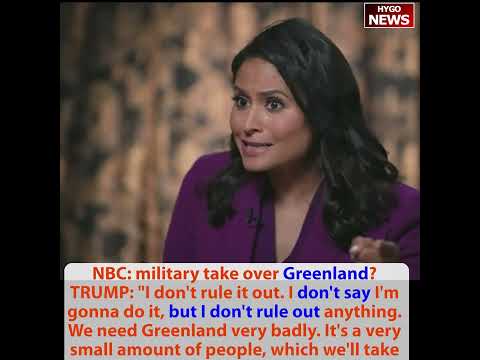
“Would you rule out military force to take Greenland?” the interviewer asked.
“I don’t rule it out,” Trump said. “I don’t say I’m going to do it, but I don’t rule out anything.”
He stated the rationale: “We need Greenland very badly. Greenland is a very small amount of people, which we’ll take care of and we’ll cherish them. But we need that for international security.”
On Canada, Trump was different: “I think we’re not going to ever get to that point. I think it’s highly unlikely. I just don’t see it with Canada.”
He criticized Canada’s military spending: “They spend less money on military than practically any nation in the world. They pay NATO less than any nation. They think we are going to protect them. Really, we are. But the truth is, they don’t carry their full share.”
The refusal to rule out military force for Greenland was calculated ambiguity. Trump was not threatening invasion; he was maintaining leverage. By keeping all options on the table, he maximized pressure on Denmark (which governed Greenland) to negotiate on American terms. The “don’t rule out anything” posture was consistent with Trump’s broader negotiating philosophy: never eliminate an option before you’ve extracted value from its existence.
The distinction between Greenland and Canada was strategically significant. Greenland’s value was military — its location controlled Arctic shipping lanes and hosted the Pituffik Space Base. Canada’s relationship was economic — trade deficits and subsidy questions. Different challenges required different tools.
DOGE: “$160 Billion”
Trump defended Musk’s DOGE operation against the interviewer’s framing.
“What do you say to those who believe Elon Musk’s chainsaw approach has jeopardized safety and security?” the interviewer asked.
“They found $160 billion worth of fraud, waste, and abuse,” Trump replied. “I think he’s done an amazing job.”
He described the team: “They’re brilliant people. They know the computer. I actually asked him, ‘What’s their big trait?’ He said, ‘They’re unbelievable at computers.’ These people are, in many cases, crooks. But it was fraud, waste, and abuse.”
He corrected the question’s framing: “Your question should be asked a different way. Were certain things found? Yes. How much? $160 billion. Think of what $160 billion is.”
He projected forward: “He said he’d find $2 trillion. Well, we’re not finished yet.”
On Musk’s departure: “He’s leaving behind some very brilliant people. Super high-IQ people. I like high-IQ people.”
He added the jab: “The Democrats don’t have many of them.”
The $160 billion figure — with the promise of more to come — represented the most concrete result of DOGE’s work. The “not finished yet” addendum suggested that the fraud and waste identification was ongoing, with additional savings still being cataloged.
Key Takeaways
- Trump on media: “Every question has a negative slant. You talk about toy companies but not gasoline below $2. Drill baby drill.”
- Cognitive test: “100% correct. One doctor said he’d never seen that. Biden couldn’t have gotten the first question right.”
- Greenland: “I don’t rule out military force. We need it for international security.” Canada: “Highly unlikely — they don’t carry their share.”
- DOGE: “$160 billion in fraud, waste, and abuse found. We’re not finished yet. He’s leaving behind very brilliant people.”
- Ambition: “I’ll be an eight-year, two-term president. There’s something about that which was very important to me.”