 HYGO News
 Trump: 'I Would Love to Defund NPR and PBS -- Very Biased, Waste of Money'; Signs EO Suspending Jenner & Block Clearances
Trump: “I Would Love to Defund NPR and PBS — Very Biased, Waste of Money”; Signs EO Suspending Jenner & Block Clearances
President Trump expressed support for defunding NPR and PBS in March 2025, saying “I would love to do that — I think it’s very unfair, it’s been very biased” and “the kind of money that’s being wasted.” He noted that the DOGE subcommittee would review funding the next day and predicted they would “make a decision relatively sooner than later.” Trump also addressed the Houthi strikes and signed an executive order suspending security clearances held by individuals at Jenner & Block LLP, the law firm that employed Andrew Weissmann after the Mueller investigation, for “weaponization of the legal system."
"I Would Love to Do That”
The exchange began when a reporter laid out the political context.
“Tomorrow the subcommittee on DOGE is going to review funding for NPR and PBS,” the reporter said. “Now every Republican president has always promised to take away this money that’s going to these two public news outlets. If they’re successful — I know Senator Kennedy has backed it, Marjorie Taylor Greene, Congress has backed it — would you be interested in defunding and taking away taxpayer dollars to NPR and PBS?”
Trump’s response was immediate: “Well, I would love to do that. I think it’s very unfair. It’s been very biased — the whole group. I mean a whole group of them.”
He then made the media landscape argument: “And frankly, there’s plenty. Look at all the media you have right now. There’s plenty of coverage.”
Trump provided historical context: “I was from a different age, and they spend more money than any other network of its type ever conceived. So the kind of money that’s being wasted, and it’s a very biased view — you know that better than anybody.”
He stated his conclusion: “And I’d be honored to see it end. We’re well covered. Look at all the people that we have here today. We’re well covered, and we don’t need it, and it’s a waste of money.”
The argument had two prongs. First, NPR and PBS were biased — they presented a one-sided view that did not reflect the perspectives of the taxpayers who funded them. Second, the media landscape had changed so dramatically since public broadcasting was created that the original rationale for government-funded media no longer applied. When NPR and PBS were established, Americans had access to three broadcast networks and local newspapers. In 2025, Americans had access to hundreds of cable channels, streaming services, podcasts, social media platforms, and online publications. The argument that the public needed government-funded media to ensure access to information was obsolete.
DOGE Review Coming
Trump deferred to the process that was already underway.
“I don’t even know what DOGE’s recommendation is,” he said. “I assume their recommendation is to close them up.”
He predicted the timeline: “Well, after they hear all the testimony, I think they’re going to make a decision relatively sooner than later. But we’ll see what that turns out.”
Trump then invoked DOGE’s broader record: “I can’t imagine that they wouldn’t, because they have found so much waste, fraud, and abuse.”
The DOGE review of NPR and PBS funding was part of the broader examination of government spending that had already uncovered billions in questionable contracts and expenditures. Placing public broadcasting in the same review process as the $830 million survey contracts and the $22 billion in EPA grants contextualized the funding as one more line item that DOGE would evaluate on its merits.
The bipartisan support that the reporter had cited — Senator John Kennedy and Representative Marjorie Taylor Greene — suggested that the political conditions for defunding public broadcasting had matured. Previous efforts had been treated as fringe proposals; in the DOGE era, they were items on a subcommittee’s review agenda.
Houthis: “We Hit Them Very, Very Hard”
Trump pivoted to national security, offering his most direct public statement on the Houthi campaign.
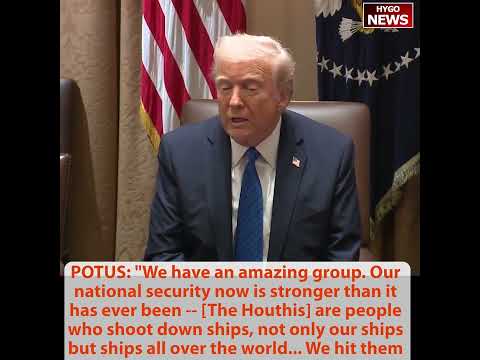
“We have an amazing group,” Trump said. “Our national security now is stronger than it’s ever been.”
He described the threat: “We have had very, very successful numerous attacks on that area. These are people that shoot down ships — not only our ships, ships all over the world. They’re shooting them right out of the water and damaging them badly, or they’re going down. They’re also shooting anything that happens to be flying in the area.”
The response: “We hit them very, very hard.”
The statement was consistent with NSA Waltz’s earlier remarks about the Houthi campaign. The administration had escalated from the Biden-era approach of limited, proportional strikes to a comprehensive campaign designed to degrade the Houthis’ capability. The results were apparent in the reopening of shipping lanes and the declining frequency of attacks.
Jenner & Block: “Weaponization of the Legal System”
Trump then signed an executive order targeting the law firm Jenner & Block LLP.
A White House official introduced the order: “We’ve taken action against a number of law firms that have participated either in the weaponization of government, the weaponization of the legal system for political ends, or have otherwise engaged in illegal or inappropriate activities.”
The official detailed the specific charges: “The law firm of Jenner and Block is one of these law firms. This is a law firm that, as you know, employed Andrew Weissmann after he came off of the Mueller investigation.”
Additional allegations: “It’s a law firm that’s engaged in invidious, racially, and sexually discriminatory practices. It’s also a law firm that has participated in the weaponization of the legal system against American principles and values.”
The remedy: “We believe that the measures in this executive order will help correct that.”
The official identified the central figure: “And Andrew Weissmann is the main culprit — he’s certainly, with respect to this firm, he is one of a number of reasons that we believe this executive order is warranted.”
Trump added: “He’s a bad guy.”
Andrew Weissmann had served as one of the lead prosecutors on Special Counsel Robert Mueller’s investigation of Trump during the first term. He had subsequently joined Jenner & Block and had been a vocal critic of Trump in media appearances and publications. The executive order suspending the firm’s security clearances was a direct response to what the administration characterized as the firm’s role in the broader pattern of legal persecution.
The Pattern: Clearances as Accountability
The Jenner & Block executive order was part of a series of security clearance actions the administration had taken since inauguration. The 51 intelligence officials who signed the Hunter Biden laptop letter, Jack Smith, Alvin Bragg, Letitia James, and now the law firms that had assisted in what the administration called “weaponization” were all having their access to classified information revoked or suspended.
The strategy served multiple purposes. It denied potential adversaries access to sensitive information. It sent a signal to the legal community that firms that participated in political prosecutions would face consequences. And it created accountability for actions that the administration believed had been taken in bad faith.
The connection between the NPR/PBS defunding discussion and the Jenner & Block executive order was thematic: both represented the administration’s willingness to use executive power against institutions it viewed as politically hostile. NPR and PBS used taxpayer money to broadcast content the administration considered biased; Jenner & Block used security clearances that the executive branch controlled to support what the administration considered political persecution. In both cases, the administration’s answer was to withdraw the government’s support.
Key Takeaways
- Trump said he would “love to” defund NPR and PBS: “Very unfair, very biased. The kind of money that’s being wasted. We’re well covered — we don’t need it.”
- The DOGE subcommittee was set to review public broadcasting funding the next day, with Senator Kennedy and Rep. Marjorie Taylor Greene supporting defunding.
- Trump confirmed the Houthi campaign: “These are people that shoot down ships all over the world. We hit them very, very hard.”
- He signed an executive order suspending security clearances at Jenner & Block LLP for “weaponization of the legal system,” citing the firm’s employment of Andrew Weissmann.
- Trump on Weissmann: “He’s a bad guy. He is one of a number of reasons this executive order is warranted.”