 HYGO News
 Trump Suspends Perkins Coie Clearances: 'Honor to Sign'; Won't Defend NATO Non-Payers; 'Only I Know' Russia Wants Deal
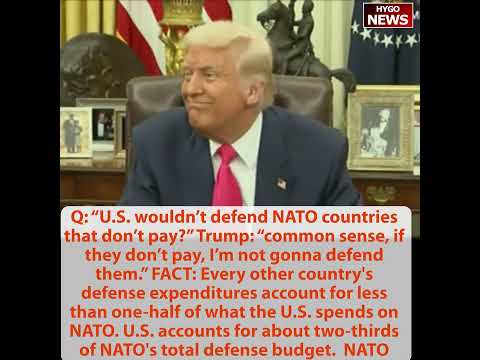
Trump Suspends Perkins Coie Clearances: “Honor to Sign”; Won’t Defend NATO Non-Payers; “Only I Know” Russia Wants Deal
President Trump signed an executive order on March 7, 2025, suspending security clearances for employees at Perkins Coie — the law firm that played a central role in the Russia collusion investigation — calling it “an absolute honor to sign.” He confirmed that the review would extend to “15 different firms or more” involved in “weaponization against a political opponent.” Trump also stated plainly that he would not defend NATO countries that don’t meet their financial commitments — “if they don’t pay, I’m not going to defend them” — and said both Ukraine and Russia wanted to make a deal, adding cryptically that Russia had “no choice either” for reasons that “only I know.” Defense Secretary Hegseth told the press: “The press is interested in narratives. Our president is interested in peace.”
Perkins Coie: “An Absolute Honor to Sign”
An administration official set up the signing by describing the dual basis for the action against Perkins Coie.
“Your administration has made it a priority both to end lawfare and the weaponization of government, and also to hold those who have engaged in lawfare accountable,” the official said. “One of those law firms that has been involved in that is called Perkins Coie. That’s also a law firm that has engaged in unlawful DEI practices.”
The official described the order’s scope: “This executive order will suspend security clearances and access to certain federal resources for that law firm, and also launch a holistic review of unlawful DEI practices at some of the nation’s largest law firms.”
Trump signed the order and delivered his assessment. “This is an absolute honor to sign,” he said. “What they’ve done is just terrible. It’s weaponization. You could say weaponization against a political opponent, and it should never be allowed to happen again.”
Perkins Coie had been the law firm that hired Fusion GPS on behalf of the Hillary Clinton campaign and the Democratic National Committee to produce the Steele Dossier — the document that formed the basis for the FBI’s investigation of alleged Trump-Russia collusion. The firm’s role in what Trump had called “the Russia hoax” made it a primary target of the administration’s anti-lawfare campaign.
Trump asked about the broader scope. “And you’re looking at about 15 different firms?” he said. The official confirmed: “That or more, sir.”
The expansion to 15 or more law firms signaled that the Perkins Coie action was the beginning, not the end, of the administration’s accountability campaign against the legal industry’s role in political weaponization. Following the earlier action against Covington & Burling for its work with Special Counsel Jack Smith, the Perkins Coie order established a pattern: law firms that participated in political persecution would face consequences.
NATO: “If They Don’t Pay, I’m Not Going to Defend Them”
A reporter asked Trump directly whether he would make it official U.S. policy not to defend NATO countries that failed to meet their defense spending commitments.
“I think it’s common sense, right?” Trump said. “If they don’t pay, I’m not going to defend them.”
He acknowledged the controversy. “I got into a lot of heat when I said that. You said, ‘Oh, he’s violating NATO,’” Trump recalled.
Then he posed the question that went to the heart of the alliance’s credibility problem. “The biggest problem I have with NATO — I know the guys very well, they’re friends of mine — but if the United States was in trouble and we called them, we said, ‘We got a problem, France. We got a problem’ — a couple of others, I won’t mention — do you think they’re going to come and protect us?” Trump asked. “They’re supposed to. I’m not so sure.”
The rhetorical question cut through the diplomatic abstractions of alliance theory to the practical reality of mutual defense. Article 5 required all NATO members to respond to an attack on any member. But Trump was asking whether European nations that could not even meet a 2% GDP defense spending commitment would actually deploy their militaries to defend the United States if the situation were reversed.
The question was unanswerable because it had never been tested. But the fact that Trump doubted the answer — and that many Americans shared his doubt — illustrated why the burden-sharing issue had become central to his foreign policy. An alliance in which one member paid the majority of costs and all members received equal protection was not an alliance; it was a subsidy.
”Only I Know” Russia Wants a Deal
A reporter asked Trump what he expected when Zelensky eventually returned to the White House. Trump’s answer contained one of his most intriguing diplomatic statements.
“I think what’s going to happen is Ukraine wants to make a deal because I don’t think they have a choice,” Trump said.
He then added the statement about Russia that drew the most attention: “I also think that Russia wants to make a deal because, in a certain different way, a different way that only I know — only I know — they have no choice either.”
The repeated “only I know” was vintage Trump — simultaneously confident, mysterious, and provocative. It suggested that Trump possessed intelligence or had received private assurances from Putin that had not been shared publicly or even with his broader team. The implication was that Russia was under constraints that made peace not just desirable but necessary — constraints that only Trump, through his direct channel to Putin, understood.
Whether the “only I know” reflected genuine private intelligence or was strategic ambiguity designed to maintain leverage, it served a diplomatic purpose. By claiming unique knowledge of why Russia needed a deal, Trump positioned himself as the indispensable intermediary. Neither side could negotiate without him because only he understood both parties’ true positions.
Hegseth: “The Press Is Interested in Narratives”
Defense Secretary Pete Hegseth closed the exchange with a rebuke of the media’s framing of the peace process.
“To the previous question from the Washington Post, the press is interested in narratives,” Hegseth said. “Our president is interested in peace.”
He addressed the partisan characterizations directly. “So we will get characterized one way or another. Oh, your stance is pro-Russia, or pro-this — it’s all garbage,” Hegseth said. “The president got elected to bring peace in this conflict.”
Hegseth emphasized Trump’s unique capacity: “He is working with both sides in a way that only President Trump can. Let’s be clear — only President Trump can — to bring them to the table to end the killing.”
He provided his behind-the-scenes assessment: “I can tell you, from being behind the scenes, he is laser-focused on making that happen. And we’re closer today than we’ve ever been because of his leadership.”
The “narratives vs. peace” framing was the administration’s most concise rebuttal to media coverage that characterized every diplomatic engagement with Russia as a concession. Hegseth was saying the choice was between peace (which required talking to both sides) and narratives (which required portraying every conversation as capitulation). The administration chose peace.
Key Takeaways
- Trump signed an EO suspending Perkins Coie security clearances over its role in the Russia investigation, calling it “an absolute honor to sign” and confirming reviews of “15 firms or more.”
- He stated plainly: “If they don’t pay, I’m not going to defend them” on NATO, questioning whether allies like France would defend the U.S. in return.
- Trump said Russia wanted a deal “for reasons that only I know — only I know — they have no choice either,” suggesting private intelligence about Russian constraints.
- Defense Secretary Hegseth told the press: “You’re interested in narratives. Our president is interested in peace. It’s all garbage” to characterize Trump as pro-Russia.
- Hegseth said “from behind the scenes, he is laser-focused” on the deal and “we’re closer today than we’ve ever been.”