 HYGO News
 Trump Reinstates Healthcare Price Transparency: 'Biggest Thing for Cutting Prices'; Admires Gulf of America Map
Trump Reinstates Healthcare Price Transparency: “Biggest Thing for Cutting Prices”; Admires Gulf of America Map
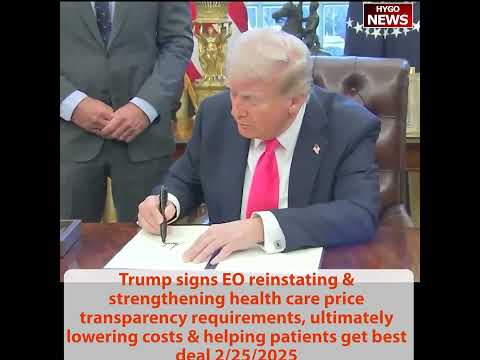
President Trump signed an executive order on February 26, 2025, reinstating and strengthening healthcare price transparency requirements that he had first imposed during his first term in 2019 and that the Biden administration had “largely reversed.” Trump called price transparency “one of the biggest things that can happen to reducing costs in healthcare” and noted that industry experts considered it “the biggest thing you can do for cutting prices.” In a lighter moment, Trump admired a map displaying the newly renamed Gulf of America, joking: “I’m getting teary-eyed, but I don’t want you to say ‘Trump broke down and started crying.’” He also criticized the Associated Press as “radical left” and “third-rate reporters.”
Reinstating First-Term Price Transparency
A senior administration official set the stage for the signing by describing the policy’s history. “In 2019, during your previous administration, you imposed price transparency requirements on the healthcare industry,” the official said. “This was a significant driver in lowering the costs of healthcare during your first administration. Those requirements were largely reversed by the Biden administration.”
Trump expressed frustration at the reversal. “Biden ended it immediately upon coming in, which was a terrible travesty in my opinion,” he said. “And we’re going to start it up. And we’ve actually made it even stronger by a couple of major factors.”
The original price transparency rules, finalized in 2019 and 2020, had required hospitals to publish their prices for services in a consumer-friendly format and required health insurers to provide patients with cost estimates before they received care. The rules were designed to break the healthcare industry’s tradition of pricing opacity, where patients often had no idea what a procedure would cost until they received the bill.
The Biden administration had weakened enforcement of these rules and relaxed compliance requirements, effectively allowing hospitals and insurers to return to opaque pricing. Trump’s executive order not only restored the original requirements but strengthened them, adding provisions that went beyond the first-term rules.
”The Biggest Thing You Can Do for Cutting Prices”
Trump made the economic case for price transparency in terms that connected healthcare costs to everyday consumer experience.
“It allows people to go out and negotiate and price,” Trump explained. “And you’re not allowed to even talk about it when you go into a hospital or see a doctor. And this allows you to go out and talk about it.”
He cited expert opinion to bolster the argument. “There’s a couple of people that actually go back a long way, real pros of the industry, who feel this is the biggest thing you can do for cutting prices,” Trump said. “And it certainly is one of them.”
The logic was straightforward: when consumers could compare prices across hospitals and providers, competition would drive prices down. The same dynamic that worked in every other market — where consumers shopped for the best value — would apply to healthcare once the information was available.
Trump acknowledged that the policy had opponents within the industry. “It’s been unpopular in some circles because people make less money,” he said. “But it’s great for the patient. It’s great for the people in our country.”
He was specific about who would be affected. “It’s not so good for pharmaceuticals. It’s not so good for the companies that make the drugs. And I guess you could say it probably isn’t so great for hospitals,” Trump said.
But he then offered a nuance that demonstrated a more sophisticated understanding of the healthcare market. “But they say that if you have a great hospital that really knows what they’re doing, it’s actually great for a hospital because everybody wants to go there,” Trump said.
The observation captured a fundamental truth about price transparency: it rewarded quality. Hospitals that provided excellent care at competitive prices would attract more patients when consumers could compare options. The institutions that feared transparency were not the best hospitals but the ones that had been overcharging because patients had no basis for comparison.
Why Biden Reversed It
Trump’s characterization of Biden’s reversal as “a terrible travesty” invited the question of why the Biden administration would undo a policy that lowered healthcare costs for consumers. The answer lay in the political economy of healthcare lobbying.
Hospitals, insurance companies, and pharmaceutical firms had collectively spent billions of dollars lobbying against price transparency requirements, arguing that the rules were burdensome, that pricing was too complex to present in a consumer-friendly format, and that published prices would not reflect the actual costs patients would pay after insurance adjustments.
The Biden administration had been receptive to these arguments, relaxing enforcement and extending compliance deadlines in ways that allowed the healthcare industry to continue operating behind a veil of pricing secrecy. Trump’s executive order was a direct repudiation of that approach, reasserting the principle that patients had a right to know what their care would cost before they agreed to receive it.
The political dimension was clear: Biden had sided with the healthcare industry against consumers. Trump was siding with consumers against the healthcare industry. The framing aligned with the administration’s broader populist message about putting the American people first against entrenched special interests.
The Gulf of America Map
In the day’s most visually memorable moment, Trump paused during the signing event to admire a map displayed in the room that showed the Gulf of Mexico renamed to the Gulf of America.
“And if you look at that shoreline, look at that shoreline,” Trump said, pointing to the map. “Look from Florida — most of it is called America. And vast majority, like big numbers.”
He indulged in the moment. “So I’m just admiring it as I look at it,” Trump said. Then, with the timing that had made him a media phenomenon, he added: “I’m getting teary-eyed, but I don’t want you to say ‘Trump broke down and started crying.’”
He continued admiring the map. “How beautiful is that? Look at the shoreline. Look at that. That’s America. We’re going to be now calling those shots.”
Trump referenced the legal victory that had secured the renaming. “As you know, we won that lawsuit right there. See the Gulf of America, which is a beautiful name. Most people agree,” he said.
The map moment was vintage Trump: finding an opportunity for showmanship in the middle of a policy event, delivering a self-deprecating joke that humanized him, and reinforcing one of his signature initiatives all at the same time. The image of the president admiring a map of the Gulf of America — simultaneously proud and self-aware enough to joke about his own emotional reaction — was the kind of clip that supporters shared and critics struggled to counter.
Criticizing the AP
Trump then addressed the ongoing dispute with the Associated Press over its refusal to use “Gulf of America” in its reporting.
“AP has been terrible,” Trump said. “I think they’re radical left. I think they’re third-rate reporters.”
He was specific in his criticism. “I know the specific young lady that works on the account is terrible. She’s a radical left lunatic, as far as I’m concerned,” Trump said. “They don’t treat us fairly.”
He connected the AP dispute to the map: “And number two, they had no right to do that. This is the Gulf of America.”
The AP confrontation had been an ongoing feature of the administration’s media strategy. By maintaining restrictions on AP’s privileged access until the outlet complied with the legal name change, the White House was establishing a precedent that media outlets were expected to report legally established facts — including the names of geographic features designated by executive order — rather than maintaining their own preferred terminology.
Key Takeaways
- Trump signed an executive order reinstating and strengthening healthcare price transparency requirements that Biden had “largely reversed,” calling it “one of the biggest things that can happen to reducing costs in healthcare.”
- He acknowledged the policy was “unpopular in some circles” — particularly pharmaceuticals and hospitals — but said it was “great for the patient” and that quality hospitals would actually benefit because “everybody wants to go there.”
- Trump admired a Gulf of America map during the signing, joking: “I’m getting teary-eyed, but I don’t want you to say ‘Trump broke down and started crying.’”
- He criticized the AP as “radical left” and “third-rate reporters” for refusing to use the legally designated name “Gulf of America.”
- The transparency rules require hospitals to publish prices in consumer-friendly formats, allowing patients to “go out and negotiate and price” — something previously not permitted.