 HYGO News
 Trump: Education Is a 'Big Con Job' -- Ranked 40th Despite Highest Per-Pupil Spending; $59M Migrant Hotel vs. Nothing for NC
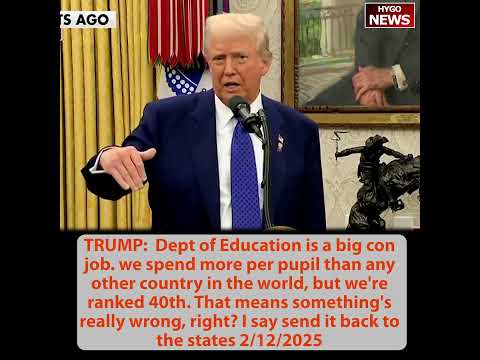
Trump: Education Is a “Big Con Job” — Ranked 40th Despite Highest Per-Pupil Spending; $59M Migrant Hotel vs. Nothing for NC
President Trump made a sweeping case for dismantling the Department of Education, calling it “a big con job” while pointing to a stark statistic: the United States spends more per pupil than any other country in the world yet ranks 40th in educational outcomes. Trump argued that education should be returned to the states, where most would perform at the level of top-ranked Scandinavian countries, and then pivoted to the FEMA spending scandal, condemning a judge who ordered the government to send $59 million to a New York City migrant hotel even after the administration had identified the expenditure as potentially fraudulent — all while North Carolina disaster victims received “nothing."
"The Department of Education Is a Big Con Job”
Trump opened with a blunt indictment of the federal education bureaucracy. “Look, the Department of Education is a big con job,” Trump said. “We’re ranked, so they ranked the top 40 countries in the world. We’re ranked number 40th. But we’re ranked number one in one department: costs per pupil.”
The contrast was designed to be immediately understood by any listener: first place in spending, last place in results. “So we spend more per pupil than any other country in the world. But we’re ranked number 40,” Trump said. “We’ve been between 38 and 40. The last time I looked, it was 38. And then I looked two days ago, it came out the new list. It came out at number 40.”
Trump then named the countries that were outperforming the United States. “Norway, Denmark, Sweden, I hate to say, China as big as it is, it’s ranked in the top five,” he said. “And that’s our primary competitor. We’re ranked number 40. So if we’re ranked number 40, that means something’s really wrong, right?”
The invocation of China was particularly pointed. Trump frequently framed policy arguments in terms of competition with Beijing, and the fact that China — a country with far lower per-pupil spending — was outranking the United States in education reinforced his argument that the problem was not a lack of money but a failure of the system itself.
”Send It Back to the States”
Trump’s prescription was straightforward: eliminate the federal Department of Education and return control to the states. “And I say send it back to Iowa, to Idaho, to Colorado,” Trump said. “Send it back to places that — and a lot of Indiana. You have a great new governor. You have a great senator that Jim Banks just got elected. You got great people. I’ll tell you what, Indiana is going to be fantastic.”
Trump projected confidence that most states would thrive without federal oversight. “We probably have 35, maybe 37 states that we’ll do as well as Denmark, Norway, Finland, Sweden. They’ll be just as good,” he said. The argument was that the federal education bureaucracy was not helping states that were already capable of managing their own schools — it was adding cost without adding value.
For states with more complex urban challenges, Trump suggested a sub-state approach. “Even they will be good,” he said of traditionally lower-performing states. “Because you look at New York, you give it to Westchester County, you give it to Long Island, you give it to Nassau County, you give it to Suffolk County. Same thing you go out to, and you give it to Upstate New York. So you’d have four or five sections.”
The proposal reflected a pragmatic understanding that educational performance varied dramatically within states. By suggesting that large states could be subdivided into educational districts, Trump was acknowledging the urban-suburban-rural divide while still arguing that local control would produce better outcomes than federal management.
Trump singled out one area as the exception: “You give it to Manhattan. Manhattan’s a little bit tougher for some reason. I don’t know why it would be tougher, but it is.” The aside drew laughter and reflected Trump’s familiarity with his home borough.
For states like Iowa, the argument was even simpler: “If you go to Iowa, you give it to Iowa. You don’t have subgroups. You have Iowa. And other places that do a good job. If they do a good job, they’re going to do a great job in education. Because this is a massive fraud that’s taking place.”
The $59 Million Migrant Hotel Scandal
Trump then pivoted from education to what he characterized as an even more egregious example of federal spending gone wrong: $59 million allocated to a New York City hotel housing migrants while FEMA-eligible disaster victims in North Carolina received nothing.
“You get nothing going to North Carolina to help them. Nothing,” Trump said. “They say, we don’t have any money because they’ve given it away on the border. But you have nothing. What they did to North Carolina is a shame.”
Trump described the specific nature of the New York expenditure: “And then they sent $59 million to New York City for a hotel for a little bit of nothing, what they’ve done. A hotel that was not luxury, that’s getting luxury rates for migrants, where they’re making a fortune.”
The characterization — a non-luxury hotel charging luxury rates to house migrants — implied that the arrangement was enriching the hotel operators at taxpayer expense. Trump said his administration had identified the spending as potentially fraudulent: “And we catch them. We catch them.”
Judges Ordering Payments Despite Fraud
The most explosive portion of Trump’s remarks addressed judicial intervention in the administration’s attempt to halt the spending. A federal judge had ordered the government to continue sending money to the migrant hotel even after the administration flagged the expenditure as potentially fraudulent.
“But a judge says, well, even though it may be a fraud, you have to send the money in anyway. Send the money,” Trump said, his voice conveying incredulity. “I said, wait a minute. We have money that shouldn’t go because we caught it before it was sent out. But they want the money to go anyway.”
The scenario Trump described was one of the most provocative flashpoints in the administration’s confrontation with federal courts. The administration had identified what it believed was a fraudulent or wasteful expenditure and moved to halt it. A federal judge then ordered the payment to proceed regardless. From the administration’s perspective, the court was ordering the government to send taxpayer money to a potentially fraudulent recipient — a position that was difficult to defend publicly regardless of the legal reasoning behind it.
Trump directed his final comment to Attorney General Pam Bondi, who was apparently present: “And I think you’re going to have a lot of things to look at, Pam. I really do. What’s going on with this whole thing? And this is just one group.”
The implication was clear: the $59 million migrant hotel was not an isolated case but one example of a broader pattern of questionable federal spending that the administration intended to investigate and challenge, even if it meant continued confrontation with the judiciary.
The Contrast That Defined the Argument
Trump’s remarks were effective because they built a single coherent argument from two seemingly separate policy areas. The Department of Education spent more per pupil than any country on earth and produced 40th-place results — a “massive fraud.” FEMA sent $59 million to a migrant hotel while North Carolina disaster victims got “nothing” — another fraud. In both cases, the federal government was spending enormous sums of money and producing outcomes that ranged from mediocre to scandalous.
The through line was Trump’s core argument about federal competence: the government could not be trusted to spend money wisely, whether in education or disaster relief. The solution in both cases was the same: reduce federal control, return authority to states and local governments, and hold accountable those who had allowed waste and fraud to flourish.
Key Takeaways
- Trump called the Department of Education “a big con job,” noting the U.S. ranks 40th in education globally despite spending more per pupil than any other country in the world.
- He proposed returning education to the states, predicting that 35 to 37 states would perform at the level of top-ranked countries like Denmark, Norway, and Sweden.
- Trump condemned the allocation of $59 million to a New York City migrant hotel — described as a non-luxury hotel charging luxury rates — while North Carolina disaster victims received “nothing” from FEMA.
- A federal judge ordered the administration to continue sending the $59 million despite the administration identifying the expenditure as potentially fraudulent, prompting Trump to express incredulity.
- Trump directed AG Pam Bondi to investigate the migrant hotel spending and suggested it was one example of a broader pattern of questionable federal expenditures.