 HYGO News
 Trump Reads Zelensky Letter to Congress: 'Ready to Negotiate'; Calls Out Warren for Clapping for War
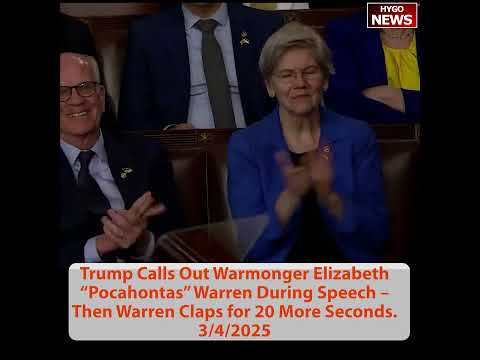
Trump Reads Zelensky Letter to Congress: “Ready to Negotiate”; Calls Out Warren for Clapping for War
In one of the most dramatic moments of his March 5, 2025, joint address to Congress, President Trump read a letter from Ukrainian President Zelensky stating that “Ukraine is ready to come to the negotiating table as soon as possible to bring lasting peace closer” and that the minerals deal was “ready to sign at any time.” Trump simultaneously announced that “serious discussions with Russia” had produced “strong signals that they are ready for peace.” The Ukraine segment also produced a viral confrontation when Democrats clapped in apparent favor of continuing the war, prompting Trump to single out Senator Elizabeth Warren: “Pocahontas says yes” to five more years of fighting. Trump noted that Europe had “spent more buying Russian oil and gas than they have defending Ukraine.”
Zelensky’s Letter: “Ready to Negotiate”
Trump revealed that he had received a letter from Zelensky just hours before the address — a dramatic reversal from the confrontation and expulsion that had occurred days earlier.
“Earlier today, I received an important letter from President Zelensky of Ukraine,” Trump told Congress.
He then read the key passage aloud: “The letter reads: ‘Ukraine is ready to come to the negotiating table as soon as possible to bring lasting peace closer. Nobody wants peace more than the Ukrainians,’ he said. ‘My team and I stand ready to work under President Trump’s strong leadership to get a peace that lasts.’”
The letter included two additional elements that addressed the administration’s specific concerns. First, gratitude: “We do really value how much America has done to help Ukraine maintain its sovereignty and independence.” Second, the minerals deal: “Regarding the agreement on minerals and security, Ukraine is ready to sign it at any time that is convenient for you.”
Trump’s reaction was gracious: “I appreciate that he sent this letter. Just got it a little while ago.”
The letter represented a complete reversal of the posture that had resulted in Zelensky’s expulsion from the White House days earlier. Zelensky was now expressing willingness to negotiate under Trump’s leadership, gratitude for American support, and readiness to sign the minerals deal — exactly the three things the administration had demanded. Whether the reversal reflected genuine recalculation or political necessity, the result was the same: Zelensky was publicly accepting Trump’s terms.
”Russia Ready for Peace”
Trump then paired the Zelensky letter with the Russian signal.
“Simultaneously, we’ve had serious discussions with Russia and have received strong signals that they are ready for peace,” Trump said.
He savored the moment: “Wouldn’t that be beautiful? Wouldn’t that be beautiful? Wouldn’t that be beautiful?”
The triple repetition of “wouldn’t that be beautiful” transformed a diplomatic update into an emotional appeal. Trump was asking the chamber — and the millions watching at home — to imagine the end of the war: no more killing, no more destruction, peace in Europe for the first time in three years. The reaction from the Republican side was sustained applause.
Trump concluded the peace segment with the principle that had guided his diplomacy: “It’s time to stop this madness. It’s time to end the senseless war. If you want to end wars, you have to talk to both sides.”
The final sentence — “you have to talk to both sides” — was the simplest articulation of the administration’s diplomatic philosophy. Peace required engagement with adversaries, not just allies. The Biden approach of supporting Ukraine while refusing meaningful contact with Russia had produced three years of war. Trump’s approach of talking to both sides simultaneously was producing signals of readiness for peace from both.
”Pocahontas Says Yes” to Five More Years of War
The most confrontational moment came when Democrats interrupted Trump’s Ukraine remarks with applause that the president interpreted as support for continuing the war.
“The United States has sent hundreds of billions of dollars to support Ukraine’s defense, with no security, with no anything,” Trump said. “Do you want to keep it going for another five years?”
Democrats responded with clapping. Trump spotted Senator Elizabeth Warren among the applauders.
“Yeah, you would say — Pocahontas says yes,” Trump said.
The exchange was devastating because it placed a specific Democratic senator on the record as clapping for continued war. Warren’s applause — whether she intended it as support for Ukraine or as opposition to Trump’s characterization — was captured on camera and interpreted as enthusiasm for extending a conflict that Trump had just described as producing “millions” of casualties.
Trump pressed the point with details that humanized the cost: “Two thousand people have been killed — they’re Russian young people, they’re Ukrainian young people, they’re not Americans, but I want to stop it.”
The fact that Trump expressed concern for Russian as well as Ukrainian casualties — “they’re not Americans, but I want to stop it” — reinforced his argument that the peace effort was motivated by humanitarian concern rather than political calculation. He was the one trying to stop the killing. The Democrats applauding in the chamber were the ones, in his framing, celebrating its continuation.
Europe: “More on Russian Oil Than on Defending Ukraine”
Trump delivered a trade statistic that reframed the entire European contribution to the war effort.
“Meanwhile, Europe has sadly spent more money buying Russian oil and gas than they have spending on defending Ukraine — by far,” Trump said. “Think of that. They’ve spent more buying Russian oil and gas than they have defending.”
He quantified the U.S.-Europe disparity: “We’ve spent perhaps $350 billion, like taking candy from a baby, that’s what happened. And they’ve spent $100 billion. What a difference that is. And we have an ocean separating us, and they don’t.”
The observation that Europe was simultaneously funding Russia’s war machine through energy purchases and asking America to fund Ukraine’s defense was one of Trump’s most effective arguments for tariff leverage and burden-sharing demands. European leaders could not credibly claim to support Ukraine while buying billions in Russian energy that financed the Russian military conducting the invasion.
Trump’s geographic point — “we have an ocean separating us, and they don’t” — underscored the absurdity of the funding disparity. The countries most directly threatened by Russian aggression were contributing the least to the defense, while the country separated by an ocean was footing the largest bill.
Key Takeaways
- Trump read a Zelensky letter to Congress: “Ukraine is ready to come to the negotiating table as soon as possible” and “ready to sign” the minerals deal “at any time.”
- He simultaneously announced “strong signals” from Russia that “they are ready for peace,” asking the chamber three times: “Wouldn’t that be beautiful?”
- Trump singled out Senator Warren for clapping during the Ukraine segment: “Pocahontas says yes” to five more years of war.
- He revealed that Europe had “spent more buying Russian oil and gas than they have defending Ukraine” while the U.S. spent $350 billion compared to Europe’s $100 billion.
- Trump stated the diplomatic principle: “If you want to end wars, you have to talk to both sides.”