 HYGO News
 Trump announced action against China, News Conference 5/29/2020
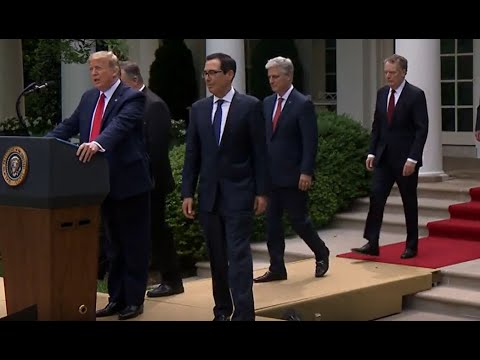
Trump announced action against China, News Conference 5/29/2020
On May 29, 2020, President Trump held a news conference announcing a sweeping set of measures against China, covering financial markets, Hong Kong’s special status, the World Health Organization, university research security, and immigration. Trump framed the actions as a response to China’s handling of the coronavirus pandemic, its crackdown on Hong Kong’s autonomy, and years of what he called intellectual property theft and unfair trade practices.
Terminating the WHO Relationship
Trump announced that the United States would terminate its relationship with the World Health Organization, accusing China of exerting “total control” over the organization despite paying only $40 million per year compared to the approximately $450 million paid annually by the United States.
“Chinese officials ignored their reporting obligations to the World Health Organization and pressured the World Health Organization to mislead the world when the virus was first discovered by Chinese authorities,” Trump said. He added that the administration had “detailed the reforms that it must make and engaged with them directly, but they have refused to act.”
“Because they have failed to make the requested and greatly needed reforms, we will be today terminating our relationship with the World Health Organization and redirecting those funds to other worldwide and deserving urgent global public health needs,” Trump declared.
Blaming China for the Pandemic
Trump placed the coronavirus pandemic squarely at the feet of China’s government. “China’s cover-up of the Wuhan virus allowed the disease to spread all over the world, instigating a global pandemic that has cost more than 100,000 American lives and over a million lives worldwide,” he said.
He raised a specific question that had become a point of contention: “Why is it that China shut off infected people from Wuhan to all other parts of China? It went nowhere else. It didn’t go to Beijing. It went nowhere else. But they allowed them to freely travel throughout the world, including Europe and the United States. The death and destruction caused by this is incalculable.”
Trump noted that he had imposed an early travel ban from China despite opposition: “They strongly recommended against me doing the early ban from China, but I did it anyway and was proven to be 100 percent correct.”
Hong Kong: “One Country, One System”
The most detailed portion of Trump’s announcement concerned Hong Kong. He responded to China’s unilateral imposition of national security controls over the territory, which he called “a plain violation of Beijing’s treaty obligations with the United Kingdom in the declaration of 1984 and explicit provisions of Hong Kong’s basic law,” noting that the agreement “has 27 years to go.”
Trump declared that China had abandoned its commitment to Hong Kong’s autonomy: “China has replaced its promised formula of one country, two systems, with one country, one system.”
He announced a comprehensive rollback of Hong Kong’s preferential status: “Therefore, I am directing my administration to begin the process of eliminating policy exemptions that give Hong Kong different and special treatment.”
The scope of the changes was broad. “My announcement today will affect the full range of agreements we have with Hong Kong from our extradition treaty to our export controls on dual-use technologies and more with few exceptions,” Trump said. Specific actions included revising the State Department’s travel advisory “to reflect the increased danger of surveillance and punishment by the Chinese state security apparatus” and revoking “Hong Kong’s preferential treatment as a separate customs and travel territory from the rest of China.”
Trump also announced sanctions: “The United States will also take necessary steps to sanction PRC and Hong Kong officials directly or indirectly involved in eroding Hong Kong’s autonomy and just if you take a look, smothering, absolutely smothering Hong Kong’s freedom.”
Financial Markets and Investor Protection
Trump directed his Presidential Working Group on Financial Markets “to study the differing practices of Chinese companies listed on the U.S. financial markets with the goal of protecting American investors.” He argued that American investment firms “should not be subjecting their clients to the hidden and undue risks associated with financing Chinese companies that do not play by the same rules.”
The precise timeline and scope of the study were not detailed during the announcement. However, the directive signaled a potential shift in how Chinese companies access American capital markets, with implications for Chinese firms listed on U.S. stock exchanges and for Hong Kong’s role as an Asian financial hub.
University Research and Immigration
Trump announced he would issue a proclamation “to better secure our nation’s vital university research and to suspend the entry of certain foreign nationals from China who we have identified as potential security risks.” This action targeted what Trump described as China’s use of espionage to steal American industrial and academic secrets.
Years of Grievances
Trump placed the day’s announcements in the context of a longer-running confrontation with China. “China’s pattern of misconduct is well known. For decades, they’ve ripped off the United States like no one has ever done before,” he said, citing “hundreds of billions of dollars a year” in losses.
He listed specific grievances: “China raided our factories, offshored our jobs, gutted our industries, stole our intellectual property, and violated their commitments under the World Trade Organization.” Trump also noted that China was classified as a developing nation, “getting all sorts of benefits that others, including the United States, are not entitled to.”
Trump acknowledged that he did not solely blame China: “They were able to get away with the theft like no one was able to get away with before because of past politicians and frankly, past presidents.”
Key Takeaways
- Trump announced the United States would terminate its relationship with the World Health Organization, accusing China of controlling the body and failing to reform it, and would redirect the approximately $450 million in annual funding to other global health priorities.
- He directed the elimination of Hong Kong’s special status across the full range of U.S. agreements, including the extradition treaty and export controls, declaring that China had replaced “one country, two systems” with “one country, one system.”
- Trump ordered a study of Chinese companies listed on U.S. financial markets, suspended entry of certain Chinese nationals identified as security risks, and framed all actions as a response to the pandemic, intellectual property theft, and Hong Kong’s loss of autonomy.