 HYGO News
 Trump at Cabinet Meeting: '$4 Trillion' in Companies Moving Back; Rubio: 'Only Leader Who Can Bring Peace'; Education to States
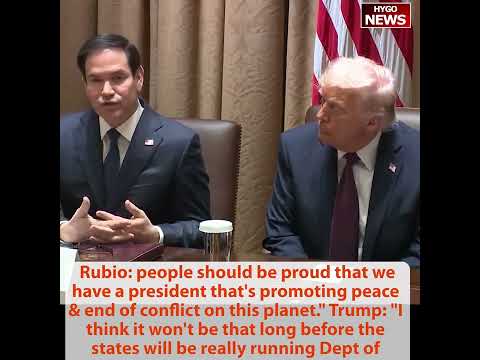
Trump at Cabinet Meeting: “$4 Trillion” in Companies Moving Back; Rubio: “Only Leader Who Can Bring Peace”; Education to States
President Trump opened a cabinet meeting in March 2025 by announcing that his administration had identified “$4 trillion worth of companies moving back or going to move back” to the United States, driven by tariffs and the election result. He dismissed the CHIPS Act as “a disaster” that “gave billions of dollars to companies that already have many billions” and credited tariffs as the real incentive for reshoring. Secretary of State Marco Rubio then praised Trump as “the only leader on the planet that can bring the two sides together” to end the Russia-Ukraine war, with teams “on the ground in Saudi Arabia” negotiating. Trump concluded with an update on dismantling the Department of Education: “I think it won’t be that long before the states will be really running the Department of Education."
"$4 Trillion Worth of Companies Moving Back”
Trump opened the cabinet meeting with the number that defined the administration’s economic narrative.
“We had a very, very good cabinet meeting on our way to some tremendous numbers,” Trump said. “First of all, many companies are now moving into the United States and coming back. Some of them left us from many years ago, decades ago, and they’re all — seems they’re all coming back.”
He quantified the trend: “We have probably identified maybe $4 trillion worth of companies moving back or going to move back. Many of them have announced. It’s going to be tremendous jobs, high-paying jobs, too.”
The $4 trillion figure represented the combined value of companies that had either announced plans to build or expand in the United States or were in discussions about doing so. Whether the number measured market capitalization, investment commitments, or some other metric, the scale was extraordinary — $4 trillion was larger than the GDP of every country on Earth except the United States and China.
Trump cited specific examples: “We have, as you know, Indiana — Honda is coming in with a massive plant in Indiana. There are many plants that are happening. Literally some have started already.”
He described the auto industry transformation: “GM is already redoing plants that were half-abandoned or they have plants that weren’t being fully utilized. They and others are going to be making parts and other things in those plants so that it’s one-stop shopping, finally.”
The “one-stop shopping” concept reflected the inefficiency of the existing supply chain: “It’s ridiculous. You had to go to Mexico. You had to go to Canada. A car went all over the place.” The tariff-driven reshoring would consolidate supply chains within American borders, reducing transportation costs, lead times, and vulnerability to cross-border disruptions.
CHIPS Act: “A Disaster”
Trump drew a sharp distinction between his tariff-driven approach and the Biden administration’s subsidy-driven approach to reshoring the semiconductor industry.
“You probably know the chip business — not because of the CHIPS Act, which was a disaster,” Trump said. “You gave billions of dollars to companies that already have many billions of dollars. They said, thank you very much. It was no incentive for them to use it.”
The critique was specific: the CHIPS Act had distributed tens of billions of dollars to some of the world’s wealthiest corporations — Intel, TSMC, Samsung — in the hope that subsidies would incentivize domestic manufacturing. Trump’s argument was that companies with hundreds of billions in revenue did not need taxpayer money to motivate them; they needed market conditions that made domestic production economically rational.
“But what is good is the tariffs will make it so that they want to come back,” Trump said. “That’s why they’re coming back.”
He identified the two forces driving reshoring: “I think they’re coming back because of the election that took place on November 5th, and because of the fact that they have to come back because the tariffs are forcing them to come back.”
Then the key distinction: “There are no tariffs if you build here. That’s a big factor.”
The logic was binary and clear. Companies that manufactured domestically faced no tariffs on their products. Companies that manufactured abroad and imported faced tariffs that eliminated their cost advantage. The incentive was not a government subsidy that required political negotiation and bureaucratic management; it was a market condition that affected every company equally and automatically.
”Numbers Beyond Our Wildest Expectations”
Trump referenced conversations with his economic advisors that suggested the reshoring trend was exceeding projections.
“Howard was just telling me the numbers that we’re talking about are crazy beyond anybody’s wildest expectation,” Trump said.
He described the momentum: “There’ll be a lot of building, all sorts of businesses, including the basics of automobiles.”
Trump acknowledged the existing trade framework: “We have a deal. It’s fine. But people took advantage of the deal. They cheated. And when you cheat, the deal’s unfortunate.” The reference was to the USMCA trade agreement that Trump had negotiated in his first term. Companies had found ways to exploit the agreement’s rules of origin provisions to route production through Mexico and Canada while maintaining limited domestic manufacturing.
“But now what’s happening is the numbers are beyond our wildest expectations,” Trump repeated.
Rubio: “The Only Leader on the Planet”
Secretary of State Rubio provided the most forceful endorsement of Trump’s peace diplomacy.
“Mr. President, first of all, I think the American people should be proud that we have a president that’s promoting peace and the end of conflict on this planet,” Rubio said.
He provided context: “This is a war that’s gone on for three years — as you pointed out, that as you rightly pointed out, would have never happened had you been president. But now it’s here, and it needs to be brought to an end.”
Rubio stated the military reality: “There is no military solution to this war. It has to end in negotiation.”
Then the assessment: “And there’s only one leader in the world that’s capable of bringing two sides to a table. And that’s our president, the president of the United States, President Trump. And that’s what he’s done.”
He revealed the current state of negotiations: “And so today, even as we speak, we have teams on the ground in Saudi Arabia, a meeting with the respective sides in the hopes of making progress towards this outcome that we all want to see.”
Rubio acknowledged the obstacles: “And you’ve done it despite impediments from other countries and others who maybe have different opinions about how this should go.” The reference to “impediments from other countries” suggested that some NATO allies or other parties were resisting the negotiation framework Trump had established.
He concluded: “But ultimately, I think that the only chance we have for peace is through the president’s leadership. And you’ve shown that. And we hope it’ll bear fruit. And today, hopefully, it’ll be one step more in that direction.”
Education: “The Process Has Already Begun”
Trump closed the cabinet meeting with an update on the Department of Education dismantling.
“I think it won’t be that long before the states will be really running the Department of Education,” Trump said.
He reiterated his personal commitment to teachers: “Our teachers are going to be taken very well care of. And I said, you know, personally, I don’t care — union, non-union, it doesn’t matter. Teachers are so important to this country and to me.”
He credited his education secretary: “And I know it’s very important to Linda,” referring to Linda McMahon.
Trump predicted rapid results: “So I think you’re going to see a tremendous change very quickly having to do with education. And the process has already begun — very strongly begun.”
The “very strongly begun” description reflected the executive order signed days earlier, the transfer of student loans to the SBA, and the transfer of special needs and nutrition programs to HHS. The Department of Education was being stripped of its core functions one by one, with each transfer reducing the rationale for the department’s continued existence.
Key Takeaways
- Trump announced $4 trillion in companies moving back to the US, driven by tariffs and the November 5th election: “There are no tariffs if you build here.”
- He dismissed the CHIPS Act as “a disaster” that gave “billions to companies that already have many billions” and credited tariffs as the real incentive.
- Honda announced a massive plant in Indiana; GM was retooling half-abandoned factories for domestic parts production.
- Rubio called Trump “the only leader on the planet” capable of ending the Russia-Ukraine war, revealing active negotiations in Saudi Arabia.
- Trump said education transfer to states was progressing: “I think you’re going to see a tremendous change very quickly. The process has already begun.”