 HYGO News
 Trudeau: resign, papers fly away A symbol of his failed tenure; Jennings: GOD BLESS THE TRUCKERS
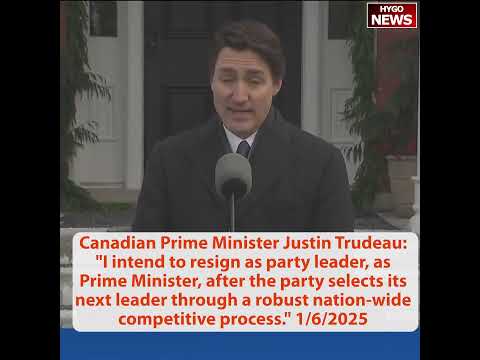
Trudeau: resign, papers fly away A symbol of his failed tenure; Jennings: GOD BLESS THE TRUCKERS
On January 6, 2025, Canadian Prime Minister Justin Trudeau announced his intention to resign as leader of the Liberal Party and as Prime Minister of Canada. The announcement came after months of political paralysis in Parliament and growing pressure from within his own party. In a moment that commentators quickly seized upon as symbolic, some of the papers from Trudeau’s prepared statement blew away in the wind just before he began speaking. CNN commentator Scott Jennings offered a blunt assessment of Trudeau’s departure, declaring “God bless the truckers” and drawing a direct line from the 2022 trucker protests to the Prime Minister’s downfall.
Trudeau Announces Resignation as Party Leader and Prime Minister
Speaking publicly on January 6, 2025, Trudeau acknowledged the dysfunction that had plagued his minority government. He stated: “And the fact is, despite best efforts to work through it, Parliament has been paralyzed for months, after what has been the longest session of a minority Parliament in Canadian history.”
Trudeau revealed that he had advised the Governor-General that morning that Canada needed a new session of Parliament, and that the Governor-General had granted his request to prorogue the House until March 24th. He then turned to the personal dimensions of his decision, describing how he had reflected over the holiday period and consulted with his family.
“Throughout the course of my career, any success I have personally achieved has been because of their support and with their encouragement,” Trudeau said. “So last night over dinner, I told my kids about the decision that I’m sharing with you today.”
He then delivered the central announcement: “I intend to resign as party leader, as Prime Minister, after the party selects its next leader through a robust nationwide competitive process. Last night, I asked the President of the Liberal Party to begin that process.”
The phrasing was notable. Trudeau was not resigning immediately but conditioning his departure on the Liberal Party first selecting a successor through what he described as a competitive leadership process. This meant he would remain in office in a caretaker capacity for an indefinite period, a detail that drew immediate attention and debate.
Papers Blow Away in the Wind: A Symbolic Moment
Before Trudeau even began delivering his statement, a gust of wind sent some of the pages of his prepared remarks flying away from the podium. The moment was immediately captured and circulated widely. Observers noted the symbolism: Trudeau could not even deliver his resignation smoothly, with part of his address literally blowing away in the wind.
The incident, while minor in practical terms, became a widely shared visual metaphor for the state of Trudeau’s leadership. Critics viewed it as a fitting coda to a tenure they characterized as disorganized and ultimately unsuccessful. The image of prepared remarks scattering in the wind, just as the Prime Minister was about to announce the end of his political career, proved too apt a symbol for commentators to ignore.
Scott Jennings: “God Bless the Truckers”
The reaction from CNN commentator Scott Jennings was among the most pointed and widely discussed. When the panel turned to the subject of Trudeau’s resignation, Jennings made his priorities clear. Asked if he wanted to talk about Justin Trudeau, Jennings replied: “I wanted to talk about Canada. You want to talk about Canada? God bless the truckers. That’s what I’m saying.”
He then drew an explicit connection between the 2022 trucker convoy protests and Trudeau’s downfall: “There’s a direct line from those truckers to what’s happening today. Good riddance.”
Jennings’s comments were a reference to the Freedom Convoy, the massive trucker-led protest movement that descended on Ottawa in early 2022 in opposition to Trudeau’s COVID-19 vaccine mandates and border restrictions. The convoy occupied streets around Parliament Hill for weeks and became an international flashpoint over government pandemic policies and civil liberties.
Trudeau had responded to the protests by invoking the Emergencies Act, a sweeping federal power that had never before been used in Canadian history. The invocation allowed the government to freeze bank accounts of protesters and their supporters, clear the blockades, and arrest convoy participants. The move was deeply controversial, with critics accusing Trudeau of authoritarian overreach against peaceful protesters exercising their democratic rights.
The Freedom Convoy and Its Lasting Political Impact
The 2022 Freedom Convoy had its origins in opposition to a federal mandate requiring Canadian truckers crossing the U.S.-Canada border to be vaccinated against COVID-19. What began as a specific grievance about cross-border trucking regulations quickly expanded into a broader protest movement against the Trudeau government’s pandemic restrictions more generally.
At its peak, the convoy drew thousands of trucks and supporters to Ottawa, with secondary blockades forming at key border crossings including the Ambassador Bridge connecting Windsor, Ontario, to Detroit, Michigan. The economic disruption was significant, and the political ramifications proved lasting.
Trudeau’s decision to invoke the Emergencies Act was subsequently reviewed by the Public Order Emergency Commission, led by Justice Paul Rouleau. The commission’s report, released in February 2023, found that the threshold for invoking the act had been met but also raised concerns about the government’s handling of the crisis in the weeks leading up to the invocation.
For Jennings and many other commentators, the convoy represented a turning point in Trudeau’s political fortunes. The protesters had challenged the government’s pandemic authority directly, and while they were eventually cleared from Ottawa, the political damage to Trudeau proved lasting and ultimately contributed to the erosion of support that led to his resignation announcement.
The Broader Context of Trudeau’s Decline
Trudeau’s announcement came after a period of sustained political difficulty. His Liberal Party had been reduced to a minority government in the 2021 federal election, and the subsequent parliamentary session had been marked by gridlock and internal party tensions. Polling consistently showed declining support for the Liberals and for Trudeau personally, with many Canadians expressing frustration over the cost of living, housing affordability, and immigration policy.
The prorogation of Parliament until March 24th gave the Liberal Party time to organize a leadership contest, but it also meant that the government was effectively in a holding pattern during a period of significant economic and geopolitical challenges, including looming trade tensions with the incoming Trump administration in the United States.
Additional Context
Trudeau’s nearly decade-long tenure as Prime Minister began with a sweeping majority victory in 2015, when he positioned himself as a fresh face representing generational change in Canadian politics. His government implemented significant policy changes including the legalization of cannabis, the introduction of a national carbon tax, and the expansion of immigration targets. However, his time in office was also marked by a series of scandals, including the SNC-Lavalin affair and the WE Charity controversy, as well as growing criticism over his handling of the economy and housing crisis.
The contrast between the optimism of his 2015 election and the windswept, paper-scattering resignation announcement of January 2025 encapsulated the arc of a political career that had begun with enormous promise but ended under the weight of accumulated controversies and declining public confidence.
Key Takeaways
- Canadian Prime Minister Justin Trudeau announced on January 6, 2025, that he intended to resign as party leader and Prime Minister after the Liberal Party selected a new leader through a competitive process.
- In a symbolically loaded moment, some of Trudeau’s prepared remarks blew away in the wind just before he began delivering his resignation statement.
- CNN commentator Scott Jennings declared “God bless the truckers” and stated “there’s a direct line from those truckers to what’s happening today. Good riddance.”
- Trudeau cited months of parliamentary paralysis and the longest session of a minority Parliament in Canadian history as context for his decision.
- Trudeau prorogued Parliament until March 24th to allow time for the Liberal Party leadership process to proceed.