 HYGO News
 Elon Musk: rather odd Gov employees to accrue tens millions of dollars, curious where it came from
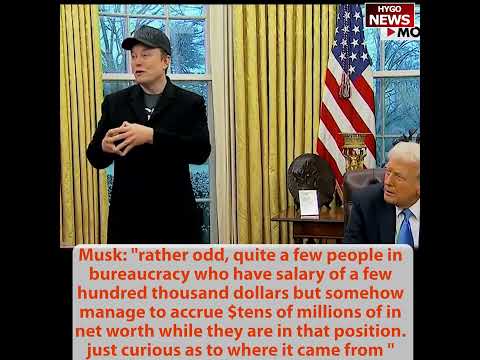
Elon Musk Questions How Federal Bureaucrats on Government Salaries Accumulated Tens of Millions in Net Worth
On February 11, 2025, Elon Musk visited the White House with his young son, X, to meet with President Trump in the Oval Office. The visit coincided with the signing of a new executive order mandating that all federal agencies cooperate with the Department of Government Efficiency, or DOGE. But the headlines came from Musk’s extended remarks about what his team had found inside the federal bureaucracy — a system so devoid of basic financial controls that he compared it to “a massive number of blank checks just flying out the building.”
The Wealth Question
Musk opened his remarks by raising a question that he said DOGE investigators had encountered repeatedly: how do career federal employees earning a few hundred thousand dollars per year manage to accumulate tens of millions of dollars in personal net worth while in government service?
“We do find it sort of rather odd that there are quite a few people in the bureaucracy who have essentially a salary of a few hundred thousand dollars but somehow managed to accrue tens of millions of dollars in net worth while they are in that position,” Musk said.
He added, with characteristic dry humor, “Maybe they’re very good at investing, in which case we should take their investment advice perhaps.”
But the humor quickly gave way to a more serious accusation. “I think the reality is that they are getting wealthy at taxpayer expense,” Musk said. “That’s the honest truth of it.”
Musk specifically cited USAID as an example of where this pattern had been identified, connecting the wealth accumulation question to the broader DOGE investigation into agency-level waste and potential fraud. The implication was clear: when government employees with modest salaries become multimillionaires during their tenure, the source of that wealth warrants investigation.
The Treasury Department’s Missing Controls
The most detailed and arguably most alarming portion of Musk’s remarks concerned what DOGE had found at the U.S. Treasury Department — or more precisely, what it had not found. Musk described a payment system that lacked the most basic controls that any private-sector company would consider non-negotiable.
First, he said that Treasury payments routinely lacked categorization codes. “If you look at, say, Treasury, for example, basic controls that should be in place that are in place in any company, such as making sure that any given payment has a payment categorization code,” Musk explained. Without these codes, it is impossible to audit where money is going or whether payments match congressional appropriations.
Second, comment fields that should describe the purpose of each payment were left blank. “You’ve got comment fields that are also blank, so you don’t know why the payment was made,” Musk said. In any corporate accounting system, a payment without an explanation would trigger immediate review. At Treasury, according to Musk, it was standard operating procedure.
Third — and most strikingly — Musk described the federal “do not pay” list, which is supposed to prevent payments to known fraudsters, terrorist organizations, and entities that do not match any congressional appropriation. The list, he said, was essentially non-functional.
“It can take up to a year for an organization to get on the do not pay list, and we’re talking about terrorist organizations,” Musk said. “We’re talking about known fraudsters, known aspects of waste, known things that do not match any congressional appropriation can take up to a year to get on the list and even once on the list, the list is not used. It’s mind blowing.”
Why the System Stays Broken: Complaint Minimization
Musk offered a theory for why these obviously dysfunctional systems had persisted for so long, and it was not a conspiracy theory about deliberate corruption — though he did not rule that out. Instead, he described a bureaucratic incentive structure that he called “complaint minimization.”
“Everything is geared towards complaint minimization,” Musk explained. “If people receive money, they don’t complain, obviously, but if people don’t receive money, they do complain and the fraudsters complain the loudest and the fastest.”
The logic was simple and devastating: Treasury employees who approve all payments avoid complaints. Treasury employees who reject payments — even fraudulent ones — generate complaints, investigations, and paperwork. Over time, the path of least resistance becomes approving everything, and the system evolves to optimize for the absence of complaints rather than the accuracy of payments.
“That’s why everything — they approve all the payments at Treasury, because if you approve all the payments, you don’t get complaints,” Musk said.
The description painted a picture of an institution that had not been corrupted by malice but had been corroded by perverse incentives — a distinction that made the problem arguably harder to fix, because there was no single villain to remove. The entire culture would need to change.
The DOGE Solution: Common Sense, Not Radical Reform
Musk was careful to frame DOGE’s proposed reforms not as revolutionary or draconian but as basic common sense that should have been implemented decades ago.
“What we’re talking about here, we’re really just talking about adding common sense controls that should be present, that haven’t been present,” he said. The reforms he described were strikingly mundane by private-sector standards: requiring categorization codes on payments, requiring explanatory comments, and actually using the do not pay list to block payments to flagged entities.
“It’s not draconian or radical,” Musk insisted. “I think it’s really just saying, let’s look at each of these expenditures and say, is this actually in the best interest of the people? And if it is, it’s approved. If it’s not, we should think about it.”
The framing was strategically effective because it made opposition to DOGE’s reforms sound like opposition to basic accounting practices. Anyone who argued against requiring payment descriptions or using a fraud prevention list would be in the awkward position of defending the absence of controls that are standard in every functioning organization.
The Executive Order
The substance of the visit was formalized in a new executive order signed by President Trump that day, mandating all federal agencies to work with DOGE. The order represented the administration’s latest move to provide legal backing for DOGE’s investigative activities, which had already generated significant legal challenges from federal employee unions and civil liberties organizations.
The signing, conducted in the Oval Office with Musk and his son present, underscored the personal relationship between Trump and Musk and the centrality of the DOGE initiative to the administration’s governance agenda.
The Scale of the Problem
The picture Musk painted was not of a government with a few bad actors but of a system-wide failure of basic financial governance. Uncategorized payments, blank comment fields, a non-functional fraud prevention list, and a workforce incentivized to approve everything — taken together, these conditions described an environment where waste and fraud could flourish not because anyone was masterminding it but because no one was preventing it.
The question of how to reform such a deeply entrenched system remained open. Installing new controls is technically straightforward, but changing a culture built around complaint minimization requires sustained pressure over years, not just an executive order. Whether DOGE could maintain that pressure — and whether the political will to endure the inevitable complaints from those whose payments get stopped would hold — would determine whether Musk’s White House visit produced lasting reform or simply a memorable press conference.
Key Takeaways
- Elon Musk said DOGE found that numerous federal bureaucrats on salaries of a few hundred thousand dollars had accumulated tens of millions in personal net worth, calling it “rather odd” and saying “they are getting wealthy at taxpayer expense.”
- At the Treasury Department, Musk said payments routinely lack categorization codes and explanatory comments, making audits impossible — describing the system as “a massive number of blank checks just flying out the building.”
- The federal “do not pay” list, designed to block payments to terrorist organizations and known fraudsters, can take up to a year to add entities and is not actually used even after entities are listed.
- Musk attributed the dysfunction to “complaint minimization” — a culture where approving all payments avoids complaints, while blocking fraudulent payments generates pushback from “fraudsters who complain the loudest and the fastest.”
- President Trump signed an executive order mandating all federal agencies cooperate with DOGE, formalizing the initiative’s authority to conduct investigations and implement financial controls across the government.