 HYGO News
 Poilievre: Nothing has changed, Every Liberal MP & Leadership supported EVERYTHING Trudeau did
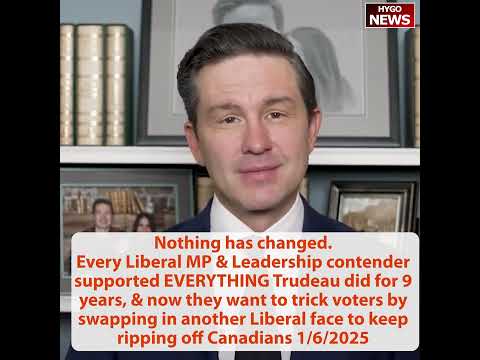
Poilievre: Nothing has changed, Every Liberal MP & Leadership supported EVERYTHING Trudeau did
Within hours of Prime Minister Justin Trudeau’s announcement that he intended to resign, federal Conservative Leader Pierre Poilievre delivered a pointed response rejecting the premise that a change in Liberal leadership would represent meaningful change for Canada. Poilievre argued that every Liberal MP and potential leadership contender had supported Trudeau’s policies for nine years and that swapping leaders amounted to nothing more than an attempt to “trick voters” before an election. His message was unambiguous: the only real change would come through a “carbon tax election” that would replace the Liberal government entirely.
Poilievre’s Core Argument: “What Has Really Changed?”
Poilievre opened his response by acknowledging that many Canadians might feel relief at Trudeau’s departure while immediately challenging the significance of the move.
“Canadians desperate to turn the page on this dark chapter in our history might be relieved today that Justin Trudeau is finally leaving,” Poilievre said. “But what has really changed? Every Liberal MP in power today and every potential Liberal leadership contender fighting for the top job helped Justin Trudeau break the country over the last nine years.”
This framing set the tone for the entire response. Poilievre was not interested in celebrating Trudeau’s departure. Instead, he aimed to tie every potential Liberal successor to Trudeau’s record, arguing that a leadership change within the party would be cosmetic rather than substantive.
The Liberal Record: A Policy-by-Policy Indictment
Poilievre proceeded to lay out a detailed catalogue of the policies that Liberal MPs had collectively supported under Trudeau’s leadership.
On the carbon tax, Poilievre stated: “All Liberal politicians actively worked to pass into law the job-killing inflationary carbon tax, a tax that Carbon Tax Carney endorsed in his book. All supported a law quadrupling the tax over the next five years.”
The reference to “Carbon Tax Carney” was a pointed jab at Mark Carney, the former Bank of Canada and Bank of England governor who was widely seen as a potential Liberal leadership contender. By branding Carney with the carbon tax label, Poilievre sought to preemptively link any potential successor to the policy Conservatives viewed as most emblematic of Liberal overreach.
On spending and fiscal policy: “All voted for or actively supported Trudeau’s out-of-control spending, debt, and immigration.”
On housing: “All passed Trudeau’s housing policies that doubled the cost of homes.”
On public safety: “All Liberal politicians helped pass catch-and-release bail and house arrest for the most rampant re-offenders. Policies that increased violent crime 50%, gun crime 116%, and hate crime by 250%.”
Why Dump Trudeau Now?
Having established that every Liberal had been complicit in the policies he condemned, Poilievre posed the rhetorical question of motive.
“So given that Liberal MPs and leadership contenders unanimously supported everything Trudeau has done, why dump him now right before an election?” he asked. “Is it because they feel guilty that they doubled housing costs, hiked taxes, unleashed crime, broke immigration, forced a quarter of the population into poverty?”
His answer was blunt: “No. They continued supporting Trudeau when he did all of those things. No, their only objection is that he is no longer popular enough to win an election and keep them in power. They want to protect their pensions and paychecks by sweeping their hated leader under the rug months before an election to trick you and then do it all over again.”
The argument was designed to neutralize the potential electoral benefit of a Liberal leadership change by framing it as a self-serving maneuver rather than a genuine response to public concerns.
Canada “Spiraling Out of Control”
Poilievre then pivoted to describe the current state of the country in urgent terms, arguing that the Liberal leadership contest would leave the government rudderless during a period of crisis.
“Now, while leaderless Liberals focus on saving their jobs and fighting each other for power, the country spirals out of control,” Poilievre said. He listed the cascading crises: “an out-of-control housing emergency, an out-of-control migrant crisis, an out-of-control $62 billion deficit, not to mention tariff threats from the United States. Oh, and another NDP-Liberal carbon tax hike kicks in this April 1st. Everything’s out of control, and now the government is out of control.”
The reference to tariff threats from the United States was particularly timely, as the incoming Trump administration had signaled aggressive trade postures toward Canada. Poilievre used this to argue that Canada could not afford the period of political uncertainty that a Liberal leadership contest would create.
The Conservative Alternative: “Take Back Control”
Poilievre concluded with a comprehensive policy platform framed as a direct contrast to the Liberal record, using the rallying cry of “take back control” across multiple policy areas.
“We need a carbon tax election now to choose between the NDP-Liberal costly coalition that taxes your food, punishes your work, doubles your housing costs, and unleashes crime and drugs in your community, or common sense Conservatives who will axe the tax, build the homes, fix the budget, and stop the crime,” he said.
He expanded the vision into a broader nationalist platform: “Canadians can take back control of their lives and their country. Take back control of our border, take back control of immigration, take back control of spending, deficits, and inflation. Take back control of our streets by locking up criminals, banning drugs, treating addiction, and stopping gun smugglers.”
Poilievre’s closing was a mission statement that synthesized the Conservative platform: “We’ll cap spending, axe taxes, reward work, build homes, uphold family, stop crimes, secure borders, rearm our forces, restore our freedom, and put Canada first. All with one mission: to bring home Canada’s promise that every hard-working Canadian gets a powerful paycheck and pension that buys affordable food and homes, on safe streets, where all are united for the country we know and love.”
He signed off with what had become a signature phrase: “Canada first, Canada last, Canada always. Let’s bring it home.”
Additional Context
Poilievre’s response reflected a deliberate strategic calculation. By the time of Trudeau’s resignation announcement, public opinion polls consistently showed the Conservative Party with a commanding lead over the Liberals, often by margins of 20 points or more. Poilievre’s team recognized that the greatest threat to their electoral prospects was not Trudeau himself but a fresh Liberal leader who could reset the political conversation.
By immediately and aggressively tying every potential Liberal leadership candidate to Trudeau’s record, Poilievre aimed to prevent the “new leader” bounce that parties often enjoy after a leadership transition. The strategy was to make the upcoming election a referendum on nine years of Liberal governance rather than a choice between Poilievre and whichever new face the Liberals selected.
Trudeau’s resignation announcement had also prorogued Parliament until March 24th, giving the Liberal Party time to organize a leadership race but also leaving the country without a functioning legislature during a period of significant economic and geopolitical uncertainty.
Key Takeaways
- Pierre Poilievre responded to Trudeau’s resignation by arguing that “nothing has changed,” since every Liberal MP and leadership contender had supported Trudeau’s policies for nine years.
- Poilievre accused Liberals of dumping Trudeau solely because “he is no longer popular enough to win an election,” calling the leadership change an attempt to “trick voters.”
- He referenced “Carbon Tax Carney” in a preemptive strike against Mark Carney as a potential Liberal leadership contender.
- Poilievre catalogued Liberal policy failures including the carbon tax, doubled housing costs, a 50% increase in violent crime, 116% increase in gun crime, and a $62 billion deficit.
- He called for an immediate “carbon tax election” and closed with the rallying cry “Canada first, Canada last, Canada always.”