 HYGO News
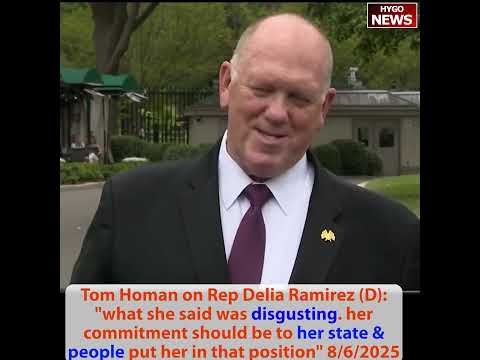
 Tom Homan on Guatemalan Rep Delia Ramirez: disgusting; Zohran Mamdani new generation of leadership
Tom Homan on Guatemalan Rep Delia Ramirez: disgusting; Zohran Mamdani new generation of leadership
Four Democratic figures producing striking material. Rep. Delia Ramirez (D-IL), born in Chicago to Guatemalan parents, declared: “I’m a proud Guatemalan before I’m an American.” Border czar Tom Homan: “I think what she said was disgusting … ICE is deporting thousands of nationals of Guatemala every week. We’re going to continue that until every illegal alien in Guatemala is removed from this country.” A Democratic Socialist running for Seattle mayor, Katie Wilson: “We need to be really active at like challenging what ICE is doing on every front we can.” Michigan Democratic Senator Elissa Slotkin characterized Zohran Mamdani as “a new generation of leadership.” And DNC Chair Ken Martin welcomed Mamdani to the Democratic coalition: “We’re a big tent … we win through addition, not subtraction."
"Proud Guatemalan Before I’m an American”
The reporter’s setup. “Congresswoman Delia Ramirez this week has said she born in Chicago to Guatemalan parents said she’s more proud to be a Guatemalan. I can’t think. I’ll give you the exact quote. I’m a proud Guatemalan before I’m an American.”
Delia Ramirez is a Democratic U.S. Representative from Illinois. She was born in Chicago to Guatemalan parents. By birth, she is an American citizen. By law, she serves as a representative of her American constituents. Her official role is American, not Guatemalan.
Her specific statement — “I’m a proud Guatemalan before I’m an American” — inverts that ordering. Her national identity, as she publicly declares it, prioritizes Guatemala over the United States.
That kind of statement from a U.S. elected official is extraordinary. Dual-heritage Americans — Americans with roots in other countries — commonly identify with both. “Italian-American.” “Irish-American.” “Guatemalan-American.” The hyphenated identity combines the two. Ramirez’s formulation is different. She is not “Guatemalan-American.” She is Guatemalan first, American second.
”Should She Face Consequences?”
“Congressman Andy Ogles has said she should be deported over this. Should she face any consequences as a sitting congress member?”
Representative Andy Ogles has proposed Ramirez be deported. That is a specific political position. Ramirez, as a U.S. citizen born in Chicago, cannot legally be deported — deportation applies only to non-citizens. But Ogles’s political message is that her prioritization of Guatemala over America is grounds for removing her from the country.
Whatever the legal merits of that specific framing, the political question is whether Ramirez should face consequences. Censure? Ethics investigation? Primary challenge? Electoral defeat? Those are different mechanisms of accountability.
Homan: “Disgusting”
Tom Homan’s response. “I think what she said was disgusting, right? I mean, she’s a sitting US Congresswoman, citizen of this country. She’s serving at the privilege of her state. Her bowlers put her in there.”
“Bowlers” is Whisper’s rendering — likely “voters.”
“Privilege of her state.” Homan’s framing. Ramirez’s position is a privilege extended by the voters of Illinois. That privilege comes with specific responsibility — commitment to the country she represents.
“So I think her commitment should be to her state and the people that put her in that position. That should be her constituency.”
Her constituency is Illinois voters. Not Guatemala. Not Guatemalan nationals. Illinois residents who voted for her in American elections to represent their interests in the American federal government.
”In a Veiled Way Supporting Illegal Aliens”
“And I think what she said there was in a veil way supporting illegal aliens from Guatemala here. And it’s a veil shot advice.”
Homan’s analytical reading. Ramirez’s declaration is not merely personal identity expression. It is political signaling to unauthorized Guatemalan immigrants in the U.S. By publicly prioritizing Guatemalan identity, Ramirez is implicitly aligning with the interests of Guatemalan nationals — including those without legal status to be in the U.S.
“This piece here is what she’s doing, right? But what she needs to know is that ICE is deporting thousands of nationals of Guatemala every week. We’re going to continue that until every illegal alien in Guatemala is removed from this country.”
“Thousands of Guatemala nationals every week” being deported. That is the operational reality. Guatemalan nationals who are in the U.S. without authorization are being removed at scale.
“Until every illegal alien in Guatemala is removed from this country.” That is the commitment. Not partial removal. Complete removal of the unauthorized Guatemalan population.
“That’s what the people voted for and that’s what we’re going to do.”
The democratic mandate. The November 2024 election explicitly included border enforcement as a major issue. Trump’s campaign promised comprehensive deportation. Voters elected that platform. Implementation reflects the mandate.
“It’s unfortunate she said that. I wish she’d shown it’s ridiculous.”
Katie Wilson for Seattle Mayor
The segment pivoted. Katie Wilson, running for Seattle mayor as a Democratic Socialist candidate. “I think we need to be really active at like challenging what ICE is doing on every front we can. And obviously being ready in the case of Trump trying to call in National Guard or whatever, federalize National Guard, be ready with those lawsuits and challenging that as much as possible.”
Wilson is preparing for multiple forms of resistance. Challenging ICE operations. Challenging National Guard deployment. Challenging federalization of law enforcement. All through lawsuits.
“And we can learn from what’s happening in California on that front, obviously.”
“What’s happening in California” is the sanctuary posture — municipal non-cooperation with ICE, state AG lawsuits, gubernatorial resistance. Wilson wants Seattle to replicate that model.
For Seattle voters, the question is whether that posture actually serves their interests. Earlier segments showed LA Mayor Karen Bass declaring victory when federal forces left Los Angeles after stabilizing anti-ICE riots. Seattle voters may find a similar trajectory under Wilson unappealing.
Slotkin on Mamdani
The reporter pressed Senator Slotkin. “Is that why you think Mamdani in New York had so much success? It wasn’t necessarily his progressiveness. It was his age.”
Slotkin’s response. “Yeah, I’ve said very openly that I don’t, I never would be called an expert on New York City politics. But the two messages were like a blinking red light. How can you miss them? People are still extremely focused on the cost of living and how they can’t get ahead. Still the motivating issue. And then number two, they want that new generation of leadership. This is Mamdani I’m talking about.”
“New generation of leadership.” That is the Slotkin framing of Mamdani. Not Democratic Socialist. Not defund-policing advocate. Not anti-Israel voice. “New generation of leadership.”
Slotkin is characterizing Mamdani’s appeal as generational rather than ideological. That framing decouples Mamdani from his specific positions. Voters, per Slotkin, are responding to his youth and newness, not to his socialist agenda.
Whether that characterization holds up is contested. Mamdani’s campaign has been explicitly socialist in its positioning. His platform includes rent freezes, government groceries, defund-adjacent policing rhetoric, and anti-Israel positions. Those are specific ideological commitments, not just generational freshness. Treating his appeal as purely generational dismisses his own campaign’s substance.
”Yes. You Bet.”
The reporter to Slotkin. “This looks like the future of the party you hold, oppressive social. Is this what the party should look like?”
Slotkin’s answer. “Yes. You bet.”
That is explicit. Slotkin is endorsing Mamdani-style politics as the future of the Democratic Party. Not hedging. Not qualifying. “You bet.”
“The Democratic Party needs to stand up and be clear. We are the party that fights for affordability for working families.”
The framing: Mamdani’s affordability agenda (rent freezes, free transit, government groceries) is the Democratic Party’s central message. Everything else is secondary.
Whether that message survives general-election scrutiny is the empirical question. Government-run grocery stores failed in Kansas City. Rent freezes historically reduce housing supply. Free transit produces unsustainable fiscal costs (as Kansas City’s experience showed). The practical outcomes of the policies Mamdani promotes do not match the affordability framing Slotkin is celebrating.
DNC Chair Ken Martin
The DNC Chair Ken Martin’s framing. “Well, I don’t think they make it difficult at all. At the end of the day, the difference between the Democratic Party and the Republican Party is that we’re a big tent. We have lots of people in that tent from all of the different ideological wings, from conservative Democrats to centrists to progressives to these new leftists.”
“We’re a big tent.” That is the DNC response to the Mamdani question. Democrats include Mamdani’s democratic socialists, Ramirez’s Guatemala-first identity framing, Crockett’s racial framing, centrist senators, moderate House members, and traditional progressives. All within one coalition.
“And the reality is, I’ve always said that you win through addition, not subtraction. You don’t win by pushing people out of your coalition. You win by bringing people into your coalition. And that includes people from all different ideological wings.”
“Addition, not subtraction.” That is Martin’s coalition theory. Don’t reject Mamdani. Don’t reject Ramirez. Don’t reject the DSA activists advocating family abolition. Include them all.
The problem with “addition, not subtraction” as a coalition strategy: some positions alienate more voters than they attract. Mamdani’s socialism attracts DSA activists but repels moderate voters. Ramirez’s Guatemala-first positioning attracts some diaspora voters but alienates patriotic voters. The DSA’s family-abolition rhetoric attracts revolutionary socialists but alienates mainstream family-oriented voters.
Addition-not-subtraction works as a coalition strategy only if the additions are net positive. If adding DSA voters costs more moderate voters than it gains, the math does not work. Martin is asserting the math works without demonstrating it does.
The Political Bet
The Democratic Party is betting, per Martin’s framing, that including the left-most positions produces net electoral benefit. The administration is betting the opposite — that the Democratic Party’s inclusion of positions like Ramirez’s Guatemala-first identity, Mamdani’s socialism, and the DSA’s family-abolition rhetoric drives moderate voters to the Republican coalition.
The 2026 midterms will test those competing bets. If Democrats win House majorities with their current coalition, Martin’s framing is validated. If Democrats lose badly, the administration’s framing is validated.
Key Takeaways
- Rep. Delia Ramirez (D-IL), born in Chicago to Guatemalan parents: “I’m a proud Guatemalan before I’m an American.”
- Border czar Tom Homan on Ramirez: “I think what she said was disgusting … ICE is deporting thousands of nationals of Guatemala every week. We’re going to continue that until every illegal alien in Guatemala is removed from this country.”
- Katie Wilson, Democratic Socialist Seattle mayor candidate: “We need to be really active at like challenging what ICE is doing on every front we can.”
- Sen. Elissa Slotkin characterized Mamdani as “a new generation of leadership” — asked if he represents the party’s future: “Yes. You bet.”
- DNC Chair Ken Martin welcomed Mamdani to the Democratic coalition: “We’re a big tent … you win through addition, not subtraction.”