 HYGO News
 Vice President Kamala Harris tribute to President Jimmy Carter as 'ahead of his time'
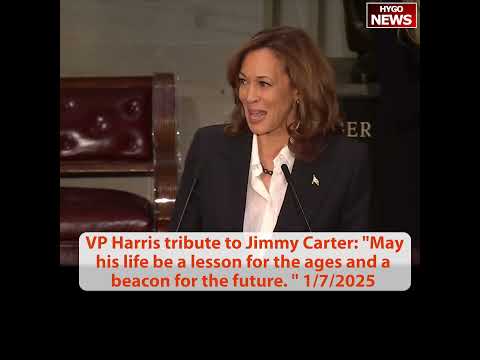
Vice President Kamala Harris tribute to President Jimmy Carter as “ahead of his time”
On January 7, 2025, Vice President Kamala Harris delivered a eulogy honoring former President Jimmy Carter at the U.S. Capitol in Washington, D.C., where Carter lay in state. Harris remembered the 39th president as a leader who was “ahead of his time,” a man of “fundamental decency and humility,” and someone who “left the world better than he found it.” The tribute drew on Harris’s personal memories of Carter’s presidency as well as his extensive post-presidential legacy of public service, humanitarian work, and advocacy for peace and democracy.
Harris Opens with a Hymn and Personal Memory
Harris opened her eulogy with a reference to a hymn that framed the entire address. “Being with you today, I’m reminded of the enduring words of a favorite hymn: May the works I have done speak for me,” Harris said. “Today we gather to celebrate the life of a man whose works will echo for generations to come.”
She then offered a vivid biographical sketch of Carter’s origins: “A man from Plains, Georgia, who grew up without electricity or running water and served as the 39th President of the United States of America and lived every day of his long life in service to the people. President James Earl Carter Jr.”
Harris drew on her own childhood memories to personalize the tribute. “I was in middle school when Jimmy Carter was elected president,” she said. “And I vividly recall how my mother admired him. How much she admired his strength of character.”
The personal touch connected Harris’s own family story to the broader narrative of Carter’s impact on the country. Harris’s mother, Shyamala Gopalan, was an Indian-American scientist, and her admiration for Carter reflected the appeal he held across diverse communities during his 1976 campaign and presidency.
Carter’s Accomplishments: Energy, Environment, and Diversity
Harris catalogued Carter’s presidential achievements, highlighting areas where she argued he was ahead of his time.
“Jimmy Carter was the first president of the United States to have a comprehensive energy policy,” Harris noted, a reference to Carter’s efforts to respond to the energy crises of the 1970s by promoting conservation, establishing the Department of Energy, and investing in alternative energy sources including solar power.
On the environment, Harris credited Carter with having “more than doubled the size of America’s national parks, including protecting our beloved redwoods in my home state of California.” Carter’s signature of the Alaska National Interest Lands Conservation Act in 1980 was among the largest conservation measures in American history, protecting over 100 million acres of federal land.
Harris also highlighted Carter’s record on diversity in government appointments. As she explained, from 1977 to 1981, Carter “appointed more Black Americans to the federal bench than all of his predecessors combined, and appointed five times as many women.” These appointments represented a deliberate effort by Carter to make the federal judiciary more reflective of the country’s demographics, a legacy that had lasting implications for the judicial system.
In addition to his presidential accomplishments, Harris noted Carter’s establishment of The Carter Center, which became one of the most influential organizations in global public health and democracy promotion. Carter’s post-presidential work in Latin America and Africa, including his efforts to eradicate Guinea worm disease and monitor elections, earned him the Nobel Peace Prize in 2002 and cemented his reputation as one of the most impactful former presidents in American history.
”A Gifted Man Who Walked with Humility”
Harris emphasized the personal qualities that defined Carter’s character, calling him “a gifted man who also walked with humility, modesty and grace.”
She invited the audience to “recall the stories from the 1976 campaign about how he slept in the homes of his supporters to share a meal with them at their table, and to listen to what was on their minds.” The anecdote illustrated Carter’s populist approach to politics and his genuine interest in the lives of ordinary Americans, qualities that distinguished his presidential campaign and shaped his time in office.
Harris described a specific scene of Carter’s volunteerism that captured his nature: “With the other volunteers, they then slept on the floor of the church basement.” The reference was to Carter’s decades of work with Habitat for Humanity, where the former president personally helped build homes for those in need, often sleeping in modest accommodations alongside other volunteers.
“And Jimmy Carter, of course, given his nature, attributed its success not to his own leadership, but to the thousands of” volunteers who participated in the work, Harris noted. The observation highlighted Carter’s habit of deflecting credit, a trait that earned him both admiration and criticism during his political career.
”He Left the World Better Than He Found It”
Harris commended Carter for maintaining “a fundamental decency and humility” throughout his 100 years of life. She characterized his legacy as one of faith, service, and improvement.
“James Earl Carter Jr. loved our country. He lived his faith, he served the people, and he left the world better than he found it,” Harris said. The statement served as both a summary of Carter’s life and an implicit standard against which other leaders might be measured.
Harris concluded with the passage that opened her remarks, bringing the eulogy full circle: “And in the end, Jimmy Carter’s work and those works speak for him louder than any tribute we can offer. May his life be a lesson for the ages and a beacon for the future. May God bless President Jimmy Carter, and may God bless the United States of America.”
The Lying-in-State Ceremony
Carter’s body lay in state in the Rotunda of the U.S. Capitol, an honor reserved for the most distinguished Americans. The ceremony was part of a series of events marking Carter’s passing on December 29, 2024, at the age of 100, making him the longest-lived American president in history.
The Capitol ceremony preceded a state funeral at the Washington National Cathedral. Former presidents, sitting members of Congress, foreign dignitaries, and members of the public paid their respects during the multi-day observances.
Harris’s eulogy was one of several tributes delivered at the Capitol. Her role as the sitting vice president gave the address an official significance, while her position as a defeated presidential candidate added a layer of personal complexity to the moment.
Additional Context
Carter’s death at 100 years old closed a remarkable chapter in American history. His one-term presidency, from 1977 to 1981, was marked by significant achievements in energy policy, environmental conservation, human rights, and the Camp David Accords between Israel and Egypt. However, it was also defined by the Iran hostage crisis, double-digit inflation, and an energy crisis that contributed to his landslide defeat by Ronald Reagan in 1980.
Carter’s post-presidential career, spanning more than four decades, transformed his legacy from that of a failed president into one of the most admired elder statesmen in American history. His work through The Carter Center, Habitat for Humanity, and his advocacy for peace and democracy earned him global recognition and the respect of leaders across the political spectrum.
Key Takeaways
- Vice President Harris eulogized President Jimmy Carter at the U.S. Capitol on January 7, 2025, calling him “ahead of his time” and a man of “fundamental decency and humility.”
- Harris noted that Carter was the first president with a comprehensive energy policy, more than doubled the size of national parks, and appointed more Black Americans to the federal bench than all predecessors combined.
- Harris recalled personal memories of her mother’s admiration for Carter during his presidency when Harris was in middle school.
- Harris concluded by saying Carter’s works “speak for him louder than any tribute we can offer” and called his life “a lesson for the ages and a beacon for the future.”
- Carter lay in state in the Capitol Rotunda following his death on December 29, 2024, at the age of 100, the longest-lived American president.